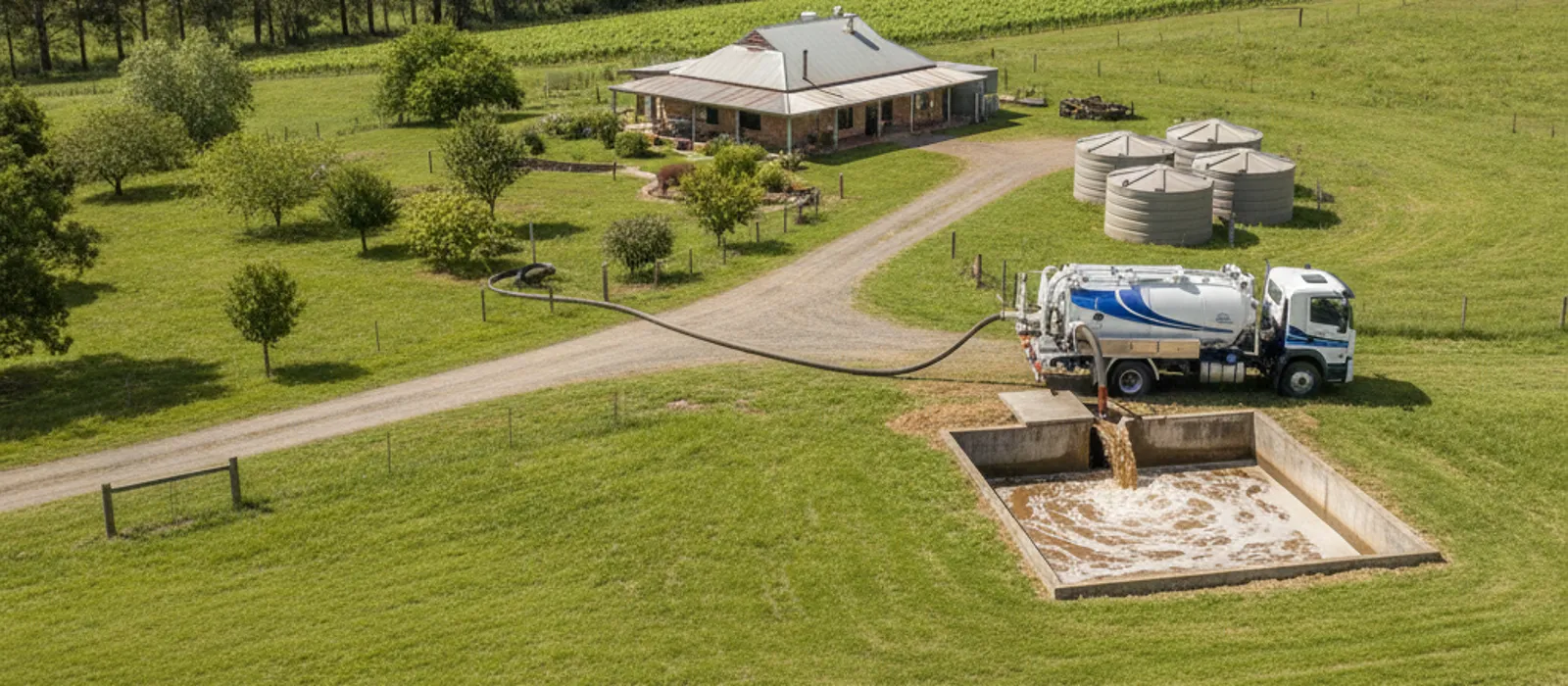
Septic Tank Not Pumped for 25 Years? What Is Inside It and What the First Pump-Out Involves
A septic tank that has not been pumped for 25 years is almost certainly full of solids, and it has probably been sending some of them out to the absorption trench for a long time. That does not mean the system has failed. Plenty of old tanks keep flushing and draining long past their due date, especially in small households.
What it does mean is that the tank has stopped holding solids back, and the real question is how much of that the trench has had to absorb. Below: what builds up inside, whether to inspect or pump first, what the first pump-out costs, and what to do if you have bought a place with no pump-out history.
What 25 years does inside a septic tank
A septic tank separates wastewater into layers. Solids sink to the bottom as sludge, fats and greases float to the top as scum, and the clearer liquid in the middle flows out to the trench. The NSW Office of Local Government (OLG) guidelines note that the internal baffle in tanks over 2,050 litres is there to stop flow short-circuiting and to reduce solids carry-over.
Bacteria break down a good share of what settles, but not all of it. Grit, lint, hair and the undigested fraction accumulate. NSW Health’s vessel accreditation guideline cites the AS/NZS 1546.1 allowance of 80 litres of sludge and scum per person per year, sets a sludge allowance of 1,550 litres for a domestic tank, and works out that a tank designed for five people reaches it in about four years.
Run that design allowance forward 25 years for a household of four and it comes to 8,000 litres, more than most domestic tanks hold in total. Treat it as an upper bound, since bacteria digest some of it. Once sludge and scum take up most of the depth, the liquid zone between them gets thin, wastewater no longer has time to settle, and solids arriving at the inlet are pushed on towards the outlet. The Easy Septic Guide describes exactly this: solids build up and reduce the working volume, and eventually wastewater with heavy solids contamination flows out of the tank, clogging pipes and trenches.
Two other changes matter at pump-out time. The bottom layer compacts into a dense cake that will not flow up a suction hose on its own, and the scum thickens into a crust close to the inlet and outlet. The OLG rule is that a tank must be desludged no later than when sludge and scum reach one-third of its depth, or come within 150 mm of the base of the inlet or outlet. A 25-year tank is almost certainly past both.
What it has probably done to the absorption trench
The trench is where a missed pump-out costs real money. The OLG guidelines explain that where effluent sits in the base of a trench, conditions go anaerobic and a clogging layer develops, slowing the flow of effluent into the soil. Fine solids and grease from an over-full tank feed that layer. The OLG’s model approval conditions put it directly: sludge or scum near the inlet or outlet T-piece means a greater risk of solids passing downstream and clogging the trench.
The Easy Septic Guide says absorption trenches should last 15 to 25 years, and that a poorly built or poorly maintained one can fail in as little as two. It also says solids flowing from an over-full tank drastically shorten a trench’s life, so one that has taken solids for years may be closer to the end than it looks.
How much damage yours has taken depends on a few things you can partly judge from the house:
- Occupancy. A one or two person household makes far less sludge and far less flow than a family of five.
- Soil. Heavy clay takes effluent slowly, so a clogged trench in clay tends to show up as boggy ground. Sandy soil drains faster, so the same problem may only show as a strip of greener grass. Your council approval or site report should say what soil the trench was designed for.
- An outlet filter. Many old tanks have none. The OLG guidelines recommend one to catch larger solids before they leave the tank.
- Symptoms. Wet or spongy ground over the trench, smells in the yard, gurgling and slow drains that get worse after rain. Our guide to absorption trench failure signs goes through each one, and signs your septic tank is full covers the ones that point at the tank.
No symptoms is a good sign, not a clean bill of health. The OLG guidelines include a poor maintenance case study of a buried, overgrown tank not desludged in multiple years, where solids carry-over had likely affected the trench. The outcome was a pump-out, lowering the soil around the tank to below the lid, drainage to direct stormwater away from the tank, and, if possible, pumping the trench out through an inspection opening if it was holding liquid.
Inspect first or pump first?
For a tank with no known history, do both on the same visit. Sludge depth has to be measured before the tank is emptied, and the tees, baffle and walls can only be seen properly once it is empty. That is why an inspection bundled with a pump-out is priced as an add-on rather than a separate job.
| Your situation | Start with | Why |
|---|---|---|
| Sewage backing up into the house or out of the relief gully | Emergency pump-out | Relieve the backup; the rest can wait a day |
| System working, no history, you own the place | Pump-out with an inspection bundled | Sludge measured, tank emptied, structure and trench checked in one trip |
| Buying, before exchange | Pre-purchase inspection | You need the written report before you commit |
| Council has asked for a compliance check | Pump-out plus compliance audit | The officer will want the docket and the tank’s condition |
If anything is overflowing now, cut water use and call 0468 278 123. A sewage backup, an active high-water alarm or an overflow gets same-day or next-morning vacuum truck response.
What to expect at the first pump-out
A first pump-out on a tank this old takes longer than a routine one, which is where the extra cost comes from.
Finding the lid. Old tanks often sit under lawn, garden beds or later paving. A lid more than 300 mm down with no riser has to be dug out by hand. While it is exposed, a riser can be fitted so nobody has to dig for it again.
Measuring before pumping. A sampling tube goes to the floor of each chamber to record sludge, clear zone and scum. The OLG guidelines say sludge cannot be reliably judged by eye, and some tanks show no scum at all while carrying a heavy sludge layer underneath.
Breaking up the cake. The crust is broken and the compacted sludge is loosened with high-pressure back-pulsing, which churns the bottom layer until it will move up the hose.
Emptying the tank. A proper desludge removes the scum, the liquid and the sludge. The OLG guidelines say about 10 per cent of the sludge should stay behind to reseed the bacteria, and that sludge can only be removed by a liquid waste contractor.
Checking the empty tank. We look at the inlet and outlet tees, the baffle, the walls and the lid. The OLG guidelines ask councils to check the structural integrity of septic tanks at inspection, and their model conditions require gaps and cracks to be sealed against stormwater, insects and vermin.
Refilling straight away. The tank goes back to at least two-thirds full of water, or to the outlet level, immediately. The OLG guidelines require this to avoid hydrostatic uplift, an empty tank lifting in wet ground.
The docket. The waste is transported and disposed of under NSW EPA waste rules at a licensed treatment facility, and a disposal docket is provided for every load. Keep it. The OLG model conditions require pump-out and repair receipts to be kept and shown to council if asked, and after 25 years yours may be the first one on file.
Sometimes, a second visit. Occasionally the sludge will not all come out in one go, or the trench is holding enough liquid to be worth pumping too. If a second visit is needed, we say so on the day and quote it first.
What it costs
The base price is set by tank size. Most owners of an old tank do not know the size, so we measure it on the day and charge the band it falls in.
| Item | Price (AUD) |
|---|---|
| Pump-out, tank up to 3,000 litres | $350 to $500 |
| Pump-out, 3,500 to 4,500 litres | $400 to $650 |
| Pump-out, 5,000 litres and over (large rural or dual tank) | $650 to $900 |
| Heavy hardened sludge (not pumped in 7 or more years) | add $75 to $150 |
| Deep lid excavation (buried more than 300 mm, no risers) | add $75 to $150 |
| Extended hose run over 45 metres | add $50 to $120 |
| Inspection bundled with the pump-out | add $100 to $200 |
| Access riser retrofit, optional | $250 to $450 |
A tank left 25 years will almost always attract the hardened sludge modifier, and many will need the lid dug out too. Add the lines that apply. There is no travel surcharge across the Maitland, Cessnock, Singleton or Port Stephens corridors, and every modifier is quoted before work starts.
Did the trench survive?
Once the tank is empty and checked, the trench usually falls into one of three groups.
It is fine. No wet ground, no smell, the liquid in the tank sat at or below the outlet before pumping, and the trench probe shows soil taking water. Have the sludge measured again sooner than the usual three to five years, since that second reading shows how fast your household actually fills the tank, and think about an effluent filter to protect the trench from here on.
It is clogged but intact. Liquid in the tank was sitting above the outlet, the ground over the trench is soft or green, and drains struggle after rain. The pump-out stops new solids arriving, and a trench in this state can sometimes recover over a dry spell. If it does not, jetting and biomat rejuvenation of the existing trench is $1,500 to $4,500. Our guide to trench rejuvenation costs explains what that work can and cannot fix.
It has failed. A collapsed arch, a crushed pipe, sewage surfacing in dry weather, or a trench too short for the soil from day one. Rejuvenation will not hold on these. A new trench is $8,000 to $14,000, carried out by licensed plumbing and drainage contractors we work with; their NSW licence number appears on every quote. Replacing a disposal area is an alteration to the system that needs council approval under section 68 of the Local Government Act 1993. We do the site assessment and sizing and help with the Section 68 paperwork.
One point in your favour: the OLG guidelines say existing systems are not required to meet current design standards unless the system fails or it, or the buildings it serves, are altered. They still have to meet the performance standards in the Local Government (General) Regulation, so for council the question is how the system performs, not how old it is.
Buying a property with no pump-out history
The Easy Septic Guide suggests asking the seller how old the system is, when the tank was last pumped and how often, whether there have been signs of failure, and whether the house has been extended in a way that might need a bigger system. It also recommends having a specialist look at the system before you buy.
If the answer to all of that is “no idea”, treat it as information: the tank is due, and the trench is the unknown. A pre-purchase septic inspection is $250 to $500 and covers a CCTV line check, a structural check of the tank, a probe of the trench and a written report. Book it before exchange so the result can inform the price. The council side, including transferring the approval to operate and what happens when council has no record of the system at all, is covered in buying a property with a septic tank in NSW.
What not to do in the meantime
- Do not open the tank and lean in. The Easy Septic Guide warns that septic tanks contain toxic and explosive gases. Under the NSW Confined Spaces Code of Practice, putting your head or upper body through the opening counts as entering a confined space, and the code notes that hydrogen sulphide from decomposing organic material, especially when disturbed, is heavier than air and settles to the bottom.
- Do not buy an additive instead. The Easy Septic Guide says additives only suit minor, temporary problems, and no amount of them helps a system that needs pumping or a trench that is failing.
- Keep vehicles off the trench. Compaction and crushed pipes turn a clogged trench into a failed one.
If your tank has gone years without a pump-out, or you have moved in and nobody can say when it was last done, call 0468 278 123. Most routine pump-outs are scheduled within 48 hours.
Frequently Asked Questions
Is it bad if my septic tank has not been pumped in 25 years?
It is well overdue, but not automatically a failure. The tank is almost certainly full of solids and has been passing some to the absorption trench, shortening its life. The first pump-out, with the sludge measured and the empty tank checked, shows whether the damage stopped at the tank or reached the trench.
Can a septic tank go 25 years without being pumped?
Some do, usually in one or two person households with low water use. The tank keeps accepting wastewater because liquid flows out as new liquid comes in. What stops is the settling, so solids go to the trench instead of staying in the tank.
Why does an old septic tank cost more to pump out?
Old sludge compacts into a dense layer that has to be broken up with high-pressure back-pulsing before it will flow up the hose. That adds $75 to $150 for tanks not pumped in seven or more years. Old tanks also tend to have buried lids, and digging out a lid more than 300 mm down adds another $75 to $150.
Should I get an inspection or a pump-out first?
For a tank with no history, book them together. Sludge is measured before pumping, and the tees, baffle and walls can only be checked once the tank is empty. Bundling an inspection with the pump-out adds $100 to $200, which costs less than two separate visits.
Will pumping an old septic tank fix a soggy trench?
It stops new solids reaching the trench, which is the first step, and a clogged but intact trench can sometimes recover over a dry spell. If it does not, jetting and biomat rejuvenation of the existing trench is $1,500 to $4,500. A collapsed or undersized trench needs a rebuild by licensed plumbing and drainage contractors and council approval.
Can I check the sludge in an old tank myself?
Not safely. Septic tanks contain toxic and explosive gases, and disturbed sludge releases hydrogen sulphide, which settles low in the tank. Under the NSW Confined Spaces Code of Practice, leaning into the opening counts as confined-space entry, so leave it to a pump-out or inspection visit.
Sources and further reading
- NSW Office of Local Government, Onsite Wastewater Management Guidelines (April 2025): septic tank baffles and outlet filters (section 5.3.1), how trenches clog (section 5.7), the one-third and 150 mm desludging rule, measuring sludge rather than judging by eye, 10 per cent sludge retention and refilling to two-thirds (A5.2), the poor maintenance case study (A6-7), model approval conditions on the T-piece risk, receipts and cracks, structural checks at inspection, and the rule that existing systems need not meet current design standards unless they fail or are altered.
- NSW Office of Local Government, The Easy Septic Guide: how sludge build-up leads to trench clogging, the 15 to 25 year trench life, safety around open tanks, the advice on additives, and the questions to ask when buying a property.
- NSW Health, Sewage Management Facility Vessel Accreditation Guideline (2016): the 80 litres per person per year allowance from AS/NZS 1546.1, the 1,550 litre sludge allowance, and the four-year desludging calculation for a five-person tank.
- SafeWork NSW, Code of Practice: Confined spaces: head or upper body through the opening counts as entry, and hydrogen sulphide from disturbed organic material is heavier than air and settles low.
Request Received!
Thank you for reaching out. Our Hunter Valley dispatch team will call you back promptly to confirm details and provide an upfront quote.
Call us directly on 0468 278 123