7 Signs Your Septic Tank Is Full (and the One Check That Tells You for Sure)
A working septic tank is always full of liquid, up to the level of the outlet pipe. When people say a tank is “full”, they mean full of solids: sludge on the bottom and scum on top have taken up so much of the depth that wastewater no longer settles before it leaves. The NSW Office of Local Government’s guidelines set the threshold at one-third of the tank’s depth, or solids within 150 mm of the inlet or outlet. Below are the seven signs that you are near or past that point, the one measurement that settles it, and how Hunter Valley clay and sand change what the symptoms mean.
The seven signs
1. Every drain in the house is slow
One slow basin is a blocked basin. When the shower, the kitchen sink and the toilet all drain sluggishly at the same time, the restriction is downstream of all of them: the house drain to the tank, the tank itself, or the trench beyond it. A tank full of solids gives wastewater nowhere to go quickly, and the effect shows up in every fixture.
2. Gurgling from toilets and floor wastes
Air being pushed back up the drain as water tries to leave makes the gurgle. It usually means the tank or the trench is not accepting flow at the rate the house is sending it. Gurgling on its own, in dry weather, points to the tank; gurgling only after rain points to the trench (see sign 5).
3. Smells near the tank, the relief gully or the trench
The Easy Septic Guide lists “smelly drains and odours near the septic tank or absorption trench” among its warning signs. A faint whiff at the tank lid on a hot afternoon is normal; a persistent sewage smell at the overflow relief gully outside the bathroom, or across the yard in the evening, is not. A scum layer that has thickened to a crust also traps and then releases gas.
4. Wastewater at the overflow relief gully
The overflow relief gully (ORG) is the grated drain outside the house, set lower than the indoor fixtures so that if the line backs up, sewage surfaces there rather than in the bathroom. Water sitting in it, or a wet patch around it after the laundry runs, means the system is not taking flow. If it is actively overflowing, that is an emergency, not a warning sign.
5. A wet patch or a bright green strip over the trench
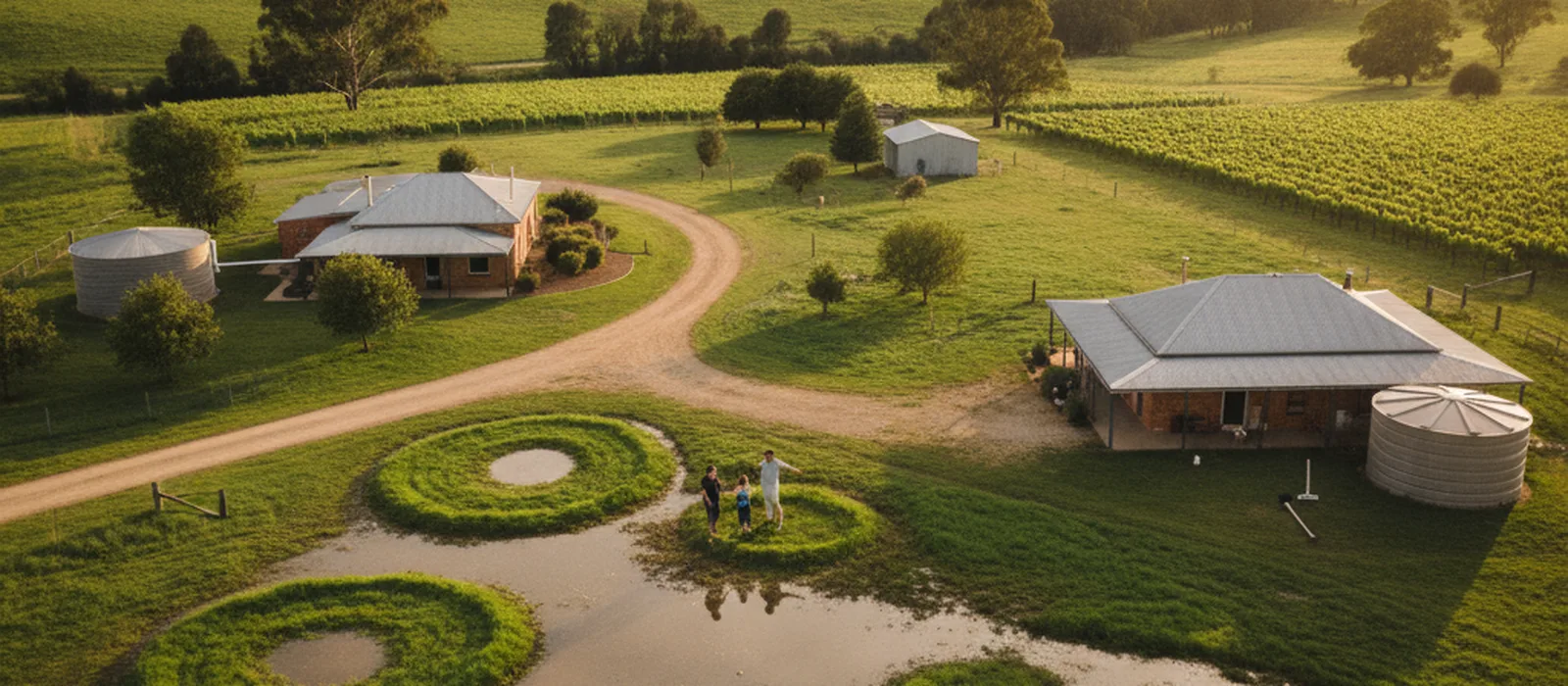
Effluent that cannot soak away rises to the surface. The Easy Septic Guide describes “wet or boggy patches over the absorption trench” and “lush or unusually green grass over the trench” as the classic signs of trouble, and the OLG guidelines explain the mechanism: solids carried out of an over-full tank form a clogging layer at the base of the trench, conditions go anaerobic, and the soil seals. On Hunter clay this shows as boggy ground that never dries; on coastal sand it more often shows as the green strip, because water gets away but the nutrients do not. Either way, by the time the trench is showing it, the tank has usually been over the one-third mark for a while. Our guide to absorption trench failure covers what can be done.
6. Wet weather makes everything worse
If the system only misbehaves after heavy rain and recovers in a dry week, the trench is saturated rather than the tank being full. A February downpour on the Maitland flats or the coalfields clay can sit in a trench for weeks. That is not a false alarm exactly; it is a sign the trench has no spare capacity, and a tank carrying too much sludge will tip it over. Pump the tank, and read sign 5 again in autumn.
7. It has been more than three to five years, or nobody knows
The Easy Septic Guide lists “the septic tank has not been pumped out (de-sludged) in the past 3 to 5 years” as a warning sign in itself. NSW Health’s sizing method has a tank sized for five people reaching its sludge allowance in about four years, faster with more people. If you bought the place and the vendor could not say when the tank was last done, treat that as sign seven. Our pump-out frequency guide shows how to work out your own interval.
The one check that settles it: the liquid level and the sludge depth
The Easy Septic Guide describes an owner’s check you can do once a year without entering the tank. Lift the inspection lid and look at the liquid level. In a healthy tank the fluid sits no higher than the outlet pipe at the wall of the tank, with only floating scum above it. Liquid well above the outlet means the outlet or the trench is blocked; liquid well below it (with normal household use) means the tank is leaking.
What the guide also says, and we repeat every time: never enter a septic tank; the gases inside are toxic and explosive; never smoke or use a naked flame near an open lid; secure the lid afterwards so children cannot open it. Under the NSW Confined Spaces Code of Practice, putting your head or upper body through the opening counts as entering a confined space, and hydrogen sulphide released from disturbed sludge is heavier than air and settles at the bottom. Look from above, in daylight, and close it up.
The sludge depth itself cannot be judged by eye. The OLG guidelines say the level of scum and sludge cannot be reliably measured by visual inspection, and that some tanks show no scum layer while carrying a heavy sludge blanket underneath. The measurement takes a clear sampling tube lowered to the floor of each chamber. We do it at every pump-out and inspection and record the depth so you have a number, not a guess.
Full tank or something else? A quick triage
| What you see | More likely | Do this |
|---|---|---|
| All drains slow, dry weather, no smell outside | Tank full of solids or outlet tee blocked | Book a pump-out; we check the tee while it is empty |
| One fixture slow, others fine | Blocked branch drain inside the house | Licensed plumber; not a tank problem |
| Gurgling and smells only after rain | Trench saturated, tank probably also due | Pump-out, then trench check in dry weather |
| Sewage at the relief gully now | Backup in progress | Stop water use, call the emergency line |
| Green strip or bog over the trench, drains fine | Trench clogging from past solids carry-over | Trench diagnostics before anyone quotes a rebuild |
| Liquid level far below the outlet | Tank leaking | Inspection; structural repair or replacement planning |
| AWTS alarm sounding | Pump, blower or high water | Mute it, cut water use, call the service agent |
Two notes on the table. Blocked house drains between the dwelling and the tank are drainage work under NSW law and need a licensed plumber or drainer; if the drain camera shows the problem is upstream of the tank, we say so and point you to licensed plumbing and drainage contractors we work with, whose NSW licence number appears on the quote. And a tank that fills to the outlet again two days after pumping is doing exactly what it should; a tank is meant to be full of liquid. What should not come back quickly is the sludge.
Why acting early is cheap
The costs run in a clear order. A routine pump-out is $350 to $500 for a tank up to 3,000 litres and $400 to $650 for 3,500 to 4,500 litres. A collapsed outlet tee or missing effluent filter, which lets solids straight through, is a $250 to $650 repair. Trench rejuvenation once solids have reached it is $1,500 to $4,500. A new trench, built by a licensed drainage contractor, is $8,000 to $14,000. Each step down that list is caused by leaving the previous one. The Easy Septic Guide’s advice that an effluent filter on the outlet keeps solids in the tank and extends the life of the trench is the cheapest insurance on the list, and we can fit one at a pump-out.
Frequently Asked Questions
Why is my septic tank full of water two days after it was pumped?
Because that is normal. A septic tank operates full of liquid to the outlet level; wastewater displaces the same volume out to the trench. What the pump-out removed was sludge and scum, which take years to rebuild. If the liquid sits well above the outlet pipe, the outlet or trench is blocked and that is worth a call.
Is it normal for a septic tank to smell after rain?
A faint smell at the lid in warm weather is normal. A sewage smell across the yard after rain usually means the trench is saturated and effluent is surfacing, or the relief gully is backing up. If it clears in dry weather the trench has no spare capacity; if the tank is also due, pump it before the next wet spell.
Can I check the sludge level myself?
You can check the liquid level from above without entering the tank, as the Easy Septic Guide describes. Measuring sludge depth needs a sampling tube in each chamber, and an open tank releases hydrogen sulphide that collects at the bottom; under the NSW code of practice, leaning in counts as confined-space entry. Leave the sludge measurement to a pump-out or inspection visit.
What does gurgling in the toilet actually mean?
Air is being forced back up the drain because water cannot leave as fast as it arrives. In dry weather that points to a full tank or a blocked outlet tee; only after rain it points to a saturated trench. Either way, reduce water use and book a measurement.
Do I need an effluent filter?
It is recommended rather than compulsory. The OLG guidelines recommend an outlet filter and require it to be checked regularly and rinsed back into the tank; the Easy Septic Guide says to have a plumber fit one to keep solids in the tank and extend the trench. We check and clean filters at every pump-out and can retrofit one.
What happens if I ignore a full tank?
Solids leave the tank, clog the trench, and the system backs up into the relief gully or the house. The repair bill moves from a pump-out to trench work, and sewage on the surface is a health matter the Easy Septic Guide is direct about: septic tanks do not kill pathogenic bacteria, viruses or parasites.
Sources and further reading
- NSW Office of Local Government, The Easy Septic Guide: the owner’s warning-sign checklist, the annual liquid-level check, safety around open tanks, effluent filters.
- NSW Office of Local Government, Onsite Wastewater Management Guidelines (April 2025): the one-third desludging rule, why sludge cannot be judged by eye, how trenches clog.
- NSW Health, Sewage Management Facility Vessel Accreditation Guideline (2016): sludge accumulation rates and the four-year calculation for a five-person tank.
- SafeWork NSW, Confined spaces: the code of practice behind the “never lean in” rule.
- NSW Government, Plumbing, draining and gasfitting licences: why blocked house drains are a licensed plumber’s job.
Request Received!
Thank you for reaching out. Our Hunter Valley dispatch team will call you back promptly to confirm details and provide an upfront quote.
Call us directly on 0468 278 123