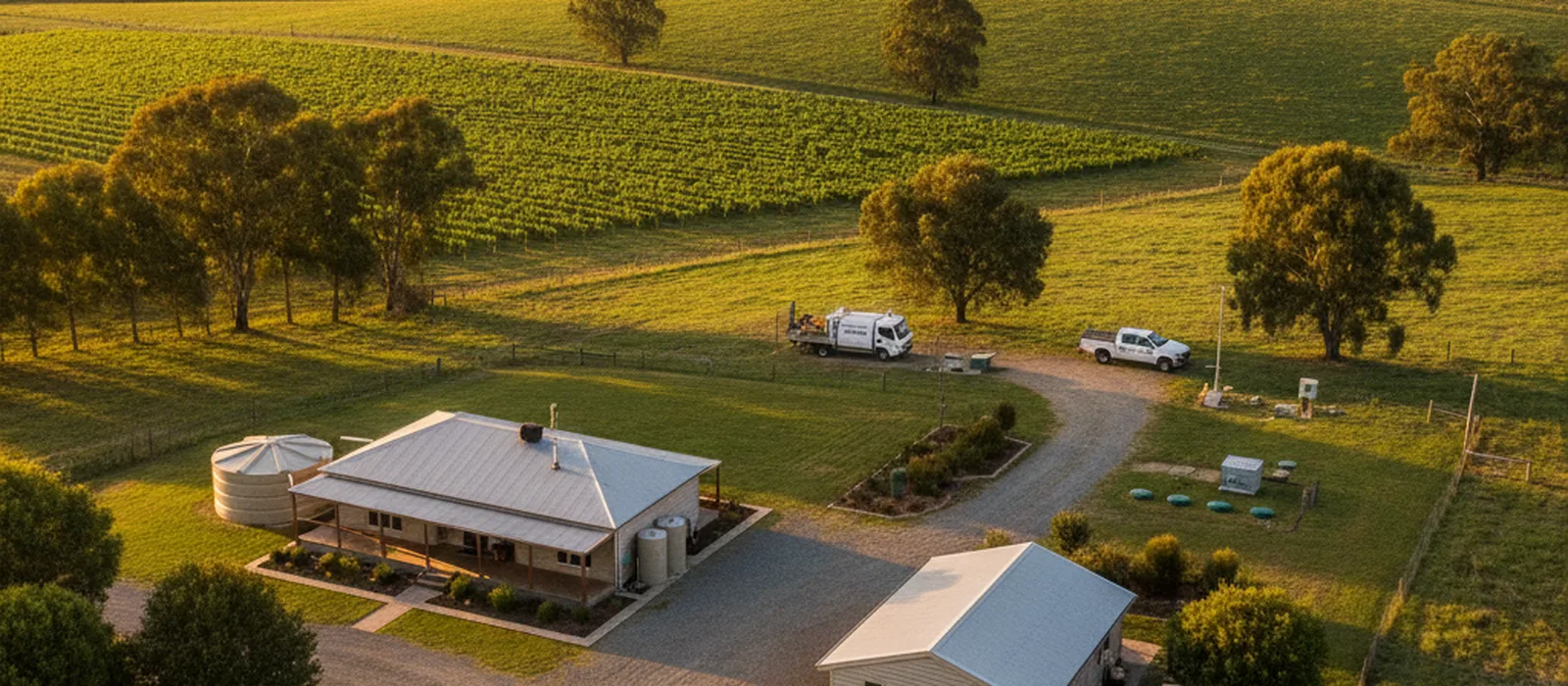
Waterless Toilets in NSW: Composting Toilet Rules, Council Approval and Greywater
Yes, you can legally put a waterless composting toilet on a property in NSW. You need your council’s approval under Section 68 of the Local Government Act 1993 to install it and to operate it, and if you’re buying a model off the shelf, it has to hold a current NSW Health certificate of accreditation before council can approve it.
The part that catches people out is the water. A composting toilet only deals with the toilet. The shower, basins, laundry and kitchen still produce wastewater, and that needs its own approved treatment and land application system, which on a Hunter block is often a septic tank and a trench or bed.
Is a composting toilet legal in NSW?
It is, with approval. Two items in the Section 68 approvals table apply: installing, constructing or altering a waste treatment device or human waste storage facility (Part C item 5), and operating a system of sewage management (Part C item 6). A composting toilet is a sewage management facility, so it needs both an approval to install and an approval to operate, the same as a septic tank or an AWTS.
The accreditation rule sits in the Local Government (General) Regulation 2021. Section 40 lists the kinds of sewage management facility that need accreditation when they are “generally available for purchase by retail”, and waterless composting closets and wet composting closets are both on that list. Section 41(1) then says council must not approve installing one unless it’s built to a design covered by an in-force certificate of accreditation from the Secretary of the Ministry of Health.
There are exceptions. Section 41(2) switches the accreditation requirement off for a facility designed and built by the owner or occupier of the premises, one designed by someone else specifically and uniquely for those premises, or a model installed for testing. An exemption from accreditation is not an exemption from approval: an owner-built composting toilet still needs council’s Section 68 approval, and the NSW onsite wastewater guidelines say exempt systems still have to meet the same performance standards. Planning your own build? Talk to council’s environmental health team first.
Two alternatives come up often. The state guidelines do not recommend pit toilets (cesspits) for environmental and health reasons. Chemical toilets need council approval unless exempt, and their waste belongs at a designated dump point. The guidelines say it should not go into a septic tank or aerated system, because the chemicals disrupt the treatment process.
How to check the NSW Health register
NSW Health keeps a public register of accredited waterless composting toilet systems. Accreditation is issued to a specific manufacturer for a specific model, and each certificate has an expiry date. Here is what the register showed when we checked it on 28 September 2026.
| Manufacturer (as listed) | Model | Certificate | Expiry shown |
|---|---|---|---|
| Ecoflo Wastewater Management | Nature Loo Classic 650 (low profile, 2 persons) | WCT 001 | 31/12/2028 |
| Ecoflo Wastewater Management | Nature Loo Classic 850 (high profile, 4 persons) | WCT 003 | 31/12/2028 |
| Ecoflo Wastewater Management | Sun-Mar Centrex (Water Flush) | WCT 005 | 31/12/2028 |
| Ecoflo Wastewater Management | Sun-Mar Centrex (Water Free) | WCT 006 | 31/12/2028 |
| Ecoflo Wastewater Management | Clivus Multrum Composting Toilet Systems | WCT 008 | 31/12/2028 |
| Ecoflo Wastewater Management | Clivus Multrum Ecolet | WCT 009 | 31/12/2028 |
| Ecoflo Wastewater Management | Alectura | WCT018 | 31/12/2028 |
| Green Loo | GT120 (4 person) and GT330 (8 person) | WCT 011 | 31/12/2028 |
| Green Loo | GL90 (3 person) | WCT015 | 15/02/2028 |
| Green Loo | Oz-e-pod (2 person) | WCT016 | 15/02/2028 |
| Green Loo | CF4 (4 person) | WCT019 | 15/02/2028 |
| Green Loo | Enviro-Loo D2010 and C2020 | WCT013 | 31/12/2026 |
| Kiel Industries (PFG Group Victoria) | Rota-Loo | WCT010 | 31/12/2027 |
| Pink Chameleon (t/a A Better Way To Go) | Separett Villa 9000-2 and 9010-2 (2 person) | WCT017 | 31/12/2025 |
Two things stand out. The register can still show a certificate whose printed expiry has passed (the Separett Villa entry read 31/12/2025 when we looked), and the Enviro-Loo certificate runs only to the end of 2026. Council’s test is a certificate “that is in force”, so ask the supplier for a current one before you buy and check again before you lodge. The list also includes microflush units such as the Sun-Mar Centrex water-flush model; the state guidelines treat waterless, dry and microflush composting pedestals as the same class of system.
Accreditation is a statement about the unit, not your site. NSW Health’s own accreditation guideline for these toilets says accreditation does not include approval to install, and does not cover the final disposal or land application system. That’s council’s call, based on your site and soil. We’re not ranking these units; they suit different buildings, so read each manual and certificate.
A composting toilet does not deal with your greywater
The NSW onsite wastewater guidelines are plain about it: a composting toilet treats the waste from the pedestal, and every other wastewater stream in the dwelling must be managed by a separate treatment or diversion process. NSW Health’s accreditation guideline recommends these toilets only be accredited where there’s an on-site system for the greywater.
So council’s main question is where everything else goes. In practice the answer is some combination of:
- a septic tank and absorption trench or bed for the greywater,
- an accredited greywater treatment system, or
- a greywater diversion device, which the Regulation also covers, although the state guidelines note that the definition of greywater for diversion does not include kitchen wastewater.
The toilet also produces its own liquid. Whatever doesn’t evaporate, mostly urine, drains out as leachate. The state guidelines say designs should allow 1.3 litres per person per day of leachate (taken from Appendix E of AS/NZS 1546.2:2008), and that it can go to the greywater system if that volume is counted in the daily load, or to a small absorption area of its own.
The guidelines include a worked example that shows how much system is still needed. For a tiny house with one bedroom, up to three occupants, a composting toilet and no flush toilet, no bath and no dishwasher, the design load is 275 litres a day including the leachate allowance. That combined greywater and leachate is to be treated in a NSW Health accredited septic tank of at least 1,350 litres, then applied below ground to a bed at least 0.4 metres deep. Beds can’t go under the tiny house, and the normal buffer distances for the application area still apply. A dry toilet shrinks the problem. It doesn’t make it disappear.
What council will ask for
Each council has its own forms, but the certificates spell out much of what goes in. For example, the NSW Health certificate for the Alectura (WCT018, issued November 2023, checked 28 September 2026) requires the owner’s application to council to include:
- plans and specifications of the composting toilet,
- a site plan to scale showing the location and type of effluent disposal system and the method of disposal,
- a statement of how the finished compost will be disposed of, how often, and the estimated volume,
- a statement on whether the system will produce liquid and how that liquid will be disposed of, backed by plans of any liquid disposal system.
The same certificate says council should require the installation to be inspected and certified by the manufacturer or its agent once it’s in, and that any electrical work be done by a licensed electrician. The state guidelines say ventilation is generally a small electric fan in the vent pipe that may need a power supply, and the Alectura certificate describes a 12-volt fan that runs off solar where there’s no mains power.
For the greywater side, council will usually want a site and soil assessment and a sized design, the same as for any on-site system. That is the part we help with: site assessment, system sizing and Section 68 paperwork support for the tank-and-trench side. Where a new tank or bed has to go in, that work is carried out by licensed plumbing and drainage contractors we work with; their NSW licence number appears on every quote. We don’t sell composting toilets. Your chosen manufacturer or its agent handles the unit itself.
Once approved, you’re in the same regime as any on-site system: an approval to operate that council renews, and inspections set by your property’s risk rating. Council OSSM inspection rules in NSW covers what an officer checks.
Where a waterless toilet suits a Hunter property
The state guidelines list the strengths and weaknesses fairly. On the plus side, a composting toilet copes with shock loads and intermittent use, it cuts the volume of wastewater generated, and it leaves little effluent to manage. On the minus side, it needs a lot of hands-on work from the owner, including the compost, and you still need separate kitchen and greywater management. Composting also slows in cold weather, and the guidelines say a larger system or heating elements may be needed to make up for it.
Put together, that makes a composting toilet a reasonable fit for:
- Weekend cabins and off-grid huts. Irregular use suits a system that doesn’t mind sitting idle, and there’s no flush water to find.
- Sheds, studios and farm amenities a long way from the house, where running a drain back to the existing tank would be the expensive part.
- Some holiday lets. Intermittent occupancy is exactly the pattern the guidelines say these systems handle, but you’re relying on guests to use it properly, and the owner is the one emptying it. Our guide to septic management on Hunter Valley holiday rentals covers the rest of the wastewater side of a short-stay property.
- Tiny houses and small secondary dwellings, where the tiny house example above gives council a clear starting point. If you’re adding a full granny flat with a flush toilet instead, see granny flat septic requirements in NSW.
It’s a harder fit for a busy family home where nobody wants to manage compost, or a site where there’s still nowhere suitable to apply the greywater.
Living with one: emptying and the compost
Each accredited system comes with a maintenance manual, and its certificate conditions become conditions of your approval. They differ by model, but the Alectura certificate is typical:
- The unit carries a permanent notice with basic instructions and a place to record the date humus was last removed.
- Compost has to stay in a chamber for at least 5 months after that chamber is taken out of service, and the total time from starting to fill it until emptying must be at least 10 months.
- Partly composted material can only be removed with council’s written consent.
- Unless council or NSW Health directs otherwise, the finished material is buried on your own property under at least 100 mm of soil, in ground that isn’t used for growing food for people (the state guidelines set the same default for all composting systems). Alternatively it can sit another three months in a lidded compost bin, after which it can be used as a soil conditioner.
Day to day, you add bulking material at the intervals the manufacturer specifies and keep the vent fan running, since the ventilation is what manages odour and keeps the composting going. There’s no pump-out truck, but there is a shovel, and that’s you or a contractor you pay.
Adding a composting toilet to a house that already has a septic
If you already have a septic tank and want to add a composting toilet, three things matter.
First, it goes through council. Installing the composting toilet needs its own Section 68 approval to install and to operate, and changing what flows to your existing tank may count as altering that system. Ask council whether your current approval to operate needs updating before you do the work.
Second, your septic tank keeps working for everything else. Greywater still carries food scraps, fats, soap and lint into the tank, so sludge and scum still build up and the tank still needs measuring and pumping. Base the interval on measured sludge. How often to pump a septic tank in NSW covers how to set it. A routine pump-out costs $350 to $500 for tanks up to 3,000 litres, $400 to $650 for 3,500 to 4,500 litres, and $650 to $900 for 5,000 litres and up. Book a pump-out and we confirm the figure before we start.
Third, keep the two systems’ waste separate unless your approval says otherwise. Leachate can go to the greywater system if council approved the design that way; compost goes in the ground as your conditions say, not down the tank riser.
If you’re unsure what your existing tank and trench can take after the change, a septic inspection measures the tank and checks the trench before you commit. Or call 0468 278 123 and we’ll talk it through.
Frequently Asked Questions
Is a composting toilet legal in NSW?
Yes. You need council approval under Section 68 of the Local Government Act 1993, both to install it and to operate it. Retail models must hold a current NSW Health certificate of accreditation before council can approve them, while owner-designed and site-specific designs are exempt from accreditation but still need council approval.
Do I need council approval for a waterless toilet?
Yes. A waterless composting toilet is a sewage management facility, so installing one needs council’s prior approval under Section 68, Part C, and running it needs an approval to operate. Council will also want to know how the greywater, leachate and finished compost will be managed.
How do I know if a composting toilet is accredited in NSW?
Check the NSW Health register of waterless composting toilet systems, which lists each manufacturer, model, certificate number and expiry date. Council can only approve a retail model built to a certificate that is in force. If the expiry date shown has passed, ask the supplier for a current certificate before you buy.
Does a composting toilet replace a septic system?
No. It only treats toilet waste. The shower, basins, laundry and kitchen still need their own treatment and land application system, which is often a septic tank and trench or bed. The state guidelines’ tiny house example still calls for an accredited septic tank of at least 1,350 litres for the greywater and leachate.
What do you do with the compost from a composting toilet?
Unless council directs otherwise, finished compost is buried on your own property under at least 100 mm of soil, in ground not used to grow food for people. Some certificates also allow extra time in a lidded compost bin before use as a soil conditioner. Certificate conditions differ by model, and at least one requires council’s written consent before partly composted material is removed, so check your own.
How much does a composting toilet cost?
Unit prices vary by model and supplier, so get current pricing from the manufacturer or its agent. Budget separately for the greywater system, council fees and installation of the unit. If a septic tank handles your greywater, pump-outs cost $350 to $500 for tanks up to 3,000 litres, and we quote before any work starts.
Sources and further reading
- NSW Office of Local Government, Onsite Wastewater Management Guidelines (April 2025): Section 68 Part C items 5 and 6; accreditation of retail waterless composting closets; section 5.3.3 on waterless composting toilet systems (other wastewater streams need separate treatment, compost and leachate, ventilation fan, cold climates); leachate at 1.3 L/person/day; the tiny house example (275 L/day, 1,350 L accredited septic tank, 0.4 m bed); the strengths and weaknesses table; pit and chemical toilets; compost burial at 100 mm (Appendix A5.3).
- NSW Health, register of accredited waterless composting toilet systems: manufacturers, models, certificate numbers and expiry dates, checked 28 September 2026.
- NSW Health, Waterless Composting Toilets (WCT) Accreditation Guideline (May 2010): accreditation excludes approval to install and the land application system; recommendation that WCTs be accredited only where greywater can be managed on site; warranty and service life minimums.
- NSW Health, Certificate of Accreditation WCT018, Alectura WCT: example application contents, installation certification, electrical work, composting periods, council consent for partly composted material, burial and compost bin options, permanent notice.
- Local Government (General) Regulation 2021, NSW legislation: sections 40 and 41 on which facilities need NSW Health accreditation and the exemptions for owner-built and site-specific designs.
- NSW Health, single domestic wastewater management: index of NSW Health registers and accreditation guidelines for on-site systems.
Request Received!
Thank you for reaching out. Our Hunter Valley dispatch team will call you back promptly to confirm details and provide an upfront quote.
Call us directly on 0468 278 123