Pokolbin’s wastewater problem is arithmetic. A domestic septic tank is sized for a household that uses water evenly across the week. A cellar door, a restaurant, a wedding venue or a six-bedroom holiday house does the opposite: near nothing from Monday to Thursday, then several hundred visitors, guests and staff between Friday lunch and Sunday afternoon. The Hunter is Australia’s oldest wine region and its most visited: Destination NSW data for 2023 shows the Hunter Valley took 69 per cent of the international visitors who went to a NSW winery, and the industry’s own figures from a decade earlier counted more than 120 wineries, 65 restaurants and 180 accommodation properties, from bed-and-breakfasts to 5,000-bed establishments, drawing 2.8 million visitors a year. Almost all of that sits on unsewered land in Cessnock City Council’s area.
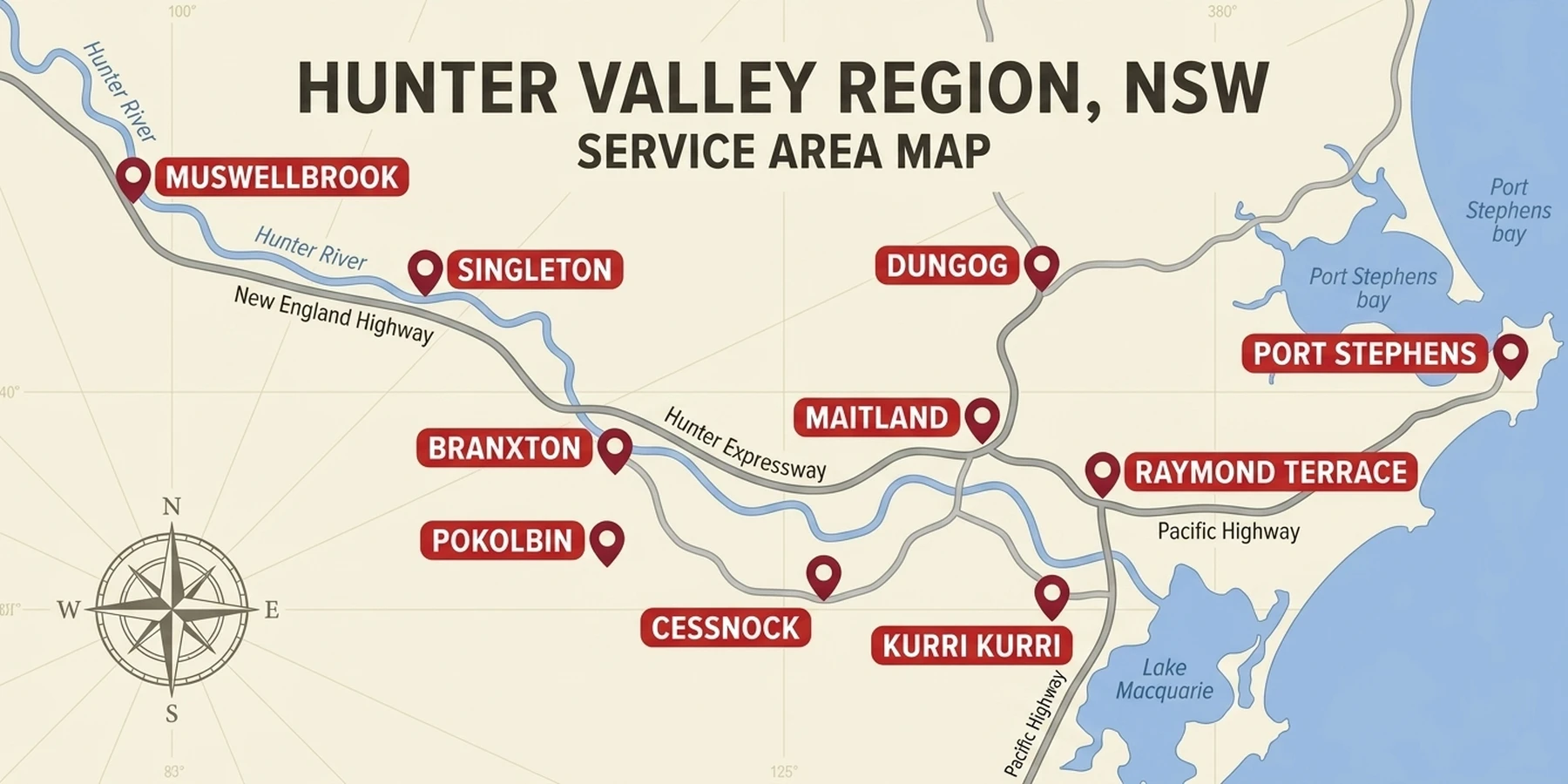
Hunter Valley Septic services Pokolbin, Lovedale, Rothbury, North Rothbury, Mount View, Nulkaba, Allandale and the Broke Road corridor with scheduled and emergency pump-outs, holding tank programs, quarterly AWTS servicing and inspections for venues, accommodation and the lifestyle blocks among the vines. Call 0468 278 123 to book.
Why a weekend venue cannot run on a domestic tank
Surge loading breaks on-site systems in two places. In the tank, a Saturday of 300 covers and a wedding pushes wastewater through faster than solids can settle, so suspended solids wash out into the disposal area. In the disposal area, a week’s worth of effluent arriving in 36 hours overwhelms the soil’s ability to absorb it, especially on the clay that underlies much of the Pokolbin and Mount View country; clay with weak structure is the high-risk soil class in every Hunter council’s risk table, and Cessnock Airport’s 743 mm a year arrives mostly in February and March, right when the vintage crowds do.
The law recognises the difference. NSW Health accreditation of septic tanks and AWTS units only covers premises normally occupied by up to 10 people or an average daily flow of up to 2,000 litres. Above that, the Local Government (General) Regulation 2021 does not let Council rely on an accredited retail model; the NSW Office of Local Government guidelines say the design should be certified by an engineer or other suitably qualified consultant as meeting AS 1546.1 (tanks), AS 1546.3 (secondary treatment) or AS/NZS 1547 (land application). Cessnock City Council’s fees follow the same logic: commercial and industrial installations are charged by treatment capacity, from $770.00 for up to 2,000 litres a day, $924.00 for 2,000 to 5,000, $1,115.00 for 5,000 to 10,000 and $1,485.00 above that plus $10.00 per extra 1,000 litres a day, with $539.00 covering up to three inspections (2026-27). Council distinguishes light commercial systems (up to three accommodation cabins on one land application area, flows generally up to 2,000 litres a day, inspected at $181.00) from complex commercial systems of 10,000 litres a day or more ($360.00 per inspection).
For a venue owner the practical choices are an engineered treatment system sized for the peak, a holding tank with pump-outs scheduled by volume, or a combination. The holding tank pumping page explains how volume-based scheduling and high-level alarms work; 5,000 litre and larger tanks are pumped at $650 to $900 a load, and commercial programs are quoted per job, never per kilolitre.
Cellar doors, restaurants and function centres
Three things make venue wastewater different from a house’s, and each needs its own answer.
Grease and wine. Kitchen fats and the acidity of winery waste knock the biology of a tank about. A grease trap on the kitchen line, cleaned regularly, is standard; the NSW Office of Local Government’s Easy Septic Guide suggests checking one every two to four weeks. Winery process waste is trade waste, not domestic sewage, and is handled under its own approvals; tell us what is in the tank before we pump it.
Peak-day scheduling. For venues on holding tanks we set the pump-out day from the booking calendar, not the month, and fit a high-level alarm so a bigger-than-expected Saturday does not end in an overflow. For venues on treatment systems, the AWTS or engineered plant needs its quarterly service timed so the blower, pump and disinfection are proven before the busy season, not after.
Irrigation near vines and guests. Treated effluent from a secondary system is usually applied to a lawn or shrub area by surface spray or subsurface drip. Muswellbrook Shire, for example, restricts AWTS irrigation to lawns and shrubs, signposted and fenced from children, pets, livestock and vehicles; Upper Hunter Shire bans surface irrigation for new systems on blocks under 4,000 m². Cessnock’s conditions are set in each approval to operate, but the pattern is the same: keep the irrigation area away from produce, seating and car parks, and signpost it.
Holiday houses and lifestyle blocks among the vines
The NSW Department of Primary Industries notes the scale of rural lifestyle development in the Pokolbin, Lovedale, Belford and Rothbury areas, and holiday letting is a big part of it. A holiday house behaves like a small venue: empty for a fortnight, then twelve people for three nights. An AWTS that has sat idle loses its bacterial population and runs its chlorine down, then gets hit with a full house. Dungog Shire Council’s guidance for holiday homes is that a technician should service the AWTS at each start-up, and Singleton Council’s is that a system used at irregular intervals might need servicing before use. For a let we schedule the quarterly AWTS service around the peak periods, $90 to $150 a visit with the service report sent to Cessnock City Council within seven days as your approval requires, and we recommend a pump-out on measured sludge depth rather than a fixed interval.
The land itself is sensitive. Pokolbin has a privately owned irrigation district drawing regulated Hunter River water, and the DPI flags lifestyle development around the vineyards as a land-use conflict risk. Any new unsewered lot in Cessnock must be at least 4,000 m² under clause 4.1E of the Cessnock LEP 2011, and most of the old ten-acre blocks are on heavy soils. If you are planning a guest cottage or converting a shed to accommodation, that is an alteration to the approved system in Cessnock and needs section 68 approval first; Council cannot grant retrospective approval. Our replacement planning service handles the site assessment, sizing and paperwork, with installation carried out by licensed plumbing and drainage contractors we work with; their NSW licence number appears on every quote.
What we do in Pokolbin
- Scheduled and emergency pump-outs for domestic tanks ($350 to $650 for standard tanks) and large, dual or commercial tanks ($650 to $900), with no travel surcharge across the Cessnock corridor and a disposal docket for every load. Waste is transported and disposed of under NSW EPA waste rules at a licensed treatment facility that has agreed to accept it.
- Holding tank programs with volume-based scheduling and alarms.
- Quarterly AWTS servicing with reports to Council, timed around your bookings.
- Inspections for council compliance and for buyers of venues and lets.
- Trench diagnostics when the lawn behind the cellar door starts to smell on Sunday afternoons.
Frequently Asked Questions
My cellar door has a domestic septic tank and we get 200 people on a Saturday. Is that legal?
That depends on your approval to operate and its conditions. NSW Health accreditation only covers systems for up to 10 people or 2,000 litres a day; a venue above that needs an engineered system certified to the Australian Standards and approved by Cessnock City Council under section 68. In the meantime, a holding tank pumped on a booking-based schedule stops the overflow.
How is a holding tank pump-out priced?
Tanks of 5,000 litres and over are $650 to $900 a load. Commercial programs with several loads a month are quoted per job on volume and frequency; we do not price per kilolitre.
Can treated AWTS water be sprayed near the vines or the guest lawn?
Irrigation areas are set by your approval to operate. Councils across the Hunter keep them to lawns and shrubs, signposted, and away from produce, play areas and traffic; Upper Hunter Shire does not allow surface irrigation at all for new systems on small blocks. Keep guests, car parks and vegetable gardens out of the irrigation area.
The holiday house has been empty for a month. Do I need to do anything before guests arrive?
Have the AWTS serviced at start-up so the blower, pump, chlorine and alarm are proven before twelve people arrive; Dungog Shire Council’s guidance for holiday homes says exactly that. If it is a septic tank, a sludge check every couple of years is enough.
Who approves a new system for a function venue in Pokolbin?
Cessnock City Council, through the NSW Planning Portal, with a site and soil assessment and, above 10 people or 2,000 litres a day, an engineer-certified design. Council’s 2026-27 commercial fees run from $770.00 to $1,485.00 plus by capacity, with $539.00 for up to three inspections. Our role is the assessment, sizing and paperwork; installation is licensed plumbing and drainage work.
Where does the waste from a Pokolbin pump-out go?
It is transported and disposed of under NSW EPA waste rules at a licensed treatment facility that has agreed to accept it. Household septic waste is not a trackable waste in NSW, so the paperwork is the disposal docket we give you for every load; keep it for Council.
Ready to set up a pump-out schedule or AWTS servicing for a venue, holiday let or lifestyle block in Pokolbin? Call 0468 278 123 or use the booking form with the property name and your busy dates. We call back within 24 hours during business hours.
Request Received!
Thank you for reaching out. Our Hunter Valley dispatch team will call you back promptly to confirm details and provide an upfront quote.
Call us directly on 0468 278 123