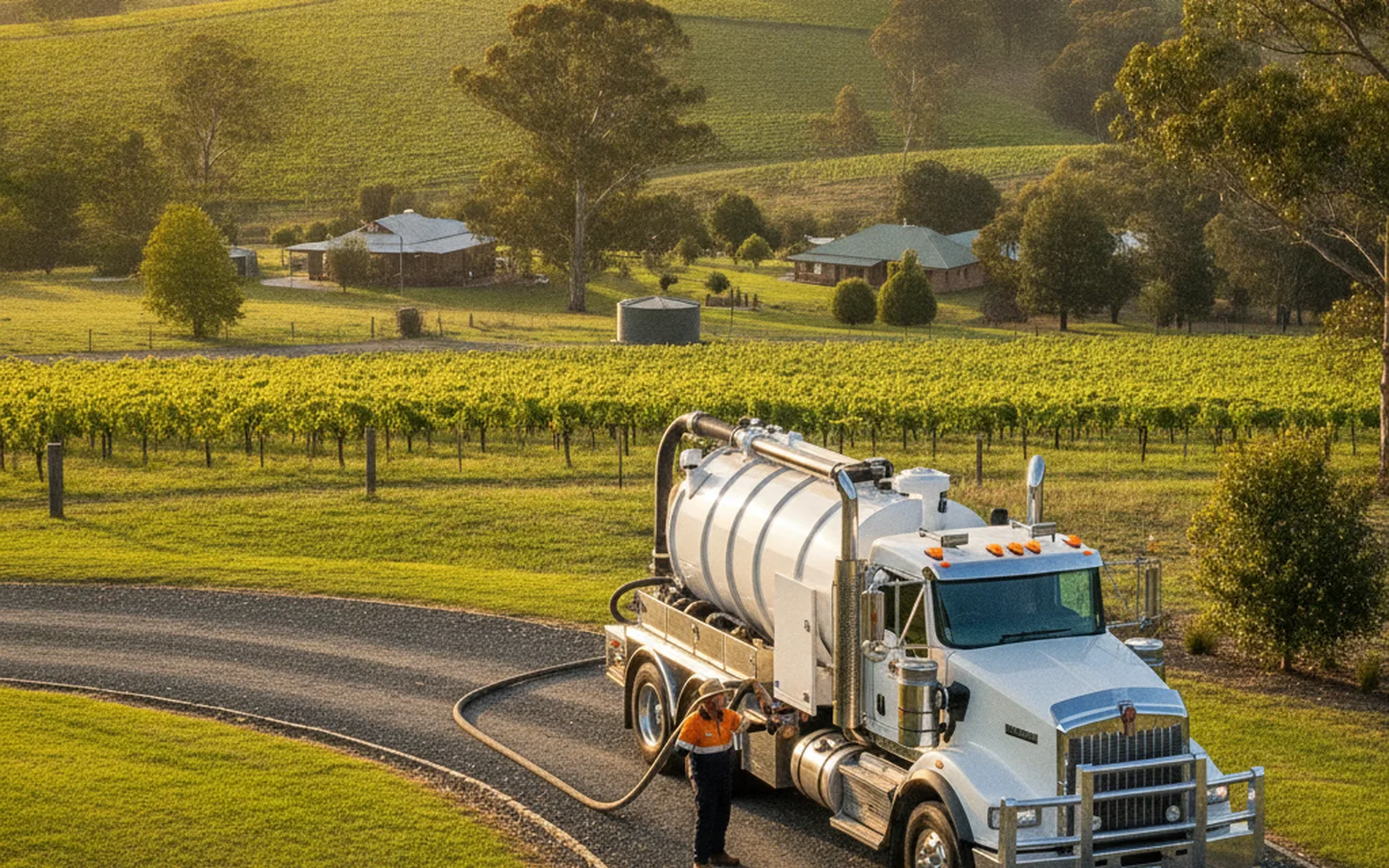
Absorption trench repair in the Hunter Valley is mostly a diagnosis job. The trench (the drain field, if you have been reading American sites) is the part of a septic system nobody sees: slotted pipe or plastic arch laid in gravel, where liquid from the tank soaks into the soil and the soil finishes treating it. When it stops soaking, effluent comes up instead of going down, and you find out through soggy grass, a smell, or a toilet that gurgles after rain.
Before anyone quotes $8,000 to $14,000 for a new trench, it is worth one visit to work out why the old one failed. Some trenches are finished. Plenty are sealed by biomat and drowned by water they were never sized for, and those can often be brought back for a fraction of a rebuild. This page covers how we tell the difference, what jetting and rejuvenation can and can't do, how the soils around Maitland, Cessnock, Singleton and Port Stephens change the odds, and where the licensed contractors we work with take over.
Full tank or failed trench? How to tell
From inside the house the two look alike: slow drains, gurgling, the odd backup. The difference shows outside.
- A full tank backs up at the house first. Lift the lid and the liquid sits above the outlet, with sludge and scum taking up more than about a third of the depth. The trench area may look fine.
- A failed trench backs up at the tank. The level stays high because the outlet has nowhere to send liquid, but the sludge measurement is normal. Outside there is a strip of greener, longer grass along the line, ground that stays spongy for days after rain, grey water or black slime surfacing at the low end, and a rotten-egg smell that gets worse after showers and washing.
- Both at once is common on older Hunter properties, because the tank that has not been pumped is usually what killed the trench.
The NSW Office of Local Government's 2025 guidelines say a tank must be desludged no later than when sludge and scum reach one-third of its depth or come within 150 mm of the inlet or outlet. You can't judge that by eye, so we measure it with a sludge judge on every trench call. Our guide to trench failure signs goes through the symptoms in more detail. If sewage is coming up inside the house right now, go to the emergency service page instead of waiting for a diagnostic.
Why trenches fail: biomat, water overload and solids carry-over
Three things wreck a trench, and they usually turn up together.
Biomat. Every trench grows a thin layer of bacteria and partly digested organic matter on the soil it drains into, and that layer is part of the treatment. Trouble starts when the trench floor sits under standing effluent for too long. The layer goes anaerobic and thickens into a slimy seal; in the OLG guidelines' words, where effluent ponds in the base, "conditions become anaerobic and a clogging layer develops". Once the seal covers the floor and lower walls, water has nowhere to go.
Water overload. Trenches are sized for a design flow, which the 2025 guidelines set at 150 litres per person per day on mains or bore water and 120 litres on tank water. Two extra occupants, a second bathroom or a leaking cistern can push a trench built for a smaller household past its limit. Rain does the same from the other side: downpipes discharging near the trench, or run-off from the paddock uphill, fills the soil so the trench can't drain. On clay blocks it is usually the water, not the trench, that is the real problem.
Solids carry-over. A tank that has not been pumped in years loses its settling volume, solids wash through the outlet, and the biomat gets fed exactly what it needs to seal faster. The state's Easy Septic Guide says this "drastically shortens the life of the trench", and Singleton Council warns that a poorly maintained tank can mean "expensive reinstatement of the absorption area". Old gravity trenches with large slotted pipe make it worse. The guidelines note they "commonly result in uneven loading and in time suffer from creeping failure": the first few metres take all the flow, seal first, and the failure creeps along the line.
Roots, crushed pipe, a distribution box that has tilted and sends everything down one line, and vehicles compacting the cover are the other suspects. They are less common, but they are the ones that decide whether rejuvenation or a rebuild is on the table.
What the soil under your block does to the odds
The Hunter is not one soil, and whether a sealed trench can be saved depends a lot on what is under it. Dungog Shire and Port Stephens councils both use risk tables that class clay or sand with weak structure as the high-risk soil group and well-structured loam as low risk. Heavy clay and clean sand fail for opposite reasons.
Hunter River floodplain: Maitland's river flats and Raymond Terrace
The flats around Maitland, Bolwarra, Phoenix Park and Raymond Terrace are alluvial soils and flood liable. Maitland City Council rates a system high risk if "the system and disposal area are flood liable", and its policy says plainly that "Not all soils or sites are suitable for absorption trenches, particularly in village areas with small blocks and soils with poor soil structures". Trenches here often fail from a high water table rather than biomat: after a wet February or a river rise the ground is saturated and there is nothing to absorb into. The OLG guidelines want effluent areas above the 1-in-20-year flood level and pressure-dosed rather than gravity-fed on flood-prone land. Rejuvenation odds are fair once the ground dries and the tank is sorted; a trench that goes under every few years is a candidate for relocation or an evapotranspiration bed, which is a designed, council-approved job. After a flood, NSW Health's advice is to stay off the system until water has dropped below the land application area and not to use anything connected to it until the whole system has been inspected.
Coalfields clay: Cessnock, Kurri Kurri and the villages
Around Cessnock, Kurri Kurri, Bellbird, Kearsley, Millfield, Ellalong and Paxton the issue is clay that takes water slowly. The 2025 OLG design tables let sands and gravels absorb up to 35 mm of effluent a day, clay loams 4 to 15 mm and light clays 5 to 10 mm. For medium to heavy clays (Category 6) no trench rate is given at all; the design "will need to rely on more processes than just absorption by the soil", and dispersive (sodic) or shrink-swell clays are treated as Category 6 regardless. Cessnock Airport averages 743 mm of rain a year, drier than Maitland or the coast, which helps. Clay trenches seal fast and drain slowly, but because the soil holds its shape a jetted and rested trench often comes back. What it can't survive is more water. A diversion drain uphill of the trench and an overdue pump-out do more here than any additive.
Coastal sand: Medowie, Salt Ash, Williamtown and Bobs Farm
On the Port Stephens sand country the trench rarely struggles to drain; the worry is where the effluent goes next. Hunter Water's catchment guidelines say sand "is highly permeable; consequently, any spills or contamination tend to move through to the groundwater table quickly in the form of pollutant plumes", and much of this belt sits over or beside the Tomago Sandbeds, which supply up to 20 per cent of the Lower Hunter's drinking water in a dry year. Williamtown RAAF averages 1,134 mm of rain a year, half as much again as Cessnock, and the water table is often shallow; both councils' risk tables put groundwater within 0.6 m of the surface in the high-risk class. Failure here usually means a trench sitting in groundwater in a wet autumn, or an undersized trench behind a holiday let that fills up every long weekend. Rejuvenation works when the trench sits above the water table. When it doesn't, the fix is a raised bed or mound, which council assesses against Hunter Water's catchment rules.
Upper Hunter: Singleton, Jerrys Plains and Muswellbrook
West of Branxton the rain drops away. Singleton averages about 655 mm a year and Jerrys Plains 646 mm, against 945 mm at Paterson (Tocal) and over 1,100 mm on the coast, and January mean maximums sit close to 32 degrees. Evaporation does a share of the work, so evapotranspiration beds suit the climate. Blocks around Singleton and Muswellbrook tend to be bigger, so there is usually room to add or relocate a line, but the alluvial river flats hold water when they do get it, and hose runs to a tank at the back of a large lot can be long. Long trenches in dry, cracking ground also suffer from uneven loading: a tilted distribution box sends every flush down one line while the others sit dry.
What happens on a trench diagnostic visit
- Paperwork first. We ask for the council approval and the as-built plan if you have them; the plan says how many lines there are and where the distribution box should be. Many older Hunter systems have no plan, so we locate the lines by probing.
- Tank check. Lid off, sludge judge in, liquid level read against the outlet, baffles and outlet filter (if fitted) inspected. A tank running above the outlet with a normal sludge depth points at the trench.
- Trench probe and walk-over. We probe each line for saturated gravel, note how high the effluent is sitting, and map where the grass, smell and soft ground are. Failure at the near end only usually means creeping failure from uneven loading; failure along the whole line points to water table or a fully sealed floor.
- Camera. A CCTV push camera down the distribution lines shows roots, crushed or separated pipe, a collapsed arch, or a distribution box that is tilted or silted up.
- Water and stormwater audit. Where the downpipes go, where the driveway drains, whether a cistern is leaking or a stock tap is left running. Ten minutes here explains a lot of clay-block failures.
- Written findings. You get a plain report saying whether the trench is a rejuvenation candidate, a partial rebuild or a full replacement, with the prices below and, for licensed work, a quote from the contractor with their NSW licence number on it.
Rejuvenation: what we do and when it holds
Rejuvenation is for trenches that are structurally sound but sealed or drowned. It is not something you pour in. The Easy Septic Guide is blunt: "No amount of additives will help a septic system if it needs to be pumped out or if the trench is failing." What works is mechanical:
- Pump and desludge the tank, leaving roughly a tenth of the sludge to reseed the bacteria and refilling to at least two-thirds so the tank can't lift, as the OLG guidelines direct. This stops the solids carry-over and gives the trench a few days' rest while the tank refills.
- High-pressure jetting of the distribution lines from the box end to clear silt, sludge and fine roots. We jet the trench side only; the house drain between the dwelling and the tank is licensed drainage work in NSW.
- Biomat rejuvenation: getting air into the trench and breaking up the clogging layer along the floor and walls so aerobic bacteria can digest it. How fast that happens depends on soil and weather; a sealed trench in Cessnock clay in February recovers slower than the same trench in September.
- Fitting an outlet (effluent) filter to the tank. NSW Health notes these "can be retro fitted into existing septic tanks", the OLG guidelines recommend one, and the Easy Septic Guide says it will "extend the life of your trenches". It needs rinsing at each check.
- Diverting stormwater: extending downpipes, cutting a shallow diversion drain on the uphill side, and re-mounding the trench cover with a less permeable topsoil so rain sheds off rather than into the gravel.
- Resting and alternating. With two disposal areas and a diversion valve, the Easy Septic Guide says to swap them "every 12 months or so". With one, the rest comes from cutting water use for a few weeks: shorter showers, one wash a day, the cistern fixed.
Gypsum comes up a lot on clay blocks. It can improve the structure of sodic clay, but it does nothing for a trench that is simply biomat-sealed or under water, and whether your clay is sodic is a soil-test question. We would rather test first than sell you a pallet of it.
Rejuvenation runs $1,500 to $4,500 depending on trench length, access and how much of the line needs opening. It is honest to say it does not always hold. A trench undersized for the house from day one, or one that sits in groundwater every autumn, will seal again, and in those cases we will say so rather than take the money twice.
When the trench has to be rebuilt
Some trenches are past saving: crushed or separated pipe over long sections, a collapsed arch, a line below the water table, or one that has simply done its years. The Easy Septic Guide says trenches "should last for 15-25 years" if well built and maintained, and Muswellbrook Shire Council's fact sheet gives the same 15 to 25 year range. The guide also warns that a badly built or neglected trench can be finished "in as little as two years".
Rebuilding, extending or relocating a trench, replacing the distribution box, or re-laying pipework is plumbing and drainage work under NSW law. It is carried out by licensed plumbing and drainage contractors we work with; their NSW licence number appears on every quote. Our part is the diagnosis, the site assessment and sizing, the council paperwork, and coordinating the job so you are not managing three trades yourself. Tank-side work such as baffles, lids and risers is covered on the septic tank repair page.
Council approval is the step people skip. Under section 68 of the Local Government Act 1993 you need council approval to "install, construct or alter" a sewage management facility "or a drain connected to" it, and the Act counts trenches as part of the system. Councils draw the line in similar places. Cessnock City Council allows like-for-like component replacement and crack repairs without a new approval, but changing the disposal location or method is an alteration that needs approval first. Muswellbrook Shire's fact sheet treats replacing a small section of disposal line with an identical section as a minor repair, while "replacement of any part of the disposal area due to failure" needs approval. Under the Local Government (General) Regulation 2021 the altered system cannot be used until council has inspected it and confirmed in writing that it matches the approval. The fees are modest: Dungog Shire charges $295.85 for a domestic application to alter in 2026-27, and Cessnock's minor amendment fee is $176.
One more thing the 2025 OLG guidelines make clear: an existing system does not have to meet current design standards until it fails or is altered. Once yours has failed, the replacement does. On a small village block or heavy clay the new design may not be a plain trench at all. Evapotranspiration beds on Category 6 clay are suitable only with secondary treated effluent, and on slowly draining soils designers move to an ETA bed, a mound, or an AWTS with subsurface drip irrigation. Setbacks are now risk-based ranges rather than fixed numbers: 1.5 to 15 m from a boundary, 2 to 6 m from a building, 50 to 100 m from permanent water, 15 to 100 m from a bore, and 0.6 to 1.5 m of soil between the trench base and groundwater or rock. The site and soil report decides which end of each range applies to you. If the answer turns out to be a new system rather than a new trench, the replacement page and the replacement cost estimator cover what is involved.
Absorption trench repair prices
These are the figures we quote across the Hunter Valley. Access and depth change the price, distance does not: there is no travel surcharge across the Maitland, Cessnock, Singleton or Port Stephens LGA service corridors. Lids buried deeper than 300 mm, hose runs over 45 metres and hardened sludge are quoted before we start. A standalone diagnostic visit is priced as a septic inspection ($250 to $500, covering the CCTV line check, tank assessment, trench probe and written report); bundled with a pump-out on the same visit it is $100 to $200 on top of the pump-out.
| Item | Price (AUD) | Who does it |
|---|---|---|
| Routine pump-out, up to 3,000 litres (2–3 bedroom domestic) | $350–$500 | Hunter Valley Septic |
| Routine pump-out, 3,500–4,500 litres (3–5 bedroom standard domestic) | $400–$650 | Hunter Valley Septic |
| Heavy hardened sludge (not pumped in 7+ years) | +$75–$150 | Hunter Valley Septic |
| Pre-purchase or OSSM council inspection bundled with pump-out | +$100–$200 | Hunter Valley Septic |
| Absorption Trench Rejuvenation / Eco-Air Jetting | $1,500–$4,500 | Hunter Valley Septic |
| Access riser retrofit | $250–$450 | Hunter Valley Septic |
| Baffle / Pipe Repair | $250–$650 | Hunter Valley Septic; pipework connected to the drain by the licensed contractors we work with |
| New Absorption Trench Installation | $8,000–$14,000 | Licensed drainage contractor |
Pump-out prices for larger and dual tanks are on the septic tank pumping page.
Keeping a rejuvenated trench alive
Most of this is the Easy Septic Guide's advice, and it is the same list council officers work from.
- Pump the tank every 3 to 5 years, or sooner when the sludge measurement says so. Our pump-out interval guide explains how occupancy shortens that.
- Keep vehicles and stock off the tank and trench. The cover is loose gravel and topsoil; Everhard's own trench instructions say "DO NOT COMPACT the trench area or expose it to traffic".
- Don't build on it. The OLG model approval conditions say buildings, driveways, concrete, pools, garden beds, vegetable gardens and large trees "must not be placed in or on" the effluent area.
- Keep roof water, driveway run-off and garden irrigation off the trench.
- Rinse the outlet filter and do the guide's annual 20-minute check: liquid below the outlet, trench area not soggy, smelly or overgrown.
- Go easy on water in the wet months. Across the Hunter the wettest months are February to April, not winter, and that is when a marginal trench tips over.
If your trench is soggy, smelly or holding the tank up, call 0468 278 123 or book a diagnostic online. We call you back within 24 hours in business hours, most routine pump-outs are scheduled within 48 hours, and a genuine overflow gets same-day or next-morning vacuum truck response. We would rather tell you a trench can be saved than sell you a new one, and when it can't, you will hear that too.
Frequently Asked Questions
How long should an absorption trench last in the Hunter Valley? ▼
The NSW Easy Septic Guide says a well-built, well-maintained trench should last 15 to 25 years, and Muswellbrook Shire Council's fact sheet gives the same 15 to 25 year figure. The same guide warns that a poorly built or neglected trench can fail in as little as two years. Soil matters: clay trenches seal faster under too much water, and sand trenches on the Port Stephens coast can sit in groundwater in a wet autumn.
Is it the tank or the trench that has failed? ▼
A full tank backs up at the house and, when measured, shows sludge and scum filling more than a third of the tank depth. A failed trench holds the tank level above the outlet even after a pump-out, and shows itself outside as soggy ground, greener grass and a smell along the trench line. On older Hunter properties it is often both, because an overdue tank is usually what sealed the trench.
Will pumping the tank more often fix a soggy trench? ▼
Pumping stops more solids reaching the trench and gives it a short rest while the tank refills, but it does not remove a biomat seal or lower a water table. If the trench is sealed it needs jetting and rejuvenation; if it is drowned, the water has to be diverted or the trench moved. The Easy Septic Guide is just as clear that additives will not fix a failing trench either.
How much does absorption trench repair cost? ▼
Absorption trench rejuvenation and jetting runs $1,500 to $4,500 AUD depending on trench length, access and how much of the line needs opening. A new absorption trench is $8,000 to $14,000 AUD and is built by a licensed drainage contractor. A standalone diagnostic visit is priced as a septic inspection at $250 to $500 AUD, which includes the CCTV line check, tank assessment, trench probe and written report.
Do I need council approval to rebuild or extend a trench? ▼
Yes, for anything beyond a like-for-like repair. Section 68 of the Local Government Act 1993 requires council approval to install, construct or alter a sewage management facility or a drain connected to it, and the trench is part of the approved system. Cessnock and Muswellbrook both allow small identical-section repairs without approval but treat replacing part of a failed disposal area, or changing its location or method, as an alteration. The altered system cannot be used until council has inspected it and confirmed in writing.
Can I drive, park or build over an absorption trench? ▼
No. Trench cover is loose gravel and topsoil over a plastic arch or slotted pipe, and vehicle weight compacts the cover and crushes the line. The NSW Office of Local Government's model approval conditions say buildings, driveways, concrete, pools, garden beds, vegetable gardens and large trees must not be placed on the effluent area, and that the area is to be protected from vehicles and stock.
Can gypsum fix a trench in clay soil? ▼
Sometimes, and only for one kind of clay. Gypsum improves the structure of sodic (dispersive) clay, which the OLG guidelines treat as Category 6 soil with no trench loading rate at all. It does nothing for a trench sealed by biomat or sitting in stormwater, and whether your clay is sodic is a soil-test question. We would rather test than guess.
Can I rest a trench, and which trees are safe near it? ▼
If your system has two disposal areas and a diversion valve, the Easy Septic Guide says to swap them every 12 months or so; with a single trench, the only rest is a pump-out plus a few weeks of low water use. On trees, the OLG model approval conditions keep large trees off the effluent area altogether, and the 2025 guidelines use risk-based setbacks rather than a fixed tree distance. Keep thirsty, root-aggressive species well away and grow grass or shallow-rooted groundcover over the trench instead.