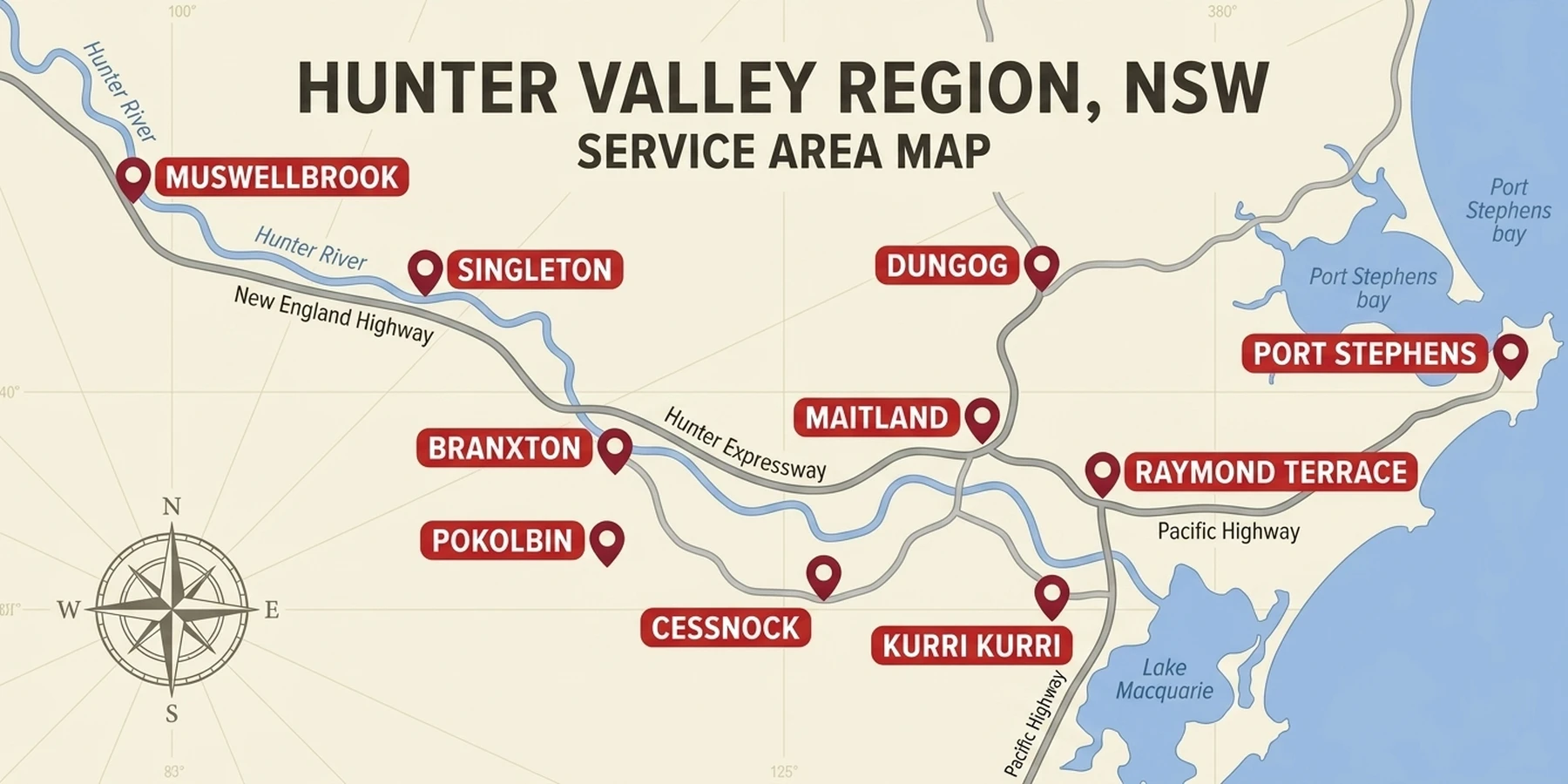
Maitland sits on the Hunter River floodplain, and that one fact shapes everything about running a septic tank here. The soils are river alluvium, the water table rises with the river, Maitland City Council rates any flood-liable system as high risk, and the NSW guidelines have specific rules about where tanks and trenches may sit relative to flood levels. Add the fact that Maitland is the most sewered council area in the Hunter, with unsewered pockets scattered along its rural edges, and you get a place where the first question is often “am I actually on septic?”
Hunter Valley Septic runs pump-outs, AWTS servicing, inspections and trench diagnostics across the Maitland local government area, from the floodplain villages to the rural blocks out towards Lochinvar and Maitland Vale. Call 0468 278 123 to book, or read on for what is different about septic systems in Maitland.
Is your Maitland property on septic?
Hunter Water says 96 per cent of Lower Hunter homes are connected to both its water and wastewater networks, but around 2,500 residential lots across 22 townships have town water without reticulated sewer. Raworth is one of the larger ones it names. Maitland City Council puts it the same way: there are a number of areas in Maitland where a direct connection to the Hunter Water sewer is not available, so wastewater has to be managed on site. Council’s policy recorded about 1,850 on-site systems on its books as of 2015, many of them in the catchments of the Hunter and Paterson rivers.
The quick test is your Hunter Water bill. Unsewered properties do not pay a Hunter Water wastewater service charge. If there is no wastewater charge on the bill, you are on a septic tank, an aerated wastewater treatment system (AWTS), a pump-out tank or a pump-to-sewer arrangement, and you will also be paying Maitland City Council’s annual on-site sewage management charge on your rates.
The rural and rural-residential localities where we see the most on-site systems are Bolwarra Heights, Lochinvar, Louth Park, Oakhampton and Oakhampton Heights, Raworth, Largs, Maitland Vale, Melville, Millers Forest, Duckenfield, Phoenix Park, Windermere, Rosebrook, Anambah, Berry Park, Tocal and the farmland around Farley and Aberglasslyn. Newer estates at Chisholm and Gillieston Heights are on the sewer (they even get a Hunter Water recycled-water scheme), and a sewered street and an unsewered acreage can sit a few hundred metres apart. Hinton, Wallalong and Butterwick are across the boundary in Port Stephens Council, which runs a different approval system; see our Raymond Terrace page for those.
Will sewer ever reach the unsewered pockets? Hunter Water says extending backlog sewer is not viable at present, because under the pricing regulator’s 2018 method existing owners would bear most of the cost, often more than $60,000 to $100,000 per property. Plan on your on-site system being permanent.
What the floodplain does to a septic system
Maitland has flooded more than 200 times since European settlement according to the NSW SES, which calls the area one of the most flood-prone in the state. The February 1955 flood killed 14 people and led to the Hunter Valley Flood Mitigation Scheme, which now runs more than 185 km of levees with floodways at Bolwarra and Oakhampton and declared floodplains at Maitland, Lorn and Woodville. The scheme has been tested in 1971, 1977, 2007, 2011, 2012, 2013, 2015, 2021, 2022 and May 2025. In June 2007 the Oakhampton spillway operated for only the second time since 1971 and about 4,000 people were evacuated from South Maitland, Central Maitland and Lorn.
Three things follow for a septic owner.
Flood liability sets your council risk rating. Maitland City Council classes a system as high risk if the system and disposal area are flood liable. High risk means a 2-year approval to operate instead of 4 or 5 years, and a renewal inspection every time it expires. The same rating applies if the disposal area is within 100 m of permanent surface water, 40 m of a gully or drain, 250 m of a domestic bore, or on a block under 1,500 m².
Position matters more than on dry ground. The NSW Office of Local Government’s 2025 guidelines say electrical and control components should sit above the 1-in-100-year flood level, treatment tanks in flood-prone areas should be sealed against floodwater, and effluent application areas should sit above the 1-in-20-year level and be pressure dosed rather than gravity fed. Maitland’s own subdivision rules require flood height data based on at least a 1-in-20-year event. If you are replacing a system on the river flats, this is where the site assessment starts, and it is why our replacement planning service begins with flood levels rather than tank brochures.
After a flood, stop and inspect. NSW Health’s advice is to avoid using the system until floodwater has dropped below the level of the land application area, and not to use toilets, laundry or kitchen drains until the whole system has been inspected and repaired by a licensed plumber or an authorised service technician. If the tank is pumped out, it should not be left empty for long, because an empty tank in saturated ground can float and snap its inlet and outlet pipes. The Hunter River in flood also leaves silt in trenches and mud over lids; a post-flood inspection is the sensible first move, and an emergency pump-out if sewage is backing up.
The alluvial soils compound this. Maitland City Council’s policy says plainly that not all soils or sites are suitable for absorption trenches, particularly village areas with small blocks and soils with poor structure, and that unsuitable landscapes can send effluent to the surface or groundwater. Hunter council risk tables treat clay with weak or massive structure as the high-risk soil class, together with a water table within 0.6 m of the surface. On the river flats both can apply in a wet February, which is Maitland’s wettest month (the Maitland Visitors Centre station averaged 838 mm a year, with February at 105 mm and August the driest).
How Maitland City Council runs approvals
Maitland issues approvals to operate on a risk basis: 2 years for high risk, 4 years for medium and 5 years for low. Low risk starts with “an AWTS with a satisfactory history and regular service reports”, a disposal area well clear of water and bores, not flood liable, fenced from stock and mown, and an owner who can show they understand the maintenance. Officers write to owners to say inspections will happen in a particular month, leave a notice if nobody is home, and give rectification requirements on site and in writing with a time frame.
Two Maitland rules catch people out. First, the approval is not transferable: a new owner must renew it in their own name within 3 months of the transfer, using Council’s application to operate a sewage management facility. Second, if a system has failed and the property is within 75 metres of sewer infrastructure, Council can require connection to the sewer under the Local Government Act.
For 2026-27, Council’s fees include $182.00 for an application to operate, an annual admin charge of $119.35 for every on-site system, no charge for the approval-to-operate inspection, and $146.35 for a compliance re-inspection. Council prefers AWTS for new applications in unsewered subdivisions and will not approve a pump-out tank unless there is no alternative. Every new sanitary drainage line is inspected by Council regardless of who certifies the build.
What we handle in that process is the part before and after the licensed work: sludge measurement and pump-outs, quarterly AWTS servicing with the service report sent to Council after each visit, inspections and reports, lid and riser work, effluent filters, pumps and alarms, and jetting of existing trenches. Trench construction, distribution boxes and sanitary pipework are plumbing and drainage work in NSW and are carried out by licensed plumbing and drainage contractors we work with; their NSW licence number appears on every quote.
Pump-outs on the floodplain: what to expect
A routine pump-out for a standard 3,500 to 4,500 litre tank is $400 to $650, and up to 3,000 litres is $350 to $500, with no travel surcharge across the Maitland corridor. Two floodplain habits are worth adopting. Refill the tank with water straight after pumping, to at least two-thirds, so it cannot lift in wet ground; a hose through the inlet lid does it. And if the block is saturated after a big rain, let us know; some manufacturers warn against pumping during or straight after heavy rain, and we would rather come back in a few days than have a tank shift.
Buried lids are common on the older river-flat blocks. If the lid is more than 300 mm down without a riser, excavation adds $75 to $150, and a permanent riser ($250 to $450) ends that charge and keeps Council’s officer happy at the next inspection. The full price list is on the septic tank pumping page.
Frequently Asked Questions
How do I know whether my Maitland house is connected to sewer?
Check your Hunter Water bill. Unsewered properties pay no Hunter Water wastewater service charge, and they pay Maitland City Council’s annual on-site sewage charge on the rates notice instead. If you have a concrete lid in the yard or a green AWTS control box on the wall, that settles it. Council can also tell you what is on the property’s file.
Does flooding change how often I should pump out?
Not the interval itself, which is set by sludge depth (the NSW guideline is to desludge once sludge and scum reach one-third of tank depth, commonly every 3 to 5 years). What changes is the aftermath: after any flood that reached the tank or trench, get the system inspected before using it, and if it is pumped out, refill it promptly so it does not float.
Why is my approval to operate only two years when my neighbour’s is five?
Maitland rates systems by risk. Flood-liable systems, disposal areas near water or bores, small blocks, a poor service history or surface ponding all put a system in the 2-year high-risk category. A well-serviced AWTS with a tidy, fenced disposal area can qualify for 5 years.
I just bought in Lochinvar. Does the previous owner’s approval carry over?
Not in Maitland. The approval is not transferable and must be renewed in your name within 3 months of the transfer. The Regulation gives you 3 months of grace to keep operating, so lodge the application early. Our buyer’s guide covers the documents to ask for.
Can Council make me connect to the sewer?
If your system has failed and the property is within 75 metres of sewer infrastructure, Maitland City Council’s policy says it may require connection. Otherwise, Hunter Water is not extending backlog sewer, so an on-site system is a long-term arrangement.
Where does the waste go after a Maitland pump-out?
It is transported and disposed of under NSW EPA waste rules at a licensed treatment facility that has agreed to accept it, and you get a disposal docket for the load. Household septic waste is not a trackable waste in NSW, so the docket is the paperwork; keep it with your approval file, because Council can ask for evidence of maintenance.
Ready to book a pump-out, AWTS service or inspection in Maitland? Call 0468 278 123 or use the booking form with your suburb and a note about tank access. We call back within 24 hours during business hours, and most routine pump-outs are scheduled within 48 hours.
Request Received!
Thank you for reaching out. Our Hunter Valley dispatch team will call you back promptly to confirm details and provide an upfront quote.
Call us directly on 0468 278 123