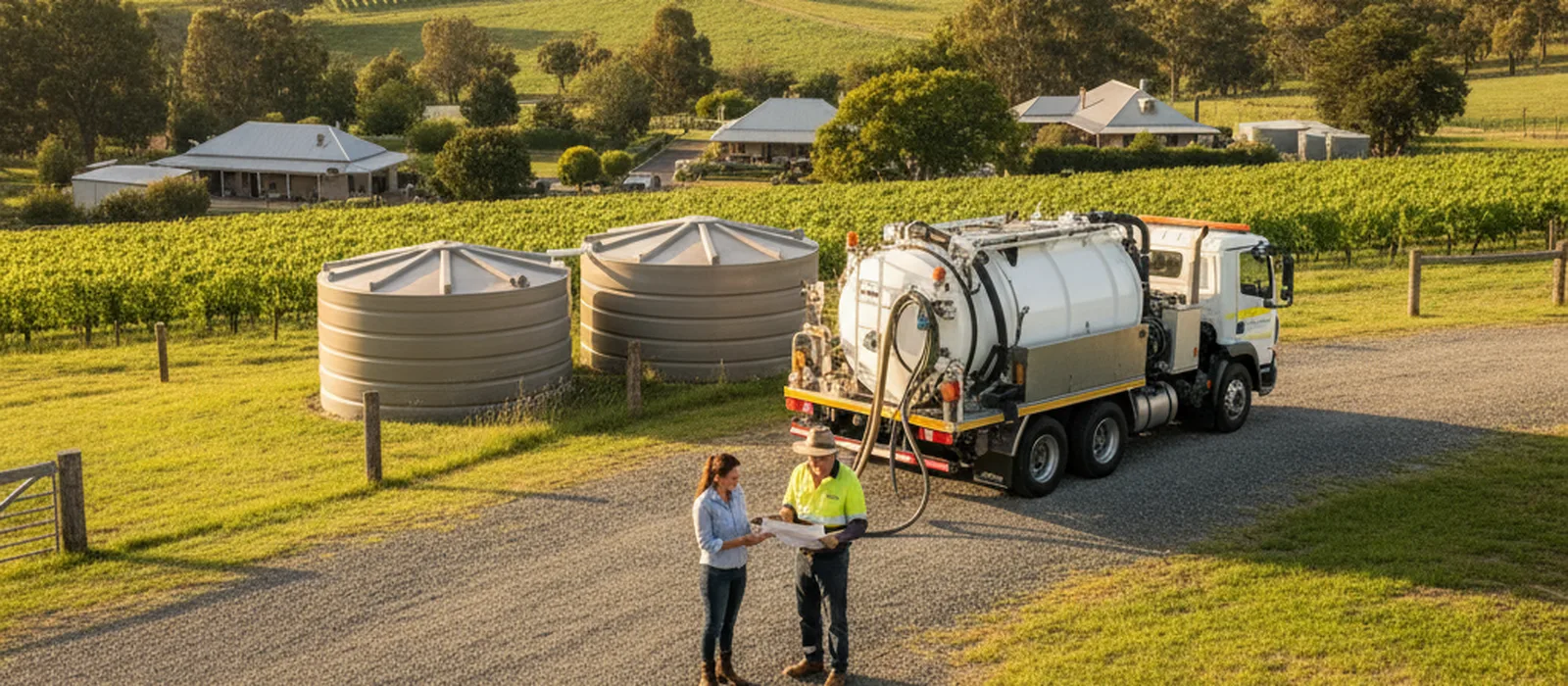
Buying a Property With a Septic Tank in NSW: What to Ask For, What to Inspect, and How the Approval Follows You
If you are buying an unsewered property in NSW, three things are true that most first-time rural buyers do not know. The building and pest inspection does not open the septic tank. The planning certificate attached to the contract has no prescribed item about on-site sewage at all. And the council approval to operate belongs to the owner, not the land, so it does not simply come with the keys. That leaves you to do three jobs before exchange: get the paperwork from the vendor, get the system inspected, and understand what your council will want from you after settlement. Here is how each works, with the Hunter councils’ actual rules.
Step 1: what to ask the vendor for
Ask through the conveyancers, early, for these documents. Clause 45(5) of the Regulation lets a council demand evidence of compliance from an approval holder at any reasonable time, so a diligent owner tends to keep a folder.
- The current approval to operate, with its expiry date and conditions. In Maitland it runs 2, 4 or 5 years by risk; in Singleton, Port Stephens, Dungog, Muswellbrook and Upper Hunter it is annual on the rates; in Cessnock it is a conditioned approval renewed for a fee.
- The section 68 approval to install, and the as-built or drainage plan if one exists. This tells you the tank size, the number of bedrooms the system was approved for, and where the disposal area is meant to be.
- AWTS service reports for at least the last two years. The NSW Health accreditation conditions require a quarterly service by a service agent authorised by the manufacturer, with the Local Council Service Report sent to council after each visit. No reports usually means no servicing.
- Pump-out dockets with dates. The OLG model approval conditions require receipts for pump-outs, services and repairs to be kept.
- Any council audit report or correspondence, including anything unresolved. Port Stephens and Dungog send an audit report to the owner after every inspection; Cessnock sends a written report with a time frame.
- Invoices for repairs, risers or trench work, showing the contractor’s licence number for anything that was licensed plumbing and drainage work.
- The operation and maintenance manual for an AWTS. Muswellbrook Shire’s buying-and-selling sheet asks vendors to hand this over.
Silence is information. A vendor who cannot produce any of this has either never been asked or has never done it.
Step 2: what the building inspector will not do, and what a septic inspection does
A standard building and pest inspector does not open the tank, measure sludge, test an AWTS blower or pump, camera the drain from the house or probe the trench. A pre-purchase septic inspection ($250 to $500) does all five and matches the paperwork against what is in the ground:
- Records versus reality: tank type and size, bedrooms approved versus bedrooms built, disposal area location. The commonest finding is a house that grew (bedrooms, a converted shed, a granny flat) without the system or council keeping up.
- The line from the house: a camera through the drain for roots, bellies and breaks.
- The tank: whether the lid is sound and secured, how deep the sludge and scum sit in each chamber against the OLG’s one-third rule, the state of the tees, baffle and effluent filter, where the liquid sits relative to the outlet, and any cracks or roots. For an AWTS, the blower, pump, floats, chlorine and alarm are tested and the service history read.
- The trench or irrigation area: a probe along the line, and a look for ponding, boggy ground, a green strip in dry weather, stock damage and vehicle tracks, with distances to waterways, bores, boundaries and buildings noted because those set the council’s risk rating.
- The report gives you photos, measurements, a pass, attention and urgent split, and a costed list at published prices, marked up for which items are licensed plumbing and drainage work.
Why the numbers matter: trench rejuvenation is $1,500 to $4,500; a new trench is $8,000 to $14,000; a complete replacement is $12,000 to $18,000 for a conventional tank and trenches or $15,000 to $25,000-plus for an AWTS, all installed by licensed plumbing and drainage contractors. A written, costed finding is what your conveyancer can put to the vendor. What happens next is between you, them and the contract; we supply the evidence, not the negotiation.
Two situations deserve extra care. An under-used system, a holiday let or a house that sat empty, can have an AWTS whose bacteria have died off and a trench that has never carried a full-time load, so “no problems” proves little. And a pump-out (holding tank) system means a truck every week or two for as long as you own the place; the OLG guidelines call pump-out systems a last resort and Maitland will not approve one unless there is no alternative.
Step 3: can council inspect it for me?
Some can. Port Stephens Council offers a pre-purchase on-site sewage management inspection on written request, with the vendor’s signed authority for officers to enter, at $427.00 in 2026-27. Singleton Council offers a pre-sale or pre-purchase inspection on request with its form and fee. Dungog Shire lists a pre-purchase inspection and report at $312.00. Maitland’s 2026-27 schedule lists a pre-purchase inspection at $350.80 but notes the option is subject to further investigation. Any council will tell you what is on the property’s file if you ask, and Muswellbrook needs the owner’s written permission before releasing documents to a solicitor.
A council inspection tells you whether the system meets its approval conditions. It is not a condition report written for a buyer, and the timing is set by council’s workload rather than your cooling-off date. Many buyers get both.
Step 4: what happens to the approval after settlement
The Easy Septic Guide puts the rule in one line: the approval relates to the owner, not the land; when the land is sold the new owner should notify the council and obtain an approval in their name. Clause 47 of the Regulation is the safety net: a buyer can keep running the existing system for 3 months after transfer with no approval at all, and a buyer who lodges their own application inside 2 months keeps that cover until council makes its decision. The vendor’s approval does not extend to you (clause 46 covers co-owners and tenants, not buyers).
How the handover works depends on the council:
| Council | What the new owner does |
|---|---|
| Maitland City | The approval is not transferable; renew it in your name within 3 months of the transfer with Council’s application to operate ($182.00 in 2026-27). |
| Cessnock City | Council updates the owner details and reissues the approval once NSW Land Registry Services sends the notice of transfer; no application. |
| Port Stephens | Council reissues the 12-month approval to you after the Land Titles Office notifies it; it renews on the rates notice ($140.00). |
| Dungog Shire | Ask Council to reissue the approval to you; it then renews each year through the rates ($145.60). |
| Singleton | The annual approval extends each July if no issues were found; a system with no approval is registered by lodging the section 68 form. |
| Muswellbrook Shire | Annual approval fee on rates ($65.00); a system 10 years or older with no installation approval goes on the register for $250, with an inspection if none has happened in the past decade. |
No Hunter council publishes a form called “application to transfer”. Do not let a conveyancer tell you there is nothing to do; tell council you are the new owner and follow the row above.
Step 5: if council has no record at all
Older farmhouses and weekenders sometimes have a system that was never approved, or an approval that lapsed decades ago. That is not a reason to walk away, but it is a cost to price in. The route is to regularise: Cessnock calls it an approval to operate an existing system, charged at the new-system fee, and says it cannot grant retrospective approval for unauthorised installation work but prefers a conciliatory approach where the owner is proactively fixing things; Muswellbrook registers systems 10 years or older for $250; Singleton asks for the section 68 form and warns that unregistered systems can attract a penalty notice. The OLG guidelines add a reassurance for old systems: they are not required to meet current design standards unless the system fails, the buildings are altered or the system is altered. Old is not illegal. Failed is a problem.
Step 6: your first year as the owner
- Put the approval in your name (above), and diarise the renewal.
- If the inspection found the tank due, book the pump-out early ($350 to $650 for standard tanks) and keep the docket.
- If it is an AWTS, sign a quarterly service contract ($90 to $150 a visit); the NSW Health conditions require a minimum 12-month agreement, and in Port Stephens and Dungog a serviced secondary system drops out of routine council inspection altogether.
- Fit an effluent filter if there is none, and a riser if the lid is buried ($250 to $450); both make the next council visit painless.
- Before adding a bedroom, a granny flat or a shed near the disposal area, read the approval: alterations to the system or the associated buildings need council’s written approval first.
Frequently Asked Questions
Does the building and pest inspection cover the septic system?
No. It covers the house and the timber. It does not open the tank, measure sludge, test an AWTS or probe the trench, and councils do not certify condition at sale. A separate pre-purchase septic inspection is the only way to know what is under the lid.
Does the approval to operate transfer to me?
Not automatically. The approval belongs to the owner. You have 3 months of grace after transfer under Regulation clause 47, and you should notify council and get an approval in your name: renewed within 3 months in Maitland, reissued after the title transfer in Cessnock and Port Stephens, reissued on request in Dungog.
What if there are no records at all?
Price in an inspection and a regularisation application. Cessnock, Muswellbrook and Singleton each publish a route for existing unapproved systems. An old system that works is not illegal because it is old; operating it without an approval is the offence, so get the approval sorted in the first months.
Can I add a granny flat later?
Only with a further section 68 approval to alter, usually with a site and soil assessment and often a bigger tank or a secondary treatment system. Cessnock requires each dwelling of a dual occupancy to have its own system. The inspection report records what the current system was approved for, which is where that conversation starts.
How old is too old for a septic system?
There is no age limit in the law. Muswellbrook Shire puts trench life at 15 to 25 years and concrete tanks commonly carry 15-year warranties, but the OLG guidelines say existing systems need not meet current standards unless they fail or are altered. Condition, not age, is the question, which is what the inspection answers.
What if the property has a pump-out system?
Budget for a truck every week or two while occupied; the Easy Septic Guide says a pump-out system in full-time use should be pumped every 1 to 2 weeks and the tank kept under two-thirds full. Councils treat pump-out systems as a last resort and some do not accept new ones, so ask whether a treatment system could be approved instead.
Sources and further reading
- Local Government (General) Regulation 2021 (NSW), clauses 45 to 47: approval conditions, co-owners and tenants, and the purchaser’s 3-month exemption.
- NSW Office of Local Government, The Easy Septic Guide: “the approval relates to the owner, not the land”.
- NSW Office of Local Government, Onsite Wastewater Management Guidelines (April 2025): renewal practice, model conditions, existing systems and current standards, pump-out systems.
- Environmental Planning and Assessment Regulation 2021 (NSW), Schedule 2: what a planning certificate must contain (no on-site sewage item).
- Port Stephens Council, Onsite sewage management: the council pre-purchase inspection option.
- Muswellbrook Shire Council, Buying and selling a house with an OSSM: vendor and buyer responsibilities and warning signs.
- Cessnock City Council, Understanding our application process: reissue of the approval on sale.
Request Received!
Thank you for reaching out. Our Hunter Valley dispatch team will call you back promptly to confirm details and provide an upfront quote.
Call us directly on 0468 278 123