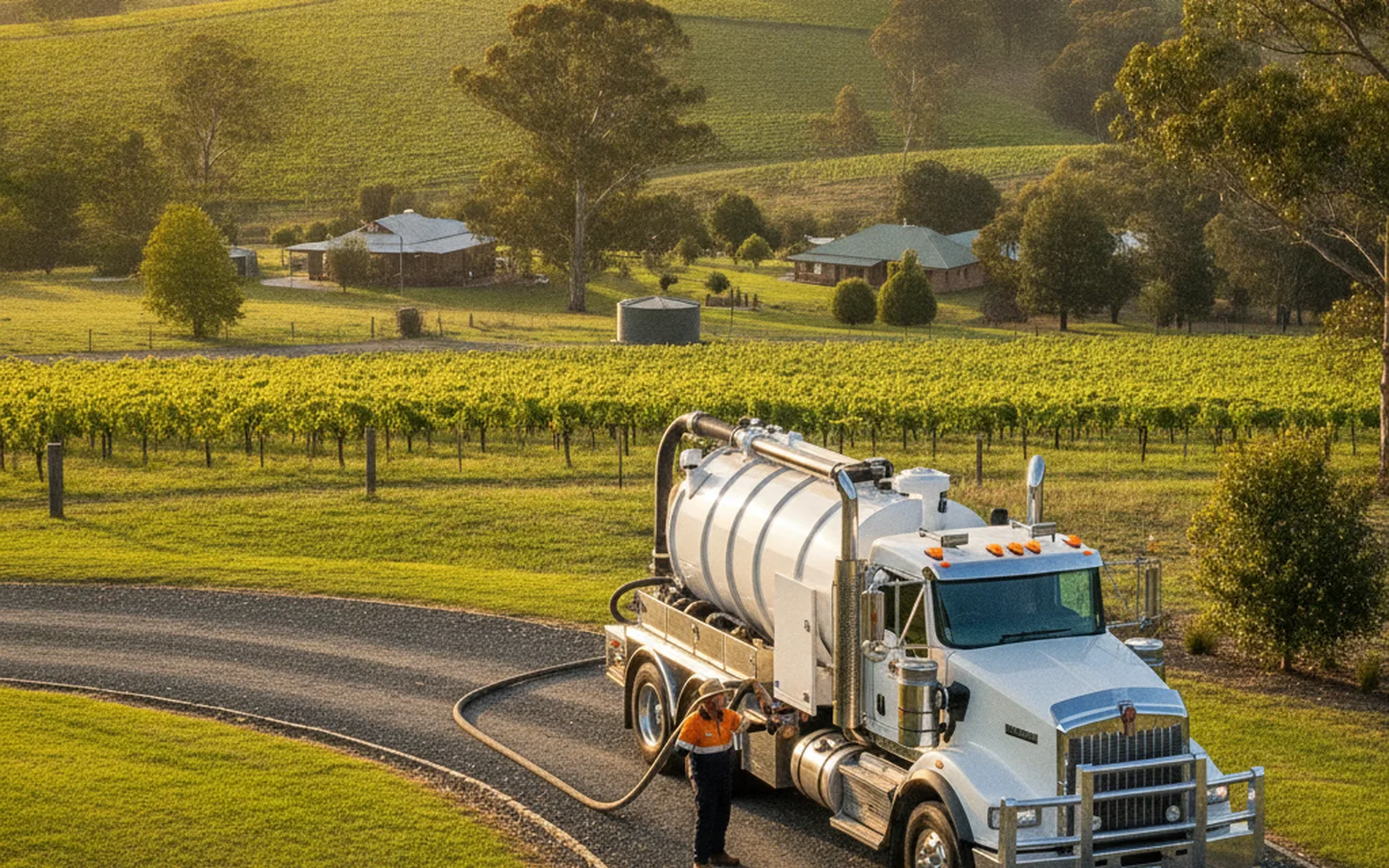
A septic inspection in the Hunter Valley is the job that tells you what is actually going on under the lawn: how full the tank is, whether the tees and baffle are intact, whether the trench is still taking water, and whether the paperwork matches the system in the ground. Every unsewered property in NSW needs a council approval to operate under section 68 of the Local Government Act 1993, and every Hunter council inspects on a risk-based cycle to decide whether to keep issuing it. Knowing the answers before the council officer does is cheaper than finding out from a notice.
Hunter Valley Septic inspects conventional septic tanks, aerated wastewater treatment systems (AWTS), pump-out and holding tanks, absorption trenches and irrigation areas across Maitland, Cessnock, Singleton, Port Stephens, Dungog and Muswellbrook. This page explains the three kinds of inspection people ask for, what we actually check, how each Hunter council runs its audits, what to do before an officer arrives, and the prices.
Three different inspections, three different reasons
People book "a septic inspection" for three quite different reasons, and it pays to be clear which one you need.
- Council OSSM compliance audit. Your council has written to say your approval to operate is due for renewal, or an officer has inspected and asked for evidence of maintenance. We inspect the whole system against the performance standards in the Local Government (General) Regulation 2021 and your council's own criteria, and write a report you can hand over. Price: $250 to $450.
- Pre-purchase inspection. You are buying (or selling) a rural property and the building and pest inspector has not opened the tank. That job has its own page: pre-purchase septic inspections. Price: $250 to $500, including a CCTV line check, structural assessment, trench probe and written report.
- Condition or fault-finding inspection. Drains are slow, the yard smells after rain, the AWTS alarm keeps sounding, or you have simply bought a place and want to know what you own. Same method as the council audit, same price line, with the report aimed at you rather than at council.
None of these is a pump-out. A pump-out includes a look at the tees and baffle while the tank is empty, but it does not test pumps and alarms, probe the trench or produce a report. Bundling an inspection with a booked pump-out adds $100 to $200.
What we check
The inspection follows the system from the house to the disposal area, because most failures start at one end and show up at the other.
- Records. The approval to operate, the section 68 approval to install if you have it, the as-built plan, AWTS service reports and pump-out dockets. Councils can ask an approval holder for evidence of compliance at any time under clause 45(5) of the Regulation, so we start by seeing what evidence exists.
- Tank access and lid. Is the lid findable, at or above ground level, sound, and secured against children? The Regulation requires facilities to be built so the contents can be removed safely, which in practice means a lid you can reach without a shovel.
- Sludge and scum depth. A clear sampling tube in each chamber. The 2025 NSW Office of Local Government guidelines say a tank must be desludged once sludge and scum together reach one-third of the tank depth or come within 150 mm of the inlet or outlet. We record the numbers so the next inspection has a baseline.
- Inlet and outlet tees, baffle, effluent filter. A collapsed outlet tee or missing filter is the most common reason solids reach a trench. We check them with the liquid level where it is, or after a pump-out if one is booked.
- Structure. Cracks, root intrusion, water coming in through the walls (a high liquid level with low household use is the giveaway), and settlement around the tank. The OLG guidelines ask councils to inspect structural integrity too.
- Mechanical parts, where fitted. Air blower, irrigation pump, float switches, chlorine level and the high-water alarm on an AWTS; the alarm on a pump well or holding tank. We test them rather than reading the last service report.
- Absorption trench or irrigation area. Ponding, boggy ground, a green strip in dry weather, odour, stock or vehicles on the area, and how far the area sits from waterways, bores, boundaries and the house. A probe along the trench line shows whether it is still draining. Where a drainage-line camera is needed to trace a blockage between house and tank, that is included in the pre-purchase inspection and quoted separately otherwise.
- The report. Photos, measurements, what passes, what needs attention now, what can wait, what it should cost using our published price list, and who does each piece of work.
How each Hunter council runs its OSSM inspections
The law is state-wide, but the audit cycle, the fees and the paperwork are set council by council. The differences matter when a renewal notice lands.
| Council | Approval to operate | Inspection cycle and what officers look at |
|---|---|---|
| Maitland City Council | Issued for 2, 4 or 5 years by risk rating; renewal needs an application and a renewal inspection at expiry; 2026-27 annual admin charge $119.35 | High risk includes lots under 1,500 m², disposal areas within 100 m of permanent water or 250 m of a bore, and flood-liable land. Officers check for surface ponding, flood liability, fencing of the disposal area from stock and whether it is mown, distances to waters and bores, and AWTS service history. |
| Cessnock City Council | Conditioned approval renewed or extended for a fee ($104 in 2026-27); reissued to a buyer once the title transfer is registered | AWTS service reports must reach Council within seven days of the service, and Council runs an online lodgement channel for registered service agents. A $181 re-inspection fee applies where the requirements of a service report were not acted on. |
| Singleton Council | 12-month approval renewed each year on the rates notice, extended in July if no issues were found | Inspections every 1, 3 or 5-plus years by risk, with a 10-year self-assessment tier for the lowest-risk systems. Unregistered systems can attract a penalty notice. |
| Port Stephens Council | 12-month approval running 1 September to 31 August, renewed on the rates notice; 2026-27 charge $140.00 | High risk includes lots under 2,000 m², clay or sand soils and flood-prone land; medium risk covers 2,000 to 4,000 m². Officers assess against the NSW Environment and Health Protection Guidelines performance standards and can ask for service reports and pump-out records; an audit report goes to the owner. |
| Dungog Shire Council | 12-month approval, 1 July to 30 June, renewed on the rates notice; 2026-27 charge $145.60 | Same risk tiers as Port Stephens (annual to 5-yearly inspections), same performance standards, audit report to the owner; the approval is reissued to a new owner on request. |
| Muswellbrook Shire Council | Annual approval fee on rates, $65.00 in 2026-27; systems 10 years or older with no record are registered for $250 and inspected if there has been no inspection in 10 years | Council's own audit inspection is free for registered systems. Owners are asked to unlock gates, restrain dogs and expose the lid before the officer's visit. |
| Upper Hunter Shire Council | Annual approval fee on rates, $81.50 residential in 2026-27 | Inspection every 1 year, 2 to 3 years or 5 years depending on how well the system meets the buffer distances in the 1998 NSW Environment and Health Protection Guidelines: 100 m to permanent surface water, 250 m to a domestic bore, 40 m to other waters, 15 m from spray irrigation to a dwelling, and 6 m up-gradient or 3 m down-gradient of a boundary. |
Fees are taken from each council's 2026-27 fees and charges and change every July; Cessnock's annual charge and Singleton's fees were not published in a form we could quote. Whichever council you are in, the approval is issued to the owner, not the land, and the obligations that come with it (keeping the system sanitary, not discharging anywhere but the approved application area, complying with the NSW Health accreditation conditions of an AWTS, and producing evidence on request) come from clause 45 of the Local Government (General) Regulation 2021. Operating without an approval carries a maximum court penalty of 20 penalty units ($2,200) and an on-the-spot penalty notice of $330. Our guide to council OSSM inspection rules goes through the enforcement steps in more detail.
Before the council officer arrives
Most "failed" council audits are not failed systems. They are systems nobody could get to, or paperwork nobody could find. A week before the visit:
- Find the lid and expose it. If it is buried, an access riser retrofit ($250 to $450) fixes it permanently and is the single most common recommendation in our reports.
- Mow the disposal area and keep stock and vehicles off it. Maitland's officers look for exactly this.
- Gather the service reports (AWTS) and pump-out dockets. If the last pump-out was more than 3 to 5 years ago, or you cannot remember, book a pump-out and keep the docket.
- Walk the trench line after rain and look for wet patches, odour or unusually green grass. If you see them, read our guide to absorption trench failure signs and get it looked at before the audit, not after.
- Unlock gates and restrain dogs on the day. Council officers have statutory powers of entry with notice, but a visit that cannot happen is a visit that gets rescheduled with a note on your file.
If you would rather know the answer first, book our compliance audit two or three weeks ahead of council's. The report tells you what an officer will see and gives you time to fix it.
A do-it-yourself annual check
Between inspections, the OLG's Easy Septic Guide sets out a simple owner's check you can do without opening anything: look for wet or smelly patches over the trench, listen for gurgling drains, check that the AWTS alarm light is off and the irrigation sprinklers are running clear, keep the grease trap clean, and keep a note of when the tank was last pumped. What you cannot do safely is measure sludge. An open tank gives off hydrogen sulphide, which is heavier than air and collects at the bottom; under the NSW Confined Spaces Code of Practice, putting your head or upper body through the opening counts as entry. Leave that part to us.
What the report leads to
We diagnose before we replace. If the problem is a root-blocked inlet tee, a failed blower diaphragm or a float switch, that is a $250 to $650 repair, not a new system. Lids, risers, effluent filters, pumps and crack sealing are ours to fix, and so is jetting and biomat rejuvenation of an existing trench ($1,500 to $4,500). Trench construction or rebuilds, distribution boxes and sanitary pipework are plumbing and drainage work under NSW law; that work is carried out by licensed plumbing and drainage contractors we work with, and their NSW licence number appears on every quote. Where a system is genuinely at the end of its life, our replacement planning service takes the report through site assessment and the section 68 paperwork.
Inspection prices in the Hunter Valley
| Inspection | Price |
|---|---|
| Council OSSM "Approval to Operate" compliance audit | $250–$450 AUD |
| Pre-purchase real estate septic inspection (CCTV line check, tank structural assessment, trench absorption probe, written report) | $250–$500 AUD |
| Pre-purchase or OSSM council inspection bundled with a pump-out | +$100–$200 AUD on the pump-out price |
There is no travel surcharge across the Maitland, Cessnock, Singleton or Port Stephens service corridors. Access or depth, not distance, is what changes a price, and any modifier is quoted before we start. Reports are written up after the site visit and sent by email.
To book a septic inspection anywhere in the Hunter Valley, call 0468 278 123 or use the booking form with your suburb and the reason for the inspection. We call back within 24 hours during business hours.
Frequently Asked Questions
What does a septic inspection involve in NSW? ▼
A proper inspection opens the tank, measures sludge and scum depth with a sampling tube, checks the inlet and outlet tees, the baffle and the lid, tests any pump, blower and alarm, walks the absorption trench or irrigation area for ponding, odour or lush growth, and checks the paperwork against what is in the ground. You get a written report with photos and a plain list of what needs doing. Looking at the lid from the outside is not an inspection.
Is a pump-out the same as an inspection? ▼
No. A pump-out empties the tank and includes a look at the tees and baffle while it is empty, but it does not produce a report, test the pump or alarm, or assess the trench. An inspection is a separate job with its own price. If you want both on the same visit, a pre-purchase or council OSSM inspection bundled with a pump-out adds $100 to $200 to the pump-out price.
How often does council inspect my septic system? ▼
It depends on the council and your risk rating. Maitland City Council issues approvals for 2, 4 or 5 years by risk and inspects at renewal. Port Stephens and Dungog issue 12-month approvals and inspect on a cycle from roughly annually up to every 5 years. Singleton inspects on a 1, 3 or 5-plus year cycle with a 10-year self-assessment tier for the lowest-risk systems. Upper Hunter Shire sets 1, 2 to 3 or 5-year intervals by how well the system meets buffer distances.
Does council charge for its own inspection? ▼
Each council sets its own fees and charges, and they change every July. For 2026-27 the annual on-site sewage charge is $65.00 in Muswellbrook Shire, $81.50 in Upper Hunter Shire, $119.35 in Maitland, $140.00 in Port Stephens and $145.60 in Dungog Shire; Cessnock charges $104 to renew or extend an approval and $181 for a re-inspection where a service report's requirements were not acted on. Check your own council's current fee schedule before budgeting.
What happens if the inspection finds a problem? ▼
Our report separates what is urgent from what can wait, and what we can do from what is licensed work. Lid, riser, effluent-filter and pump faults, and jetting of a clogged trench, are ours. Trench rebuilds, distribution boxes and sanitary pipework are plumbing and drainage work under NSW law and are carried out by licensed plumbing and drainage contractors we work with; their NSW licence number appears on every quote. If council's own audit found the fault, the report gives you what you need to show council it is being fixed.
Can I check my own sludge level? ▼
You can look for the warning signs, and the NSW Office of Local Government publishes a do-it-yourself annual check for owners. Measuring sludge properly means opening the lid and lowering a sampling tube into each chamber, and an open tank gives off hydrogen sulphide that is heavier than air. Never lean into a tank; under the NSW Confined Spaces Code of Practice putting your head through the opening counts as entry. We do the measuring.
Who inspects, council or a private contractor? ▼
Both, for different reasons. Council officers inspect to decide whether to issue or renew your approval to operate, and they have statutory powers of entry with notice. A private inspection like ours is for you: to find faults before council does, to satisfy a buyer or your own conveyancer, or to work out why the system is misbehaving. Our report is not a council approval, but it is written so a council officer can read it.
How much does a septic inspection cost in the Hunter Valley? ▼
A council OSSM approval-to-operate compliance audit is $250 to $450. A pre-purchase real estate inspection, which includes a CCTV line check, tank structural assessment, trench absorption probe and a written report, is $250 to $500. Adding either inspection to a booked pump-out costs $100 to $200 on top of the pump-out. There is no travel surcharge across the Maitland, Cessnock, Singleton or Port Stephens service corridors.