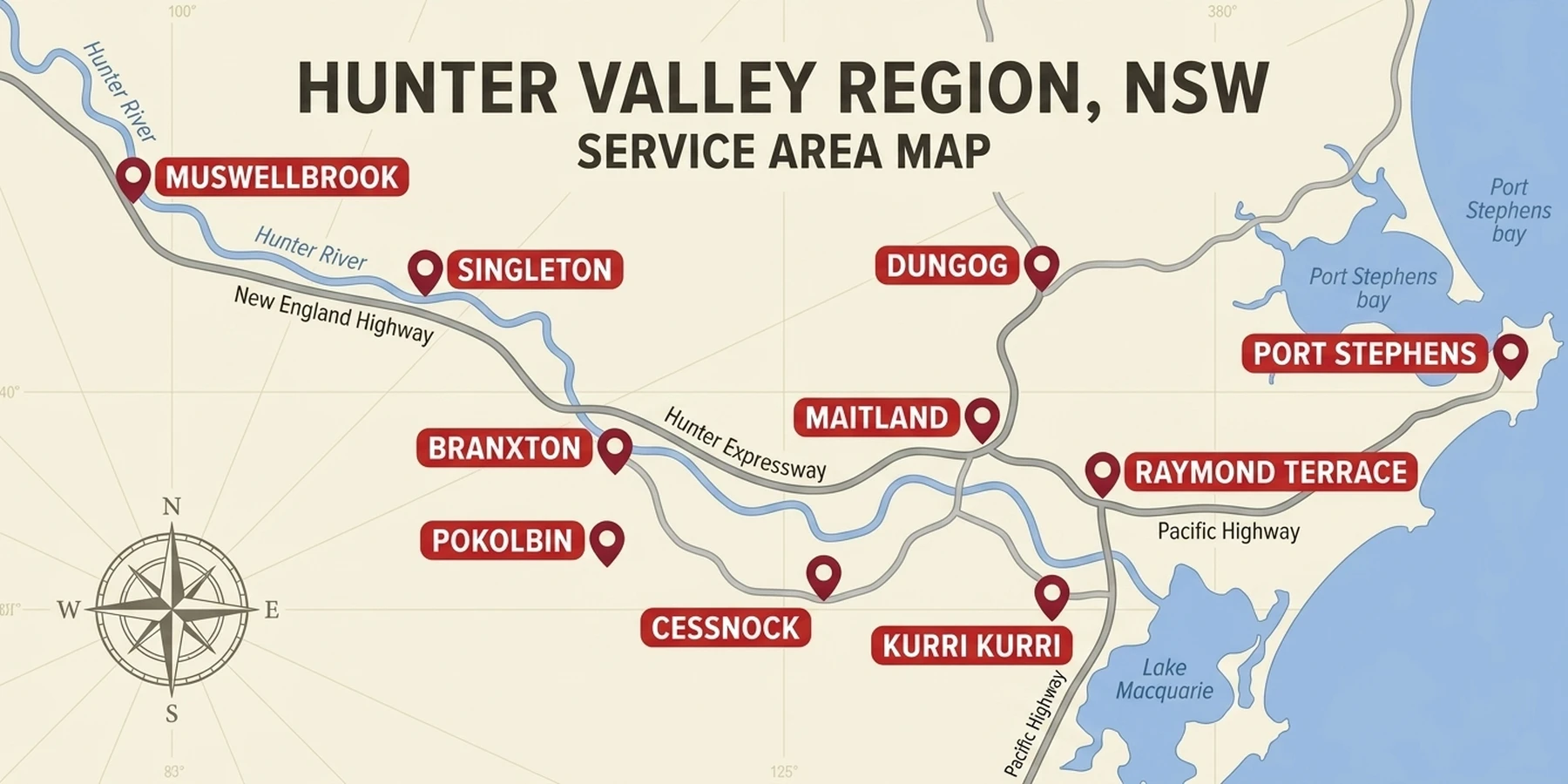
Muswellbrook is the upper end of our run, and it is a different country from the coast. Rainfall at the nearest Bureau stations is 600 to 650 mm a year, January afternoons average close to 32 degrees, July nights drop to about 4, and the land is black-soil plain and alluvial river flat given over to cattle, horse studs, vineyards and coal. Muswellbrook Shire Council runs the sewer in Muswellbrook and Denman; everything on the rural lots and in the smaller localities, Sandy Hollow, McCullys Gap, Wybong and Baerami, manages wastewater on site.
One thing to get straight first: Muswellbrook Shire and Upper Hunter Shire are different councils. Scone, Aberdeen, Murrurundi, Merriwa and Cassilis belong to Upper Hunter Shire Council, which has its own approvals, fees and inspection rules, covered further down. Hunter Valley Septic services both with pump-outs, quarterly AWTS servicing, inspections and trench diagnostics. Call 0468 278 123 to book.
Heat, evaporation and what it does to a system
Jerrys Plains Post Office, with 128 years of records, averaged 646 mm a year with January the wettest month and August the driest; Scone Airport averages 617 mm and Merriwa 597 mm. Both stations record January mean maxima of 31.8 to 31.9 degrees, against 28 at Williamtown and 25.6 at Newcastle. The NSW Department of Primary Industries describes the inland Upper Hunter as having a drier, hotter climate with a greater risk of frost.
For an on-site system that cuts both ways. Strong evaporation is a gift to an evapotranspiration bed or an irrigation area; effluent applied to a lawn in a Muswellbrook January disappears fast, and an AWTS with surface or subsurface irrigation suits the climate well. The soils are the catch. The black soils and alluvial flats that make this the region’s best cropping and grazing land hold water, shrink and crack in a dry spell and swell in a wet one, and heavy clay with weak structure is the high-risk soil class in every Hunter council’s risk table. A conventional trench in cracking clay can look perfect through a dry winter and fail in the first wet February. Muswellbrook Shire Council’s own fact sheet says disposal trenches and beds generally have a lifespan of 15 to 25 years, and replacing any part of a disposal area because of failure needs Council approval, not just a contractor with a digger.
The other Upper Hunter reality is distance. Standard pump-out pricing covers a hose run of up to 45 metres from where the truck can park; beyond that the extended-hose modifier is $50 to $120, quoted before we start. On studs and cattle properties, tell us at booking where the tank sits relative to the nearest hardstand.
Muswellbrook Shire Council: cheap approval, free inspection, firm rules
Muswellbrook runs one of the simpler and cheaper approval regimes in the Hunter. Every on-site system needs an approval to operate, charged at $65.00 a year in 2026-27 on the rates notice, and the approval-to-operate inspection carries no fee for a registered system. Renewal inspections need at least 7 days’ notice; you do not have to be home, but Council asks for safe access: vegetation cleared from the tank and disposal area, gates unlocked, animals restrained. If an approval has lapsed and there has been no inspection in the last 10 years, Council will require one. A system 10 years or older with no installation approval is registered for $250.00, and unregistered systems attract extra fees and processing time.
Copies of approvals and renewals are requested by email to Council (council@muswellbrook.nsw.gov.au) or by phone, and Council needs the owner’s written permission before releasing documents to a solicitor. Council’s guidance to owners is direct: pump the tank out about every 2 to 5 years depending on tank size, use and household habits; service an AWTS at generally 3-month intervals by an approved service agent, with service reports forwarded to Council; and confine AWTS irrigation to lawns and shrubs, signposted and fenced or otherwise kept from children, pets, livestock and vehicles. On a horse property that last rule is the one that gets tested.
For new or altered systems, applications go through the NSW Planning Portal with a site plan showing distances to structures, driveways, pools, dams, watercourses, bores and boundaries, a floor plan with bedrooms and drainage lines, NSW Health accreditation for the system, a site assessment covering climate, geology, hydrogeology, topography, soil and vegetation (with soil testing where needed), sizing calculations to AS/NZS 1547:2012, and the operation and maintenance arrangements. The 2026-27 fee to install a domestic system is $500.00 including one inspection; modifying a domestic system and disposal area is $460.00, the system alone $180.00, the disposal area alone $220.00; any inspection outside the routine approval inspection, including a re-inspection after an unsatisfactory one, is $228.00. Minor repairs (a broken lid, an inspection opening, replacing a short section of disposal line with an identical section) need no approval.
On sale, Council’s buying-and-selling sheet asks vendors to hand over the system’s location, sizing, approvals and the operation and maintenance manual, and lists as warning signs a tank not pumped out in the past 3 to 5 years or not checked in over 12 months. To decommission a tank, Council follows NSW Health Advisory Note 3 and wants the final pump-out receipts and photographs of each stage emailed in so the system comes off the register and the fees stop. Keep every docket we give you; here it is an explicit Council requirement.
Upper Hunter Shire Council: the buffer-distance test
Cross into Scone, Aberdeen, Murrurundi or Merriwa and the rules change. Upper Hunter Shire Council has more than 2,500 homes outside its sewered areas (it runs treatment plants at Scone, Aberdeen, Murrurundi and Merriwa) and charges $81.50 a year for a residential approval to operate in 2026-27, on the rates notice; that fee covers one inspection, monitoring and record keeping, and further inspections are charged.
Upper Hunter sets its inspection interval by buffer distances rather than a general risk score: 100 metres to permanent surface water, 250 metres to a domestic groundwater bore and 40 metres to other waters such as farm dams, intermittent waterways and drainage channels. Meet all of them and the system is low risk, inspected every 5 years; one minor breach is medium risk, every 2 to 3 years; most breached is high risk, inspected annually. Surface irrigation is not permitted for new systems on blocks under 4,000 m² or in sensitive locations, and accepted disposal methods are absorption trenches, evapotranspiration beds, subsurface irrigation deeper than 100 mm, subsurface disposal deeper than 300 mm and mounds. Council’s plain advice: a family of four needs a pump-out at least every 5 years, pump when the sludge reaches two-thirds rather than waiting until full, and never remove sludge yourself or spread it on land. Section 68 applications go to Council on its own form, with several inspections during the install. The 2026-27 install fee for a system up to 10 people is $381.00.
Studs, cattle, vineyards and mine housing
The Upper Hunter region produces two-thirds of Australia’s exported stud horses by volume according to the DPI, and dairying and equine grazing concentrate on the alluvial soils with reliable water, which is exactly where the older homesteads and their tanks sit. Stud and cattle properties raise three recurring wastewater issues: fencing the disposal area from stock (a condition in Muswellbrook and a risk factor everywhere), staff quarters and managers’ cottages on the same lot each needing their own approved system, and vehicle traffic over trenches. Muswellbrook LGA also had about 1,375 hectares of vines across just 23 growers at the last DPI count, an average of 60 hectares each, so the wine here is broadacre rather than cellar-door, with the wastewater load in the sheds and staff amenities rather than tourist traffic. The DPI notes that coal mining and equine development have both displaced vineyards in the shire over the past decade, and mine-related rental housing on rural lots is where we most often find a tank nobody can date; a condition inspection is the starting point there.
Frequently Asked Questions
What does an approval to operate cost in Muswellbrook Shire?
$65.00 a year in 2026-27, on the rates notice, and the approval-to-operate inspection is free for a registered system. Upper Hunter Shire (Scone, Aberdeen, Murrurundi, Merriwa) charges $81.50 a year for a residential approval.
Do I have to be home for Council’s renewal inspection?
No. Muswellbrook asks for at least 7 days’ notice and safe access: vegetation cleared, gates unlocked and animals restrained. If the approval lapsed and there has been no inspection for 10 years, an inspection is required before it is renewed.
How often should I pump out a tank in the Upper Hunter heat?
Muswellbrook Shire says about every 2 to 5 years depending on tank size, use and household habits; Upper Hunter Shire says a family of four needs one at least every 5 years and to pump when sludge reaches two-thirds rather than waiting until full. Heat helps the disposal area, not the sludge, so measure rather than guess.
Can I irrigate the vegetable garden with AWTS effluent?
Not in Muswellbrook Shire. Council restricts AWTS irrigation to lawns and shrubs, signposted and fenced or otherwise kept from children, pets, livestock and vehicles. Upper Hunter does not permit surface irrigation at all for new systems on blocks under 4,000 m² or in sensitive locations.
My trench has failed. Can I just have it dug out and replaced?
Muswellbrook Shire requires Council approval to replace any part of a disposal area because of failure, and trench construction is plumbing and drainage work in NSW. We diagnose first (many failures are solids carry-over or a collapsed outlet tee, fixed at $250 to $650), jet and rejuvenate existing trenches where that will work ($1,500 to $4,500), and where a new trench is needed it is carried out by licensed plumbing and drainage contractors we work with; their NSW licence number appears on every quote.
What do I need to give Council when I decommission an old tank?
Muswellbrook follows NSW Health Advisory Note 3 and asks for the final pump-out receipts and photographs of each decommissioning stage by email, so the system is removed from the register and the annual fee stops.
Ready to book a pump-out, AWTS service or inspection in Muswellbrook, Denman or the Upper Hunter? Call 0468 278 123 or use the booking form with your locality and a note about access. We call back within 24 hours during business hours, and most routine pump-outs are scheduled within 48 hours.
Request Received!
Thank you for reaching out. Our Hunter Valley dispatch team will call you back promptly to confirm details and provide an upfront quote.
Call us directly on 0468 278 123