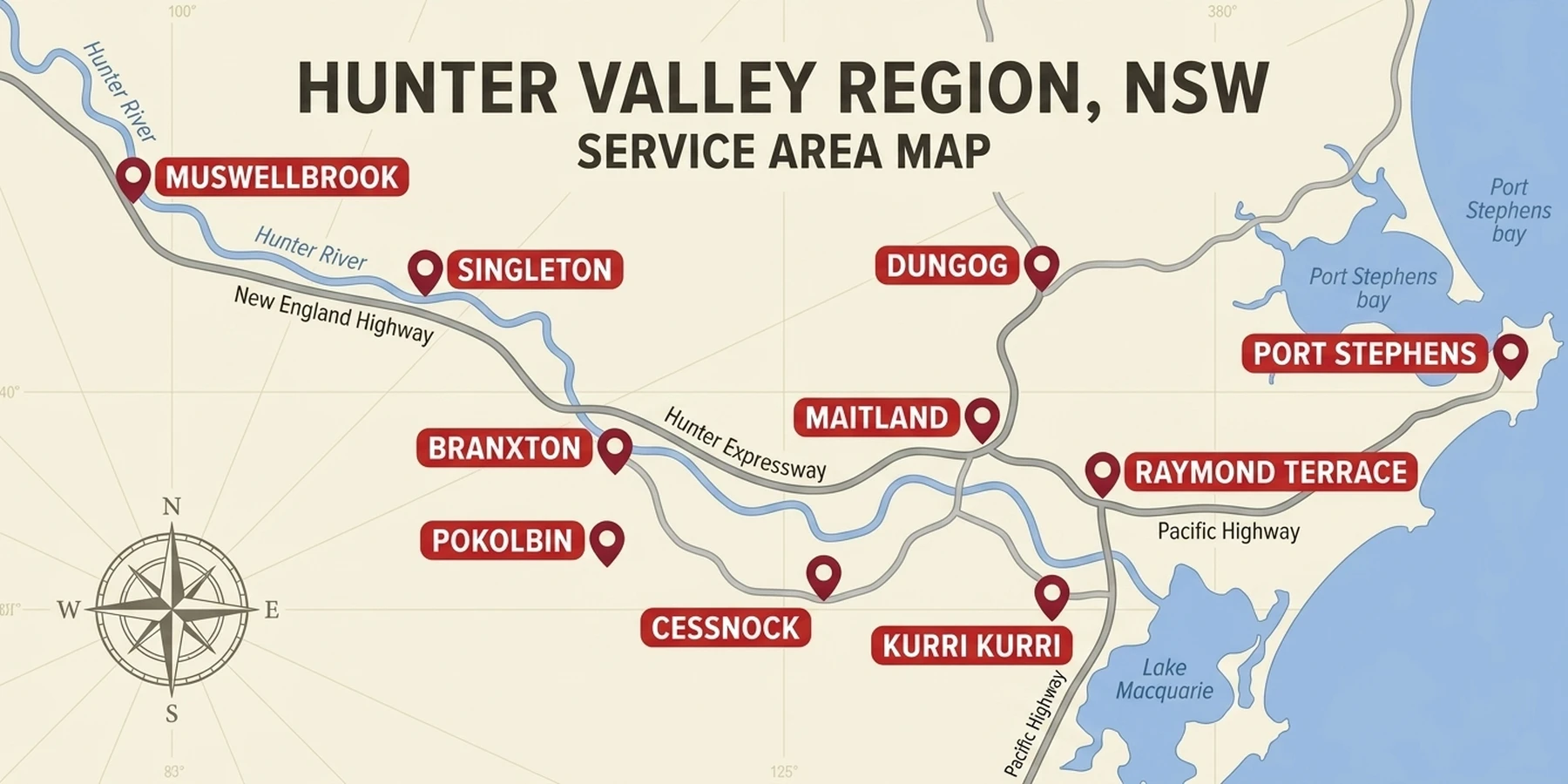
Branxton is the one place in our run where the council boundary matters more than the town sign. The Branxton locality itself, along with Elderslie, Belford, Lower Belford, Lambs Valley and Dalwood, sits in Singleton Council’s area. Cross the New England Highway into Greta, East Branxton or North Rothbury and you are in Cessnock City Council’s area, with a different approval, a different renewal cycle and different AWTS reporting rules. Layered over that is a sewer map that surprises people: Hunter Water, not Singleton Council, sewers Branxton town, and the Huntlee estate at North Rothbury runs on its own private water and sewer network, while the old village next to it is one of the larger unsewered townships in the Lower Hunter.
Hunter Valley Septic services the whole corridor, both sides of the highway, with pump-outs, quarterly AWTS servicing, inspections and trench diagnostics. Call 0468 278 123 to book.
Which council you deal with
| Locality | Council | What that means for your approval to operate |
|---|---|---|
| Branxton, Elderslie, Belford, Lower Belford, Lambs Valley, Dalwood (NSW 2335) | Singleton Council | Approval valid one year; Council sends an extension each July if no issues were found. Inspections yearly (high risk), every 3 years (medium), every 5 or more (low) or a 10-year self-assessment (minimal). Unregistered systems can attract a penalty notice. |
| Greta, East Branxton, North Rothbury | Cessnock City Council | Conditioned approval renewed or extended for $104.00 (2026-27), reissued to a buyer automatically after the Land Registry notice of transfer. AWTS service reports due to Council within seven days of each service. Routine inspections free; re-inspection $181.00. |
Both councils take section 68 applications for new or altered systems through the NSW Planning Portal, and both require NSW Health accreditation for the system, a site plan with buffer distances and, for on-site disposal, a site and soil assessment. Singleton Council is the delegated plumbing and drainage inspector for its area except the parts of Branxton served by Hunter Water’s sewer rising main, where NSW Fair Trading’s inspection service applies. If you are unsure which side of the line a property falls, the rates notice names the council.
Where the sewer ends
Hunter Water operates a wastewater treatment works at Branxton and is planning a capacity upgrade there under its July 2025 growth plan, so Branxton town is reticulated; Singleton Council states plainly that it does not supply sewer services to Branxton. Greta and East Branxton are older villages on the Cessnock side, part sewered and part not. The rural lots at Elderslie, Belford, Lambs Valley and Dalwood, and the acreage south towards Lovedale and Rothbury, are on tanks and AWTS units.
Then there is Huntlee. The estate at North Rothbury, planned by its developer for 7,500 homes and a 20,000-resident community around a town centre, is served by a private network operator, Huntlee Water, which had 1,246 connected dwellings at July 2024 and buys bulk water from Hunter Water; Huntlee lots are sewered and marketed with recycled water. The original North Rothbury village beside it is named by Hunter Water as one of the larger of the 22 Lower Hunter townships that have town water but no reticulated sewer, and Hunter Water says extending backlog sewer to such townships is not viable at present because existing owners would bear most of the cost, often more than $60,000 to $100,000 a property. Two neighbours in North Rothbury can therefore have entirely different wastewater arrangements. The test is the Hunter Water bill: no wastewater service charge means you are on a tank.
Vineyards, lifestyle blocks and an expressway
The Hunter Expressway, 40 km from the M1 near Seahampton to the New England Highway at Branxton, opened in March 2014 and turned the corridor into commuter country. The NSW Department of Primary Industries singles out the Belford and Rothbury areas, with Pokolbin and Lovedale, as places where rural lifestyle development is inflating land prices and creating land-use conflict with the vineyards; Lower Belford’s compact vineyards are part of the Pokolbin sub-region. Many of the lifestyle blocks changing hands are older farmhouses with older systems, and any new unsewered lot on the Cessnock side must now be at least 4,000 m² under clause 4.1E of the Cessnock LEP 2011.
The ground is transitional. Rainfall falls from about 743 mm a year at Cessnock Airport to about 655 mm at Singleton, with February the wettest month at both; the soils grade from coalfields clay to the alluvium of the Hunter flats, and clay with weak structure is the high-risk class in both councils’ thinking. A wet February on a small Greta block is when a marginal trench shows itself. Our trench diagnostics service sorts a soil problem from a solids-carry-over problem before anyone quotes a rebuild.
Older village systems: risers, tees and filters
The recurring jobs in Greta, East Branxton and the older Branxton streets are the same three. A concrete lid buried under decades of lawn (excavation beyond 300 mm adds $75 to $150 to a pump-out; a riser at $250 to $450 ends it and makes the next council inspection easy). A corroded or collapsed outlet tee, which lets solids into the trench and is the most common reason we find a failing disposal area behind a healthy tank; replacing a tee or short pipe section is $250 to $650, with the part that connects to the sanitary drain done by a licensed plumbing and drainage contractor we work with, whose NSW licence number appears on the quote. And a missing effluent filter, which the NSW Office of Local Government’s Easy Septic Guide recommends fitting because it keeps solids in the tank and extends the trench. Our tank repair page covers all three.
For the AWTS units on the newer lifestyle blocks, the rule that differs by council is reporting. Cessnock requires the service report within seven days of each quarterly service and runs an online lodgement channel for registered agents; Singleton requires servicing every three to four months by a Council-approved service provider and says the power must never be turned off. Our AWTS servicing is $90 to $150 a visit on either side of the highway, with the report sent to the right council after each visit.
Routine pump-outs are $350 to $500 for tanks up to 3,000 litres, $400 to $650 for 3,500 to 4,500 litres and $650 to $900 above 5,000 litres, with no travel surcharge across the Cessnock and Singleton corridors. The waste is transported and disposed of under NSW EPA waste rules at a licensed treatment facility that has agreed to accept it, and you get a disposal docket for every load.
Frequently Asked Questions
I live in Branxton. Is my council Singleton or Cessnock?
The Branxton locality (postcode 2335), with Elderslie, Belford, Lambs Valley and Dalwood, is in Singleton Council’s area. Greta, East Branxton and North Rothbury are in Cessnock City Council’s area. Your rates notice names the council.
Is Branxton on sewer?
The town is, through Hunter Water’s Branxton wastewater treatment works, even though Singleton Council runs water and sewer for the rest of its area. Greta and East Branxton are partly sewered, and the rural lots around Belford, Elderslie, Lambs Valley and Dalwood are on on-site systems.
Is Huntlee on septic?
No. Huntlee is served by Huntlee Water, a private network operator with bulk water from Hunter Water, so its lots are sewered. The old North Rothbury village next door is one of Hunter Water’s larger unsewered townships, and those properties are on tanks.
How often is a septic system inspected on the Singleton side?
Yearly for high-risk systems, every three years for medium, every five years or more for low, and a 10-year owner self-assessment with random inspections for minimal risk, with about two weeks’ notice. The approval to operate itself is annual and Council extends it each July if no issues were identified.
I bought at Greta. Do I need to transfer the approval?
Not on the Cessnock side. Council updates the owner details and reissues the approval to operate once NSW Land Registry Services notifies it of the transfer. On the Singleton side, an existing system without an approval is registered by lodging the section 68 form. Either way, ask the vendor for service reports and pump-out dockets and consider a pre-purchase inspection.
Will the sewer be extended to North Rothbury village or Lambs Valley?
Not on current plans. Hunter Water says backlog sewer extensions are not viable at present because existing owners would bear most of the cost, in many cases more than $60,000 to $100,000 per property.
Ready to book a pump-out, AWTS service or inspection anywhere along the Branxton and Greta corridor? Call 0468 278 123 or use the booking form with your locality and a note about tank access. We call back within 24 hours during business hours, and most routine pump-outs are scheduled within 48 hours.
Request Received!
Thank you for reaching out. Our Hunter Valley dispatch team will call you back promptly to confirm details and provide an upfront quote.
Call us directly on 0468 278 123