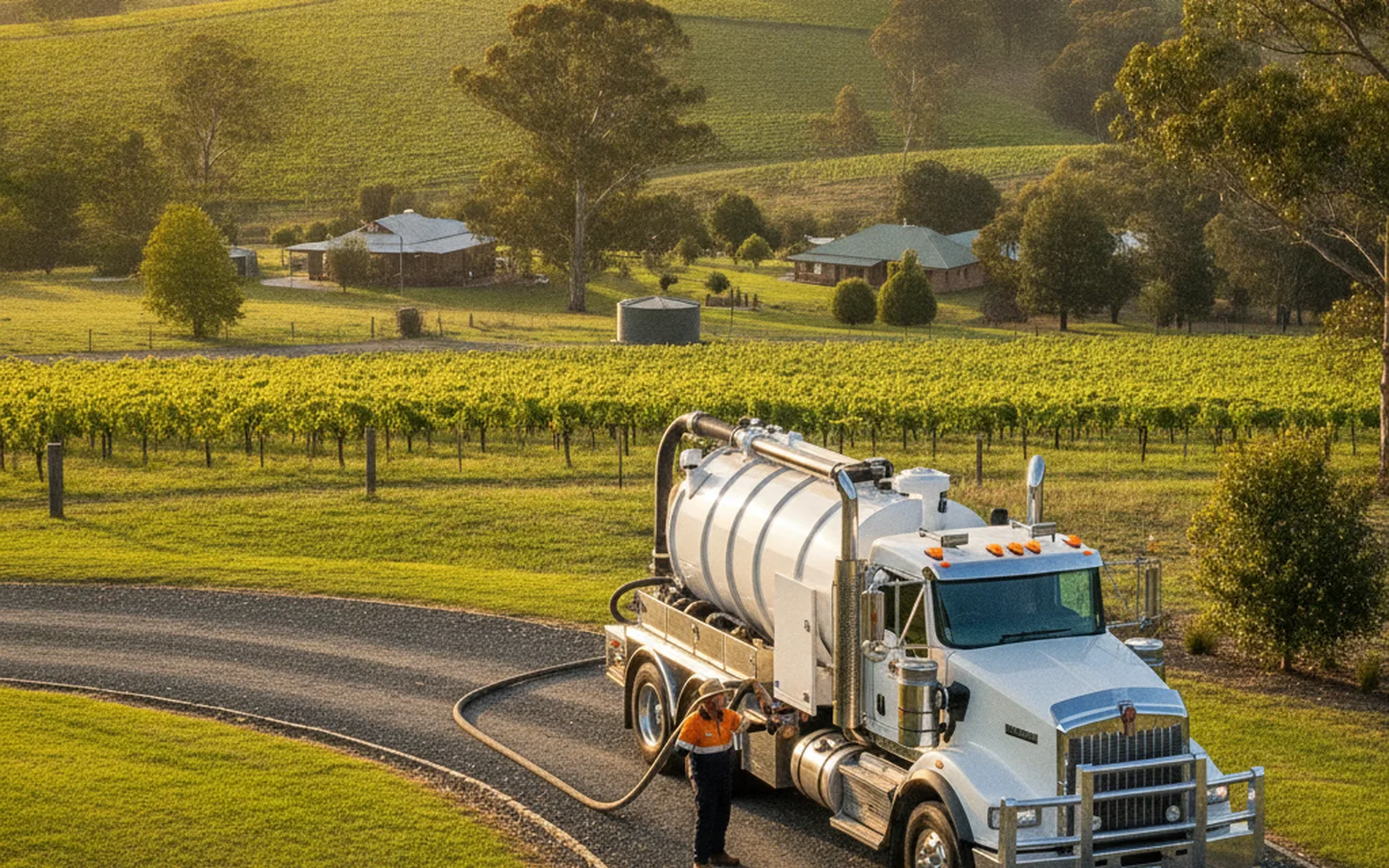
Emergency septic service in the Hunter Valley comes down to one promise, and we'd rather state it plainly than dress it up: sewage backup, an active high-water alarm, or septic overflow gets same-day or next-morning vacuum truck response. Our hours are Monday to Friday 7am to 6pm and Saturday 8am to 4pm, and the emergency line is answered outside those hours. We won't tell you a truck is twenty minutes away when it isn't.
This page covers what counts as a real emergency, what to do in the first hour, what happens when we arrive, what an after-hours call-out costs, and what to do if your tank has been under floodwater. It applies across Maitland, Cessnock, Singleton, Port Stephens, Muswellbrook, Dungog, Kurri Kurri, Pokolbin, Raymond Terrace and the rural acreages between them.
Is this actually an emergency?
Plenty of after-hours calls don't need an after-hours truck, and the after-hours modifier is real money. Here's how we sort them.
Call now, whatever the hour:
- Sewage coming up through a shower drain, floor waste or toilet inside the house.
- The overflow relief gully outside is running and won't stop.
- Raw effluent pooling on the surface over the tank or trench, or running towards a dam, creek or a neighbour's block.
- An AWTS high-water alarm together with effluent surfacing or backing up.
- A holding tank (pump-out system) at the full mark in a house that can't stop using water.
Ring in business hours and we'll book it:
- Drains that gurgle or slow down after heavy rain, then clear on their own. That is a waterlogged absorption trench (drain field), not a full tank, and trenches here are under most stress in the wet late-summer and autumn months of February to April, not winter.
- An AWTS alarm with no effluent surfacing. Mute it, ease off the water, and book a service.
- A tank you know is overdue. Most routine septic pump-outs are scheduled within 48 hours.
- Extra guests over a long weekend pushing an AWTS or holding tank harder than usual. Cut the load, then book.
If you're not sure, ring anyway. Working out which list you're on takes two minutes on the phone and costs nothing.
The first hour: before the truck arrives
- Stop putting water down the drain. No showers, no washing machine, no dishwasher, and flush only if you must. Every litre in is a litre with nowhere to go.
- Find the overflow relief gully. It is the fitting outside the house, usually near the bathroom or laundry wall, with a loose grated cover that sits lower than the indoor floor wastes. It is built to lift and let sewage out onto the ground before it comes up inside. If it's running, it is doing its job. Don't seal it, don't stand a pot plant on it, and keep people away from the puddle.
- Keep children and pets out of it. Fence off wet ground and lock the dog inside. Sewage carries germs that cause disease.
- Don't open the tank. Leave the lid alone. Under the NSW Confined Spaces Code of Practice, putting your head or upper body through the opening counts as entering a confined space, and hydrogen sulphide from disturbed sludge settles at the bottom of a tank. There is nothing useful you can see from the top anyway.
- Skip the additives. The Easy Septic Guide from the NSW Office of Local Government says no amount of additives will help a system that needs pumping out. Save your money.
- Clear the way for the truck. Unlock gates, move cars, and know where the lids are. If the tank is more than 45 metres of hose from where a truck can stand, or the lid is buried, tell us on the phone so we bring the right gear and quote it before we start.
- Ring 0468 278 123. Tell us where it is coming out, whether it has rained, when the tank was last pumped, and what kind of system you have. That is how we decide what to load.
If your AWTS alarm is sounding
Mute it first. Every manufacturer's manual says the same three things: press the mute, minimise water use, call your service agent. Fuji Clean and Taylex panels re-sound after 24 hours and Ozzi Kleen after 9 hours, so a buzzer that returns overnight isn't a new fault. On an Ozzi Kleen, a light flashing fast means high water and a slow flash means low air. Aqua Nova units won't sound at all in a general power failure, while a Fuji Clean panel has a battery and does. Whatever the brand, don't turn the unit off at the switchboard: Fuji Clean and Taylex both tell owners never to cut power to the system, because the blower is what keeps the treatment alive.
A high-water alarm with a dry, quiet lawn usually means the irrigation pump or its float switch has stopped. A low-air alarm means the blower. Neither is dangerous on its own; both turn into an overflow if the household keeps running water for a couple of days. Our AWTS servicing page covers the parts and what they cost.
If the power is out
A conventional septic tank with gravity trenches doesn't care about a blackout. An AWTS does: the blower stops, treatment stops, and the irrigation pump can't send water out, so the unit fills its emergency storage and then overflows. Ozzi Kleen puts that storage at roughly 1,000 litres; Fuji Clean's ACE 1200 holds at least 1,104 litres. NSW design rules assume 150 litres a person a day, so a household of four can use that up in under two days, faster on wash day. When the power comes back, check that the blower has restarted. Econocycle's manual says if it hasn't, switch the power off for ten minutes and then on again.
What we do when we get there
An emergency visit is a pump-out plus a diagnosis, not just a pump-out. In order:
- Look at the overflow gully, the fixtures inside and the ground over the tank and trench before touching anything. Where the sewage is appearing tells us where the fault is.
- Open the lids ourselves, note the liquid level against the outlet pipe (in a healthy tank it should sit no higher than the outlet), and measure sludge and scum depth. The 2025 OLG guidelines say a tank must be desludged once sludge and scum reach one-third of its depth or come within 150 mm of the inlet or outlet.
- Pump the tank down. That restores gravity flow from the house within minutes, which is the relief you rang for. We take the crust and sludge, not just the liquid, and leave a little sludge behind to reseed the bacteria as the OLG guidelines recommend.
- Check the inlet and outlet tees for roots, collapse or a jammed outlet filter. A blocked filter gets rinsed back into the tank. A root-choked or broken tee is a $250 to $650 repair, not a new system.
- On an AWTS: check the blower is running, the float switches move freely (Ozzi Kleen documents a float cable slipping out of its groove and running the pump dry until it fails), the irrigation pump lifts, the alarm works and the chlorinator has tablets.
- Tell you, on the spot, whether the problem is the tank, the trench, a pump or the house drain, and what the follow-up costs from the price table below. Anything beyond the pump-out is quoted before it starts.
- Hand you a disposal docket. Tank waste is transported and disposed of under NSW EPA waste rules at a licensed treatment facility that has agreed to accept it. Hunter Water's plants take tanker loads between 7am and 3pm on weekdays, so waste from a late or weekend job is held in the sealed truck and tipped on the next business day.
One more thing worth knowing. The model approval-to-operate conditions that NSW councils adapt include a duty to notify council of any system failure that may result in a pollution event. If effluent has reached a watercourse or a neighbour's land, we'll tell you so you can make that call.
Tank, trench, pump or house drain?
A pump-out fixes a full tank. It only buys time on a failed trench, and it does nothing for a blocked house drain. Sorting out which one you have is most of the value of the visit.
| What you're seeing | Most likely cause | What fixes it |
|---|---|---|
| Backs up in any weather; tank not pumped in 3 to 5 years; scum at the lid | Tank full of solids, or inlet or outlet tee blocked | Pump-out; tee or baffle repair if needed |
| Backs up after heavy rain; soggy or dark green strip over the trench; tank liquid sitting above the outlet pipe | Absorption trench saturated or clogged with biomat | Pump-out for relief, then trench rejuvenation or, if it has failed, a new trench built by a licensed drainage contractor |
| AWTS alarm; lawn irrigation not running; pump humming or silent | Irrigation pump, float switch or blower | Part replacement from the table below; hard-wired electrical work by a licensed electrician |
| One fixture blocked, the rest fine; overflow gully dry; tank level normal | Blockage in the house drain between the house and the tank | Licensed drainage work; we refer it to the contractors we work with |
| Holding tank alarm or dipstick at the full mark | Collection well full | Holding tank pump-out |
The Easy Septic Guide lists the same tells for a struggling system: rotten-egg smell, damp or pooling ground downhill of the trench, unusually green grass over the absorption area, slow drains, and a tank that hasn't been pumped in three to five years, which it calls the most common cause of problems.
Emergency call-out prices
An emergency septic service call-out in the Hunter Valley is priced from the same table as our routine pump-outs and the cost calculator, with the emergency modifier added. There is no travel surcharge across the Maitland, Cessnock, Singleton or Port Stephens LGA service corridors. What changes the price is access or depth, not distance, and it is always quoted before we start.
| Item | Price (AUD) |
|---|---|
| Up to 3,000 Litres, 2–3 Bedroom Domestic | $350–$500 |
| 3,500 – 4,500 Litres, 3–5 Bedroom Standard Domestic | $400–$650 |
| 5,000+ Litres, Large Rural / Commercial / Dual-Tank | $650–$900 |
| Emergency / same-day / after-hours dispatch (added to base) | +$150–$300 |
| Deep lid excavation (buried >300mm without risers) | +$75–$150 |
| Difficult access / extended hose run (>45m) | +$50–$120 |
| Heavy hardened sludge (not pumped in 7+ years) | +$75–$150 |
| Full AWTS Desludge & Total Pump-Out | $450–$750 |
| Submersible Irrigation Pump Replacement (installed) | $600–$1,200 |
| Air Blower Replacement (installed) | $650–$1,400 |
| Baffle / Pipe Repair | $250–$650 |
| Access riser retrofit | $250–$450 |
| Absorption Trench Rejuvenation / Eco-Air Jetting | $1,500–$4,500 |
So a 4,000 litre tank pumped on a Sunday night lands at $400 to $650 plus $150 to $300 for the after-hours dispatch. If the lid is under more than 300 mm of lawn, add the excavation line, and think about a riser so the next visit doesn't need a shovel.
We diagnose before we replace. If a root-blocked inlet baffle, a faulty air blower diaphragm, or an electrical float switch is the issue, that is the fix, not a new $20k system.
After a flood
The Hunter floods. The state's flood mitigation scheme lists 2015, 2021, 2022 and May 2025 among the events it has withstood, and the SES calls the Maitland area one of the most flood-prone regions in New South Wales. On the floodplain around Maitland and where the Hunter meets the Williams near Raymond Terrace, tanks and trenches go under water, and a system that has been under water needs checking, not restarting.
NSW Health publishes advice on flooding and on-site wastewater systems, and it is what we follow:
- Avoid using the system until floodwater has subsided to at least the level of the land application area. A trench under water can't take anything.
- Don't use toilets, laundry, kitchen or bathroom fixtures connected to the system until it has been inspected and repaired by a licensed plumber or an authorised service technician familiar with on-site systems.
- If the tank is pumped out, leave it empty only for a short time. An empty tank in saturated ground can float out and snap its inlet and outlet pipes. The OLG guidelines say to refill to at least two-thirds or to the outlet level straight after desludging for the same reason.
- Cut water use (fewer flushes, shorter showers, no washing machine or dishwasher) until the system has been checked.
- Look for pungent odours, sewage on the surface, open or displaced covers, a cracked tank and broken pipes, and tell us what you find.
AWTS owners have one extra job: the blower and control box. The OLG guidelines want all electrical and control components above the 1-in-100-year flood level, and Envirocycle's handbook treats a blower that has taken on water in heavy rain as owner negligence outside the warranty. If yours sat in floodwater, don't power it up until it has been checked. Our emergency visit after a flood is a pump-out of the water and silt, a look at the tees, lids and pipes, and a straight answer on whether you can restart or whether a licensed contractor needs to repair pipework first. Maitland City Council, Port Stephens Council and Dungog Shire Council all class flood-liable systems as high risk, which generally means a shorter approval-to-operate renewal cycle, so keep our docket and report for your file.
Safety around an overflow
We never climb into a septic tank, and we won't lean into one either. SafeWork NSW's Confined Spaces Code of Practice lists tanks of decomposing organic material as a source of hydrogen sulphide, warns that the gas is heavier than air and settles at the bottom of an unventilated space, and notes that it dulls the sense of smell, so you stop noticing it at exactly the wrong moment. Entry needs a permit, a stand-by person and atmosphere testing; a homeowner with a torch has none of those. The Easy Septic Guide adds the low-tech rules: no smoking or naked flames near an open lid, switch off power to electrical controls before touching them, and secure the lid afterwards so children can't lift it.
On the ground, treat any wet patch downhill of the tank as sewage until proven otherwise. Wash hands and boots, keep food off the area, and don't hose the puddle towards a drain or creek.
What we hand to licensed contractors
Pumping, desludging, tee and outlet-filter work, riser retrofits, AWTS servicing and jetting of existing trenches are ours. Clearing or repairing the house drain between the house and the tank is licensed draining work under the Home Building Regulation, as is trench construction, distribution-box and sanitary pipework repair. That work is carried out by licensed plumbing and drainage contractors we work with; their NSW licence number appears on every quote. Hard-wired electrical repairs on an AWTS go to a licensed electrician. We coordinate it, you get one point of contact, and nobody ends up with an unlicensed job on their council file.
If sewage is coming up right now, stop the water, keep everyone clear and call 0468 278 123. If it can wait until morning, the booking form gets a callback within 24 hours. Either way, read our step-by-step backup guide while you wait, and check the warning signs so next time you catch it before the gully does.
Frequently Asked Questions
How fast can you get to me? ▼
Sewage backup, an active high-water alarm, or septic overflow gets same-day or next-morning vacuum truck response. Our hours are Monday to Friday 7am to 6pm and Saturday 8am to 4pm, and the emergency line is answered outside those hours. Tell us what you can see when you call and we'll give you a realistic arrival window rather than a promise we can't keep.
Is it an emergency if the drains only back up when it rains? ▼
Usually not, but it is a warning. Drains that slow down or gurgle after heavy rain and clear again a day later point to a waterlogged absorption trench rather than a full tank. Book a routine pump-out and inspection within the week; if sewage is coming up inside the house or out of the overflow gully, treat it as an emergency and call.
My AWTS alarm is going off at night. What do I do? ▼
Press the mute button on the control panel, cut water use to a minimum, and phone us in the morning unless effluent is surfacing or backing up. Most panels re-sound after a set period (24 hours on Fuji Clean and Taylex units, 9 hours on Ozzi Kleen), so a buzzer that comes back is normal, not a second fault. Do not switch the whole system off at the switchboard.
Does a septic system work in a blackout? ▼
A conventional septic tank with gravity trenches keeps working because nothing in it is powered. An AWTS stops treating and stops pumping to irrigation, and holds only about 1,000 to 1,100 litres of emergency storage on units like the Ozzi Kleen RP10 and Fuji Clean ACE 1200. Keep showers short and washing on hold until the power is back and you have checked the blower has restarted.
Can I use the toilet while I wait for the truck? ▼
If sewage is already backing up, every flush adds to it. Use a neighbour's toilet or a bucket with a lid if you can, skip showers and washing, and leave the dishwasher alone. Once the tank has been pumped down the house drains again straight away.
How much extra is an after-hours or same-day call-out? ▼
Emergency, same-day or after-hours dispatch adds $150 to $300 to the standard pump-out price for your tank size, which starts at $350 to $500 for tanks up to 3,000 litres. The full table is on this page and we confirm the figure on the phone before the truck leaves.
Will my insurance cover a sewage backup? ▼
We can't tell you what your policy covers, and we don't get involved in claims. As a general rule insurers treat a sudden event differently from damage caused by a system that was never pumped, so keep photos, our disposal docket and the invoice, and ring your insurer before you start pulling up carpet.
Our tank went under floodwater. Do we still call you? ▼
Yes, but the first thing to do is stop using the system until the water has dropped below the level of the absorption area, which is NSW Health's advice. Once we can get to the tank we pump out the floodwater and silt, check the lids, tees and pipes, and tell you whether it is safe to refill and restart. Damaged pipework is licensed drainage work and we arrange it with the contractors we work with.