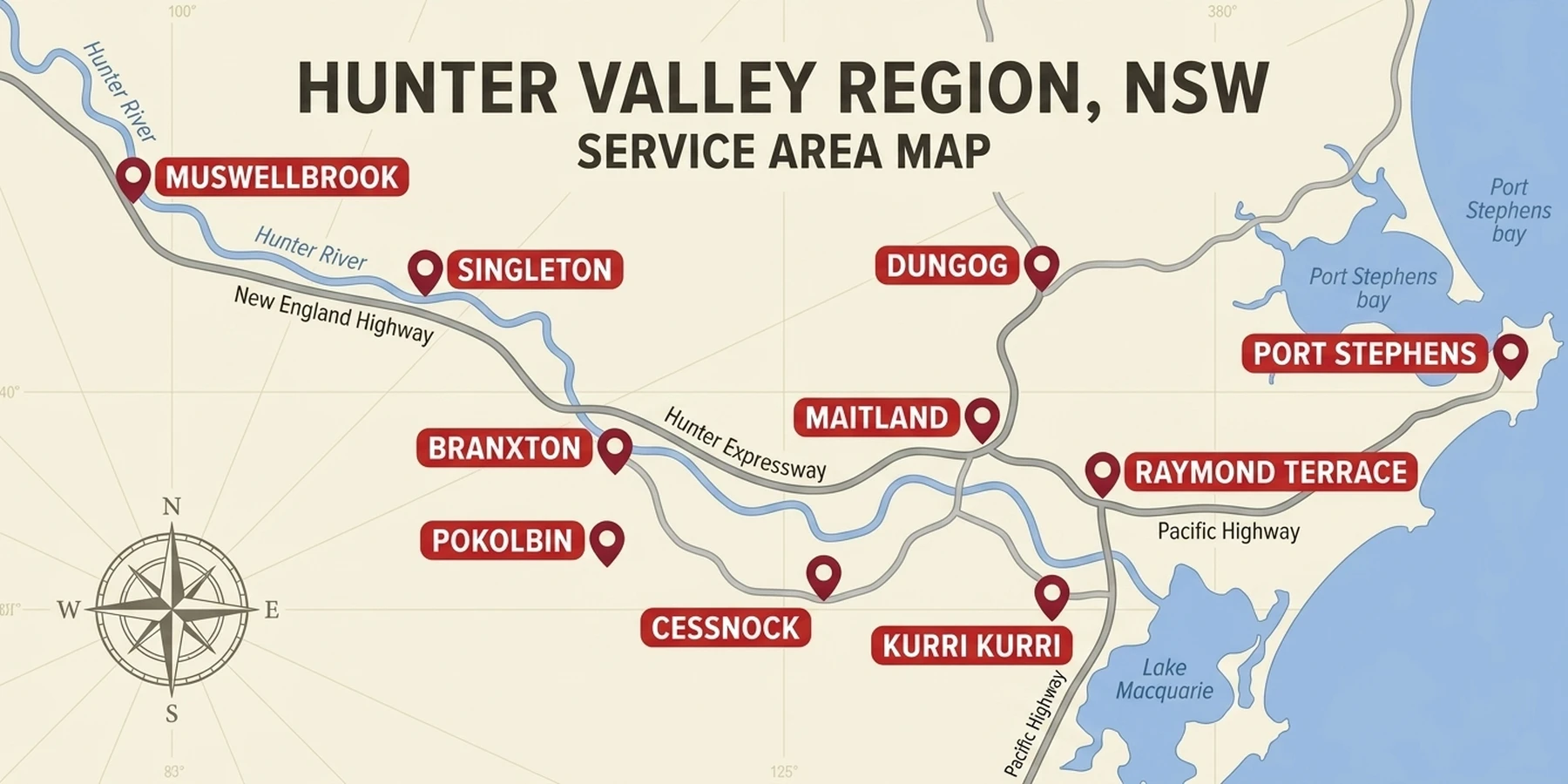
Port Stephens has more on-site sewage systems than any other council area we work in: Port Stephens Council counts more than 4,600 of them, from septic tanks with absorption trenches or evapotranspiration beds to aerated wastewater treatment systems (AWTS), pump-to-sewer systems and effluent pump-out tanks. It also has the most sensitive ground to put them in. Most of the unsewered land sits on sand over the aquifers and around the dam that supply drinking water to Port Stephens and much of Newcastle, and the Hunter Water Regulation 2024 has something to say about that.
Hunter Valley Septic runs pump-outs, quarterly AWTS servicing, inspections and trench diagnostics across Port Stephens, from Medowie, Salt Ash, Bobs Farm, Williamtown and Tomago to Karuah, Swan Bay, Twelve Mile Creek and the rural belt behind Raymond Terrace. The Raymond Terrace side of the council area, including Williamtown, Nelsons Plains, Seaham, Balickera and Hinton, has its own page at Raymond Terrace. Call 0468 278 123 to book.
Why sand changes the job
Hunter Water’s catchment guidelines put it plainly: sand is highly permeable, so any spills or contamination tend to move through to the groundwater table quickly in the form of pollutant plumes, and lateral groundwater movement through sand can also be rapid, spreading contamination even where the source is not close to the extraction bores. The Tomago Sandbeds supply up to 20 per cent of the Lower Hunter’s annual water consumption and are drawn on hardest in drought. Grahamstown Dam, an off-river storage between Raymond Terrace and Medowie holding 182,000 million litres, provides around half of Hunter Water’s drinking water, and about 7 per cent of its inflow is stormwater pumped in from the Medowie and Campvale drains. Hunter Water names on-site sewage systems on unsewered land as a major potential source of pathogens and nutrients in these catchments, and its Grahamstown fact sheet lists “properly maintaining and inspecting septic systems” among the things residents can do about it.
Sand is the mirror image of the Hunter’s clay problem. A trench in clay fails because water cannot get away; a trench in clean sand works hydraulically almost forever but treats the effluent poorly, so nitrogen and pathogens reach the water table fast. That is why the Hunter council risk tables put sand with weak or massive structure in the same high-risk class as heavy clay, and why a water table within 0.6 m of the surface is a high-risk trigger on its own. The coast is also wet: Williamtown RAAF averages 1,134 mm a year, about 50 per cent more than Cessnock, with March the wettest month at 127 mm and September the driest at 60 mm. High rainfall on sand with a shallow water table is the classic setting for effluent reaching groundwater rather than being treated by soil.
The practical response is secondary treatment and disciplined servicing. An AWTS treats and disinfects before the effluent reaches the sand, which is why so many Port Stephens systems are AWTS units, and why keeping one serviced is the single most useful thing an owner here can do.
The special areas: what the Hunter Water Regulation 2024 actually says
Part 2 of the Hunter Water Regulation 2024, which commenced on 1 September 2024, applies to six special areas: the Chichester, Grahamstown, Nelson Bay, North Stockton, Tomago Sandbeds and Williams River catchment areas. Grahamstown, Tomago Sandbeds and Nelson Bay (the Tomaree sandbeds) are in Port Stephens. Clause 6 says an owner or occupier of land in a special area must not erect, install or operate an on-site sewage management facility, with a maximum penalty of 70 penalty units for an individual, unless it is done in accordance with a development consent, an approval granted under the Local Government Act 1993, or an environment protection licence.
In plain terms: a council-approved on-site system is lawful inside a special area, and an unapproved one is not just a council matter but a breach of the water-catchment regulation. Council must refer development applications that may significantly affect catchment water quality to Hunter Water under section 51 of the Hunter Water Act 1991, and Hunter Water’s June 2026 development guidelines require connection to sewer wherever possible, want on-site systems to follow Port Stephens Council’s assessment framework, and support in principle applications to upgrade existing on-site systems on developed lots. For new unsewered lots inside the catchments, Port Stephens Council’s framework does not accept lots with less than 4,000 m² of useable land under any circumstances.
None of this bans septic tanks in Medowie or Salt Ash. It does mean the approval to operate matters more here than almost anywhere in NSW, and that a lapsed approval on a catchment block is worth fixing quickly.
Port Stephens Council’s OSSM program
Council has run a dedicated on-site sewage management program since March 2000, with three full-time staff funded by the program’s fees. Every on-site system needs an approval to operate that renews annually, with the fee, $140.00 in 2026-27, included on the rates notice. The approval year runs 1 September to 31 August and renewal needs no application.
Systems are rated low, medium or high risk depending on the sensitivity of the location, the system type and its condition, and inspected on a 1, 2, 3 or 5-year cycle with prior notice and a written result sent to the owner afterwards. High risk includes lots under 2,000 m², clay or sand soils with weak structure, flood-prone land, primary treatment only, groundwater or hardpan within 0.6 m, slopes over 20 per cent, land within a drinking-water catchment, unmet buffer distances and commercial systems over 10 kilolitres a day. Council can move a system down a risk level after two consecutive satisfactory programmed inspections, and up after any inspection.
The category worth knowing about is Low (TS). A secondary or advanced secondary treatment system installed under a valid approval, operated to its conditions, serviced under a maintenance agreement by a suitably qualified and experienced service agent, and with no outstanding issues on its service report is managed by exception rather than routine inspection. In Port Stephens a well-serviced AWTS can drop out of the inspection cycle altogether. That is the strongest argument for a quarterly AWTS service contract we know of: $90 to $150 a visit, with the service report sent to Council after each visit so the maintenance record exists.
Other Port Stephens specifics: a residential application to install is $395.00 in 2026-27 with inspections at $225.50 each, an approval to install is valid for 5 years, and the approval to operate is reissued to a new owner after the Land Titles Office notifies Council, without a transfer application. Council offers a pre-purchase inspection on written request at $427.00, separate from our own pre-purchase inspection ($250 to $500, with a CCTV line check and written report inside your cooling-off period).
Localities: who relies on on-site systems
Council’s own locality guide rates suburbs by how much they depend on on-site systems. High reliance: Balickera, Bobs Farm, Brandy Hill, Butterwick, Campvale, Duns Creek, Eagleton, East Seaham, Ferodale, Glen Oak, Heatherbrae, Hinton, Nelsons Plains, Osterley, Oyster Cove, Salt Ash, Swan Bay, Tomago, Twelve Mile Creek, Wallalong, Williamtown and Woodville. Moderate reliance: Anna Bay, Medowie, Taylors Beach, Raymond Terrace and the Tomaree Peninsula. Low reliance: Fern Bay, Karuah and One Mile. Hunter Water runs wastewater works at Raymond Terrace, Karuah, Tanilba Bay and Boulder Bay, so those town cores are sewered while the acreage around them is not, and Hunter Water expected (in 2016) the wider Medowie area to add about 3,100 dwellings, with Grahamstown’s water quality already declining and on-site systems named among the threats.
Williamtown, Salt Ash and Fullerton Cove also sit in the NSW EPA’s Williamtown PFAS Management Area, in three zones. The EPA’s precautionary advice is that groundwater, bore water and surface water in the primary zone should not be used for any purpose, and in the secondary and broader zones should not be used for drinking, cooking or pools; town water is safe to drink and use throughout. For a septic owner the relevant consequence is that households there run on mains water, which is what the tank has to handle, and that any work around drains follows the EPA’s handling advice.
Holiday lets and weekenders on sand
Port Stephens Council weighs suburb population and commercial hydraulic load in its risk ratings, and the coastal villages carry a lot of holiday accommodation. An AWTS in a house that sits empty for weeks loses its bacterial population and then gets hit with a full house at Christmas; Singleton Council’s guidance that a system used at irregular intervals may need servicing before use, and Dungog’s that a technician should service an AWTS at each start-up, apply just as well on the coast. If you manage a let, put the service dates around the peak periods, and for venues on pump-out tanks see our holding tank pumping page for volume-based scheduling.
Frequently Asked Questions
Are septic tanks allowed in the Tomago Sandbeds or Grahamstown catchment?
Yes, with a council approval. Clause 6 of the Hunter Water Regulation 2024 prohibits erecting or operating an on-site system in a special area except in accordance with a development consent, a Local Government Act approval or an environment protection licence. An approved, maintained system is lawful; an unapproved one is a breach of both the council and catchment rules.
How often does Port Stephens Council inspect my system?
On a 1, 2, 3 or 5-year cycle by risk rating, with prior notice and a written result. A secondary treatment system with a valid approval, a maintenance agreement and clean service reports can be classed Low (TS) and managed by exception, with no routine inspection.
What does the approval to operate cost in Port Stephens?
$140.00 in 2026-27, charged on the rates notice on initial approval and each annual renewal. The approval year runs 1 September to 31 August and renewal needs no application.
Why do so many Port Stephens properties have an AWTS rather than a plain septic tank?
Sand treats effluent poorly and moves it to the water table fast, and much of the unsewered land is inside drinking-water catchments. Secondary treatment and disinfection before the effluent reaches the sand is the answer councils and Hunter Water look for, and a serviced AWTS also earns the lightest inspection category.
How much is a pump-out in Medowie or Salt Ash?
$350 to $500 for a tank up to 3,000 litres, $400 to $650 for 3,500 to 4,500 litres and $650 to $900 for 5,000 litres plus, with no travel surcharge across the Port Stephens corridor. A full AWTS desludge is $450 to $750. Soft sand tracks after rain can mean a longer hose run rather than a closer park; runs beyond 45 metres add $50 to $120, quoted first.
I have a bore in the Williamtown management area. Does that affect my septic?
Follow the EPA’s zone advice on groundwater use, which for the primary zone is not to use bore water for any purpose. Your septic system runs on the household’s mains water either way. Keep the disposal area away from any bore in line with the buffer distances your approval sets, and keep the approval current.
Ready to book a pump-out, AWTS service or inspection anywhere in Port Stephens? Call 0468 278 123 or use the booking form with your suburb and a note about tank access. We call back within 24 hours during business hours, and most routine pump-outs are scheduled within 48 hours.
Request Received!
Thank you for reaching out. Our Hunter Valley dispatch team will call you back promptly to confirm details and provide an upfront quote.
Call us directly on 0468 278 123