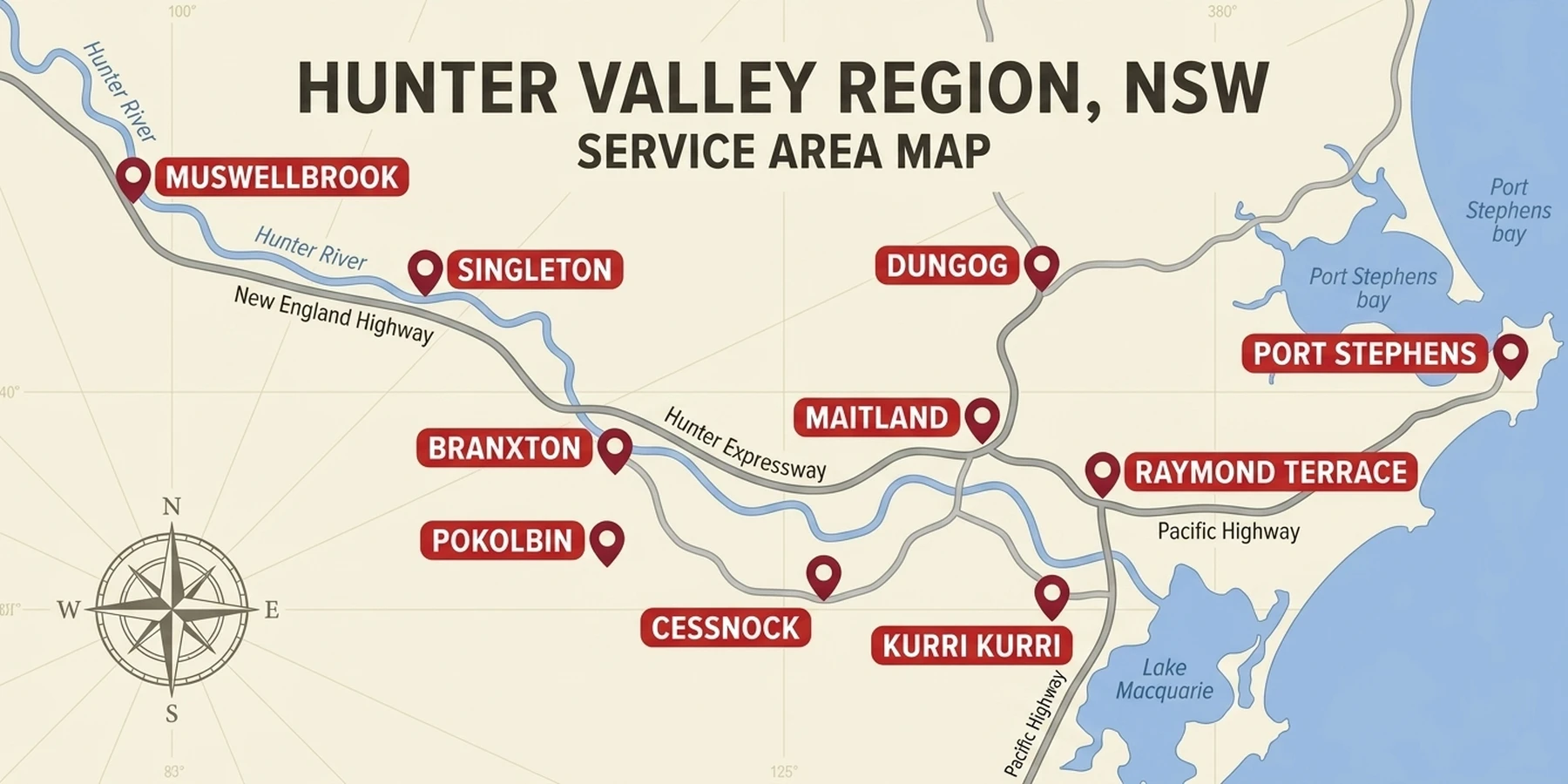
The Hunter Valley is one region with seven councils, two kinds of sewer authority and three very different kinds of ground to put a septic system in. The state law is the same everywhere: every on-site system needs a council approval under section 68 of the Local Government Act 1993, and the conditions in clause 45 of the Local Government (General) Regulation 2021 apply to all of them. How each council runs its approvals, what it charges, how often it inspects and what the soil does to your trench vary a great deal between Maitland and Muswellbrook, or between Medowie and Millfield.
Hunter Valley Septic runs septic pump-outs, quarterly AWTS servicing, inspections, tank repairs and trench diagnostics across the Lower and Upper Hunter, with no travel surcharge across the Maitland, Cessnock, Singleton and Port Stephens service corridors. This page is the map: who regulates what, where the sewer stops, what the ground is like, and where to go for the detail on your own town. Call 0468 278 123 to book anywhere in the region.
Where the sewer stops
Hunter Water serves the Cessnock, Dungog, Lake Macquarie, Maitland, Newcastle and Port Stephens council areas and a small part of Singleton’s. By Hunter Water’s own count 96 per cent of Lower Hunter homes have both its water and its sewer, leaving roughly 2,500 lots in 22 townships (North Rothbury, Hexham and Raworth the largest) with town water and no sewer. Those owners pay no Hunter Water wastewater charge, and they should not expect a connection: Hunter Water has ruled out backlog sewer extensions for now, because under the pricing regulator’s method the owners would pay most of the bill, which it puts at more than $60,000 to $100,000 a property in many cases.
Singleton, Muswellbrook Shire and Upper Hunter Shire councils run their own water and sewer for their towns (Singleton, Muswellbrook, Denman, Scone, Aberdeen, Murrurundi and Merriwa). Everything outside those town footprints, and every village Hunter Water does not reach, is on an on-site system: a septic tank, an AWTS, a pump-out tank or a pump-to-sewer setup. The numbers are large: more than 4,600 systems in Port Stephens, about 3,500 in Dungog Shire, more than 2,500 unsewered homes in Upper Hunter Shire, and around 1,850 on Maitland City Council’s books as of 2015.
The test for any property is the Hunter Water bill (no wastewater charge) plus the rates notice (a council on-site sewage charge).
Three soil zones and what they do to a trench
The river flats. Maitland, Morpeth, Hinton, Woodville and the land around Raymond Terrace sit on Hunter River alluvium that floods. The Hunter Valley Flood Mitigation Scheme, built after the 1955 flood killed 14 people, has been tested in 2007, 2015, 2022 and May 2025 among other years. Councils rate a flood-liable system as high risk, and the NSW Office of Local Government’s guidelines want tanks and electrics above the 1-in-100-year level and disposal areas above the 1-in-20.
The coalfields clay. Cessnock, Kurri Kurri, Pokolbin, Greta and the villages between them sit on clay that will not let water through. Clay with weak structure is the high-risk soil class in every Hunter council’s risk table; a trench in it stays wet for weeks after the late-summer rain and clogs for good once solids reach it. Cessnock now requires any new unsewered lot to be at least 4,000 m².
The coastal sands. Medowie, Salt Ash, Williamtown, Bobs Farm, Tomago and Karuah sit on sand over the Tomago Sandbeds and beside Grahamstown Dam, which together supply most of the Lower Hunter’s drinking water. Sand drains fast and treats poorly, moving effluent to the water table quickly, so the Grahamstown, Tomago Sandbeds and Nelson Bay catchments are special areas under the Hunter Water Regulation 2024, where an on-site system is lawful only with a council approval. The same applies to the Williams River and Chichester catchments in Dungog Shire.
Beyond those three, the Upper Hunter around Singleton and Muswellbrook has black soils and hot dry summers (about 600 to 650 mm of rain a year against 1,130 mm on the coast), and Dungog’s hills are steep, wet and prone to perched water tables. Each town page below covers its own ground.
How the seven councils compare
| Council | Approval to operate | Inspection cycle | Annual charge (2026-27) |
|---|---|---|---|
| Maitland City | 2, 4 or 5 years by risk; renewal inspection application at expiry; not transferable, renew within 3 months of purchase | With each renewal, plus random | $119.35 admin charge |
| Cessnock City | Conditioned approval; renewal or extension $104.00; reissued to buyer after Land Registry notice | Risk-based, routine inspections free | Levied on rates (amount not published in a quotable form) |
| Singleton | 12 months, extended each July if no issues | 1, 3, 5-plus years, or 10-year self-assessment | Set in Council’s fees and charges |
| Port Stephens | 12 months, 1 September to 31 August, renewed on the rates notice | 1, 2, 3 or 5 years; serviced secondary systems by exception | $140.00 |
| Dungog Shire | 12 months, 1 July to 30 June, renewed on the rates notice; reissued to buyer on request | Annual to 5 years by hazard class; serviced secondary systems by exception | $145.60 |
| Muswellbrook Shire | Annual, on rates; free renewal inspection for registered systems | Inspection required if none in 10 years | $65.00 |
| Upper Hunter Shire | Annual, on rates, covering one inspection | 1, 2 to 3 or 5 years by buffer-distance compliance | $81.50 |
Every council now takes applications to install or alter a system through the NSW Planning Portal or its own section 68 form, and each wants the system’s NSW Health accreditation, a site plan with buffer distances to waterways, bores and boundaries, and a site and soil assessment where effluent is disposed of on site. Cessnock requires quarterly AWTS service reports within seven days; the state guideline elsewhere is 14 days. Operating a system without an approval carries a maximum court penalty of 20 penalty units ($2,200) and an on-the-spot penalty notice of $330.
What is the same everywhere
Whichever council you are under, the obligations in clause 45 of the Regulation come with the approval: keep the system in a sanitary condition, never discharge anywhere but the approved application area, comply with the NSW Health accreditation conditions of an AWTS (which is where quarterly servicing comes from), and give council evidence of compliance when it asks. Desludging guidance is statewide too: the Office of Local Government’s trigger is sludge and scum at one-third of tank depth, roughly every 3 to 5 years for a household in full-time occupation. And the approval belongs to the owner, not the land; a buyer can operate the existing system for 3 months after settlement and, if they apply within 2 months, until council decides.
Our prices are the same across the region too: routine pump-outs at $350 to $500 up to 3,000 litres, $400 to $650 for 3,500 to 4,500 litres and $650 to $900 above 5,000 litres; AWTS servicing at $90 to $150 a visit with the report sent to your council; inspections at $250 to $450 for a council compliance audit and $250 to $500 for a pre-purchase report. Access, not distance, is what changes a price, and every modifier is quoted first. The waste goes, under NSW EPA waste rules, to a licensed treatment works that has agreed to take it, and every load comes with a disposal docket. Installing systems, building trenches and working on sanitary pipework is licensed plumbing and drainage work; it is carried out by licensed plumbing and drainage contractors we work with, and their NSW licence number appears on every quote.
Your town
- Maitland: the floodplain, the sewered edges and Maitland’s 2, 4 and 5-year approvals.
- Cessnock: coalfields clay, the 4,000 m² rule and Cessnock’s two-stage approval process.
- Kurri Kurri: where the sewer ends, and what a first-time acreage buyer should check.
- Pokolbin: cellar doors, weddings and holiday lets on holding tanks and engineered systems.
- Branxton: two councils, Hunter Water sewer in town and Huntlee’s private network.
- Singleton: big blocks, long hose runs, council-run sewer and a 10-year self-assessment tier.
- Muswellbrook: Upper Hunter heat, horse country, and the Upper Hunter Shire difference.
- Dungog: the Williams River drinking-water catchment, steep blocks and 3,500 systems.
- Port Stephens: sand, the Tomago Sandbeds and Grahamstown catchments and 4,600 systems.
- Raymond Terrace: the rural belt, two rivers, Grahamstown Dam and the Williamtown zones.
Frequently Asked Questions
Which council regulates my septic system?
The council that sends your rates notice. Boundaries cut through the region in unexpected places: Branxton is Singleton Council while Greta is Cessnock; Hinton and Wallalong carry Maitland postcodes but are Port Stephens; Scone is Upper Hunter Shire, not Muswellbrook.
How do I know if I am on septic or sewer?
No wastewater service charge on your Hunter Water bill (or no sewer charge from Singleton, Muswellbrook or Upper Hunter council) plus an on-site sewage charge on your rates notice means you are on an on-site system. A concrete lid or an AWTS control box settles it.
Is the law the same across the Hunter?
The state law is: section 68 approvals, clause 45 conditions, NSW Health accreditation and the 20-penalty-unit maximum for operating without approval. What differs is each council’s approval term, fees, inspection cycle and reporting deadlines, which the table above summarises and the town pages explain.
Do the drinking-water catchments ban septic tanks?
No. The Hunter Water Regulation 2024 prohibits on-site systems in the Grahamstown, Tomago Sandbeds, Nelson Bay, North Stockton, Williams River and Chichester special areas except under a development consent, a Local Government Act approval or an environment protection licence. An approved, maintained system is lawful; an unapproved one breaches two laws.
How often should a Hunter Valley septic tank be pumped out?
The NSW guideline is to desludge once sludge and scum reach one-third of tank depth, commonly every 3 to 5 years for a full-time household. Councils across the region give the same range. Occupancy and tank size set where in that range you fall; we measure at each visit.
Is there a travel charge for outlying towns?
No travel surcharge applies across the Maitland, Cessnock, Singleton and Port Stephens service corridors. What changes a price is access: hose runs beyond 45 metres, lids buried more than 300 mm without risers, or hardened sludge in a tank not pumped in seven or more years, each quoted before we start.
Ready to book a pump-out, AWTS service or inspection anywhere in the Hunter Valley? Call 0468 278 123 or use the booking form with your town and how the truck gets to the tank. Expect a call back within 24 hours in business hours; routine pump-outs usually go on the run within 48 hours.
Request Received!
Thank you for reaching out. Our Hunter Valley dispatch team will call you back promptly to confirm details and provide an upfront quote.
Call us directly on 0468 278 123