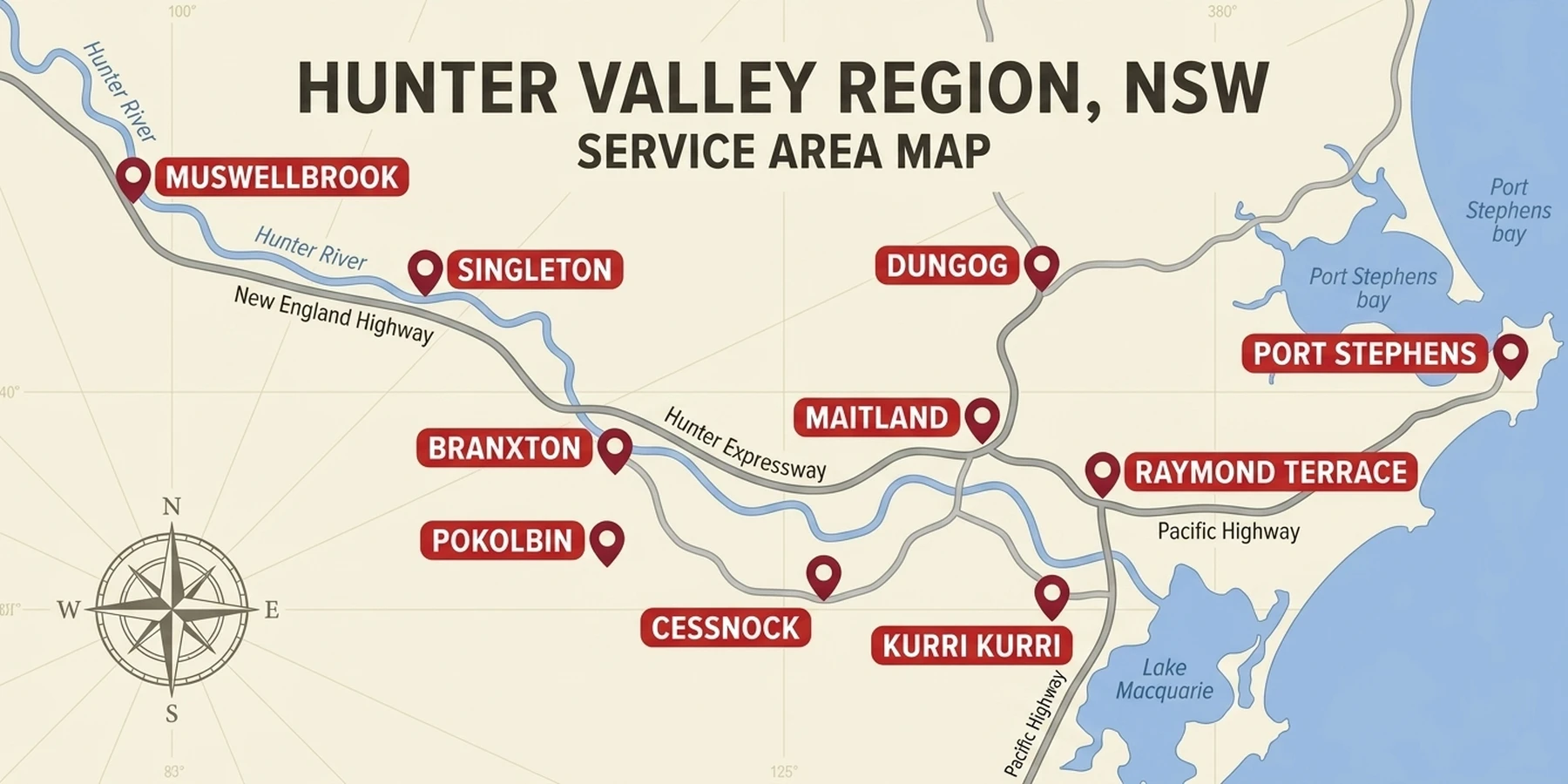
Cessnock has the largest spread of unsewered villages in the Lower Hunter. Hunter Water runs sewer to Cessnock town, Kearsley and Paxton, but the coalfields settlements and the bush blocks that fan out from them, Bellbird, Aberdare, Abernethy, Kitchener, Millfield, Ellalong, Mulbring, Mount Vincent, Brunkerville, Wollombi, Laguna, Paynes Crossing, Sweetmans Creek, Cedar Creek, Neath and Sawyers Gully, run on septic tanks and aerated wastewater treatment systems (AWTS). The soils are hard on trenches, the lots are often small, and Cessnock City Council has one of the most fully documented approval processes in the region.
Hunter Valley Septic services Cessnock and its villages with pump-outs, quarterly AWTS servicing, inspections and trench diagnostics. Kurri Kurri, Pokolbin and Greta are also in the Cessnock local government area and have their own pages: Kurri Kurri, Pokolbin and Branxton. Call 0468 278 123 to book.
Clay, small lots and the 4,000 square metre rule
The Hunter councils that publish risk tables treat two soil types as high risk for on-site systems: sand, and clay with weak or massive structure. Much of the coalfields country falls into the second group. Clay that will not let water through means an absorption trench sits wet for weeks after Cessnock’s late-summer rain (Cessnock Airport averages 743 mm a year, with February the wettest month at 99 mm and July the driest at 36 mm), and a trench that stays saturated lets solids and biomat seal the soil for good. That is the failure our trench diagnostics service exists to catch early, and it is why councils on these soils generally look for secondary treatment and a designed application area rather than a plain trench on a new build.
Lot size is the other constraint. Since 2023, clause 4.1E of the Cessnock Local Environmental Plan 2011 stops Council approving any subdivision that will not be sewered unless every resulting lot is at least 4,000 m² and suitable for on-site sewage management. Existing village lots are often far smaller than that, which is why Council’s fees distinguish lots up to 4,000 m² from larger ones, and why the 2,000 m² and 4,000 m² thresholds recur in Hunter council risk ratings. Cessnock also requires each dwelling of a dual occupancy to have its own system; two houses cannot share one tank.
For an owner, the practical meaning is simple. On a small clay block the tank is doing more of the work than it would on a big sandy loam, so sludge depth matters more, and the 3-to-5-year pump-out interval Council itself recommends is a maximum, not a target.
How Cessnock City Council’s approval process works
Cessnock accepts on-site sewage management applications only through the NSW Planning Portal, as a section 68 approval under the Local Government Act 1993. One combined application produces two separate approvals: an approval to install or alter, and then, after a satisfactory final inspection, an approval to operate. Both are separate from any development application, and the system cannot be used until the approval to operate is issued.
The application needs Council’s on-site wastewater declaration and owner’s consent form, the documents on Council’s application checklist, and, where effluent is disposed of on site, a site and soil assessment report. Council assigns the file to an environmental health officer after payment and inspects at stages set as conditions of the approval to install; the owner or installer books each inspection directly with Council.
Council’s 2026-27 fees for a single dwelling are $770.00 for lots up to 4,000 m² and $539.00 for larger lots, plus $452.00 covering up to three post-approval inspections (external plumbing, tank and disposal area, final), with each extra inspection $181.00. Commercial systems are scaled by treatment capacity, from $770.00 for up to 2,000 litres a day. A minor amendment to an approval is $176.00; a significant alteration is half the new-system fee.
Once the system is running, the approval to operate sets out the conditions of operation, including maintenance. Council runs risk-based routine inspections of existing systems, notifies owners in advance, does not require you to be there, and sends a written report afterwards describing any problem, the options and an agreed time frame. There is no charge for a periodic routine inspection of a residential system; a re-inspection is $181.00, and that fee expressly covers inspections that arise from a failure to act on the requirements of a quarterly AWTS service report. Renewing or extending an approval to operate costs $104.00 in 2026-27. When a property is sold, Council reissues the approval to the new owner once NSW Land Registry Services sends it the notice of transfer; the buyer does not lodge a fresh application.
AWTS servicing in Cessnock: the seven-day rule
If you own an AWTS anywhere in the Cessnock local government area, Council states that quarterly servicing by a suitably qualified service technician is a requirement of both the NSW Health accreditation of the system and your approval to operate, and that the owner or service agent must submit a service report to Council within seven days of each service. Cessnock’s preferred channel is electronic lodgement through its on-trac platform for registered service agents, and it intends to phase out paper and email methods that cannot meet the seven-day window.
That is what our AWTS servicing does in Cessnock: a quarterly service at $90 to $150 a visit ($360 to $600 a year) covering the NSW Health minimum checks, chlorine top-up, blower and pump tests and the alarm, with the service report sent to Cessnock City Council within the seven days. If the report lists a defect, act on it; the $181 re-inspection fee is Council’s way of saying it reads the reports.
What needs approval, and what does not
Cessnock is unusually clear about the line between maintenance and alteration. Replacing components like for like, repairing cracks or resealing a tank, pump-outs and restocking chlorine do not need a new approval. Changing the treatment system, moving the disposal area, changing the disposal method (underground to surface irrigation, say) or altering the connected sanitary drainage is an alteration that needs section 68 approval first, and Council cannot grant retrospective approval for unauthorised work. An unapproved system is regularised through an application for approval to operate an existing system, charged at the new-system fee, and Council says it prefers a conciliatory approach where the owner is proactively fixing things.
Our side of that line is the maintenance: pump-outs, AWTS servicing, inspections, lids, risers, effluent filters, pumps, alarms and jetting of existing trenches. Trench construction and rebuilds, distribution boxes and sanitary pipework are plumbing and drainage work in NSW and are carried out by licensed plumbing and drainage contractors we work with; their NSW licence number appears on every quote. If you connect to sewer and decommission a tank, Council requires a licensed plumber and a notice of decommission, after which it removes the annual approval-to-operate charge from your rates.
Pump-outs across the villages
Most Cessnock village tanks are older concrete units of 3,000 to 4,500 litres. A routine pump-out is $350 to $500 up to 3,000 litres and $400 to $650 for 3,500 to 4,500 litres, with no travel surcharge across the Cessnock corridor. The recurring extras on coalfields blocks are buried lids (many were lawned over decades ago; excavation beyond 300 mm adds $75 to $150, and a riser at $250 to $450 ends it) and hose runs beyond 45 metres on the bush blocks around Wollombi, Laguna and Cedar Creek ($50 to $120). On saturated clay we may suggest holding a routine pump-out for a few days after heavy rain.
The waste is transported and disposed of under NSW EPA waste rules at a licensed treatment facility that has agreed to accept it, with a disposal docket for every load. Keep the docket: Council’s written inspection reports and your approval conditions both turn on evidence of maintenance.
Frequently Asked Questions
Which parts of Cessnock are on sewer?
Hunter Water operates wastewater treatment works at Cessnock, Kearsley and Paxton, so those town areas are sewered; enquiries about connection go to Hunter Water on 1300 657 657. The surrounding villages and rural blocks are on on-site systems, and Council levies an annual approval-to-operate charge on those properties through the rates notice.
How often do I have to pump out a septic tank in Cessnock?
Cessnock City Council tells owners to have the tank or treatment plant pumped out every three to five years, to keep vehicles and large animals off the system, and to keep mechanical systems serviced. On small clay blocks we measure sludge at each visit and set the next date from the depth rather than the calendar.
Do I need council approval to replace a broken lid or a pump?
No. Cessnock allows like-for-like component replacement, crack repairs, resealing, pump-outs and chlorine restocking without a new approval. Changing the system, the disposal area or the disposal method does need section 68 approval first.
What happens if I miss a quarterly AWTS service report?
The report is due to Council within seven days of each service as a condition of your approval to operate. Failing to act on a report’s requirements can trigger a $181 re-inspection, and operating outside the approval conditions is an offence under the Local Government Act. A service contract with the report sent after every visit is the easy fix.
I am buying in Millfield. Do I have to apply for a new approval?
Not in Cessnock. Council updates the owner details and reissues the approval to operate to you once Land Registry Services notifies it of the transfer. Do ask the vendor for the service reports and pump-out dockets, and consider a pre-purchase inspection before exchange.
Can I subdivide my unsewered block?
Only if every resulting lot is at least 4,000 m² (or larger if the Lot Size Map says so) and suitable for on-site sewage management, under clause 4.1E of the Cessnock LEP 2011. Talk to Council’s planning staff before spending money on a wastewater report.
Ready to book a pump-out, AWTS service or inspection in Cessnock? Call 0468 278 123 or use the booking form with your suburb and a note about tank access. We call back within 24 hours during business hours, and most routine pump-outs are scheduled within 48 hours.
Request Received!
Thank you for reaching out. Our Hunter Valley dispatch team will call you back promptly to confirm details and provide an upfront quote.
Call us directly on 0468 278 123