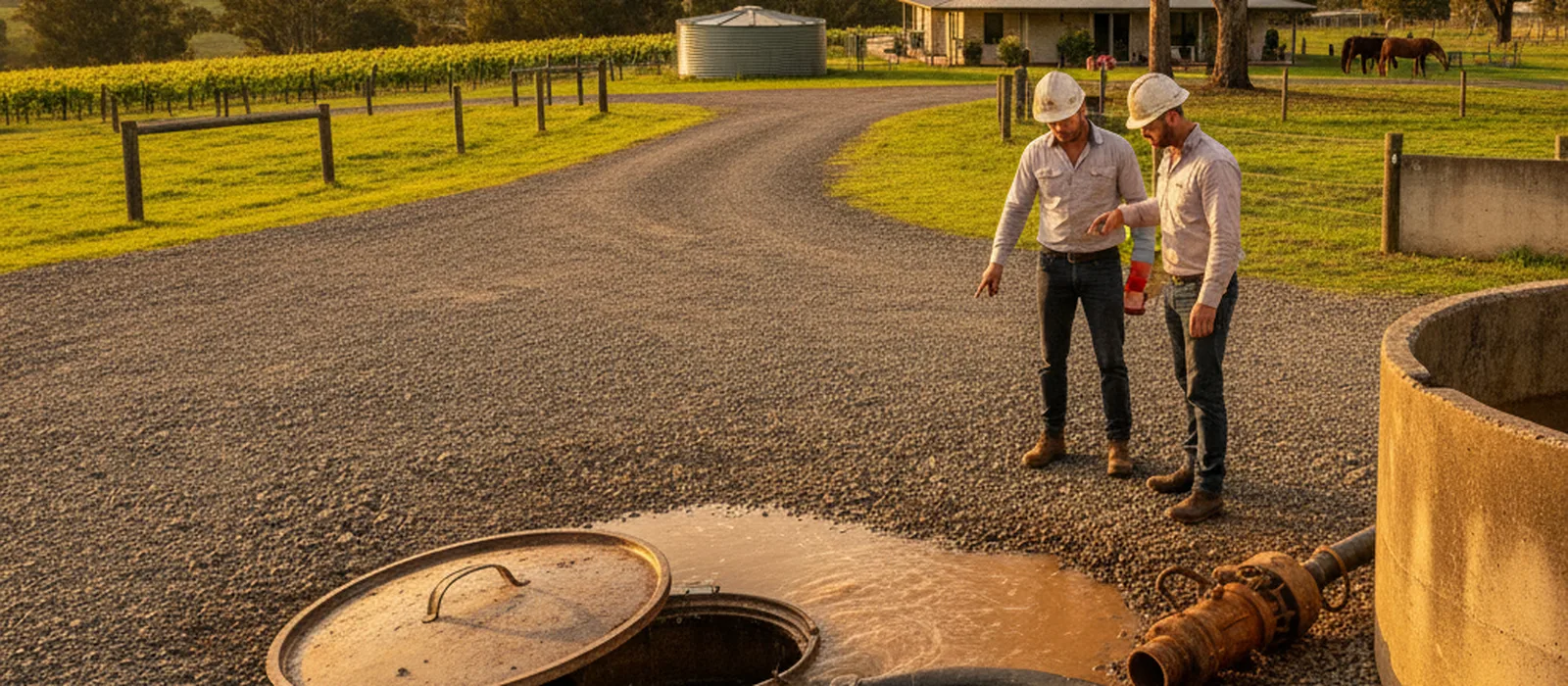
BioCycle Septic System: A Hunter Owner’s Guide to Models, Servicing and Parts
A BioCycle septic system is an aerated wastewater treatment system (AWTS), not a plain septic tank. It settles solids in a primary chamber, then aerates, clarifies and chlorinates the liquid and pumps the treated water out to garden irrigation. Four BioCycle models currently hold NSW Health accreditation, all rated for up to 10 people, in concrete or poly, one-tank or twin-tank.
If you own one, it needs a service every three months by an agent the manufacturer has authorised, a report to your council after each visit, and a desludge of the primary chamber every 3 to 5 years. Most faults trace back to a short list of parts: the air blower, the irrigation pump, the chlorinator and the alarm.
If you’re still comparing brands, our AWTS brands comparison covers the rest of the field. This guide is for BioCycle owners.
BioCycle vs a septic tank
A conventional septic tank holds wastewater long enough for solids to settle, then lets partly treated effluent run to an absorption trench. No power, no chlorine, no service contract.
A BioCycle adds a stage in the middle. An air blower runs around the clock, feeding oxygen into an aeration chamber where aerobic bacteria break down what the primary chamber left behind. The cleaner, disinfected water can then go onto your garden through sprinklers or drippers, or below the surface through subsurface irrigation, instead of soaking away in a gravel trench.
That extra treatment comes with obligations: power to the blower and pump, chlorine in the chlorinator, and a quarterly service on top of the pump-outs both systems need. Our septic tank vs AWTS comparison covers which suits which block. On heavy clay around Maitland or Cessnock, where trenches struggle to absorb, spreading treated water over an irrigation area can be the reason an AWTS was chosen.
BioCycle models on the NSW Health register
NSW Health accredits AWTS designs under the Local Government (General) Regulation 2021, and a council can only approve a new install of an accredited design. These are the four BioCycle entries on the register as we checked it on 28 September 2026 (the page is marked current as at 22 September 2026).
| Model on the register | Tanks | Certificate | Expires | Notes from the certificate |
|---|---|---|---|---|
| BioCycle Pro Concrete 1500 Advanced | One concrete tank | STS-AWTS075 | 31 December 2029 | 7,000 litre tank; Medo LA80B air blower or equivalent |
| BioCycle Pro Poly 1500 Advanced | One poly tank | STS-AWTS076 | 31 December 2029 | Poly version of the one-tank Pro |
| BioCycle Twin Tank Poly Advanced Nutrient Reduction | Two poly tanks | STS-AWTS079 | 31 December 2030 | Hiblow HP80 air blower or equivalent; septic tank feeding a treatment tank |
| BioCycle Twin Tank Concrete Advanced Nutrient Reduction | Two concrete tanks | STS-AWTS080 | 31 December 2030 | Concrete version of the twin-tank NR design |
All four are accredited to the “advanced secondary” effluent standard under AS/NZS 1546.3:2017, and the twin-tank models also carry a nutrient reduction (NR) rating. For the Twin Tank Poly, the certificate reports testing showed total nitrogen down 36.7% and total phosphorus down 7%. If your block drains toward a creek or the Hunter or Williams rivers, ask your council whether an NR model is a condition before you choose.
Two things the register won’t tell you. An older BioCycle installed years ago may not match any model above; it keeps running under the approval your council gave it at the time. And the register holder for all four is Eco-septic Pty Ltd, trading as BioCycle, at Warragamba in western Sydney, while the BioCycle website lists a head office in South Australia and says agencies are available in NSW, Victoria and Queensland. For warranty questions, start with whoever sold and commissioned your unit, and check the model plate.
How the chambers work
The clearest description of a BioCycle’s insides is Schedule 1 of its NSW Health certificate. Here’s the one-tank BioCycle Pro Concrete 1500, following the wastewater from the house.
Primary treatment. Sewage flows by gravity into a 3,000 litre primary chamber, split by a partition. Solids settle, fats and scum float, and anaerobic bacteria start breaking the solids down. This part behaves like an ordinary septic tank, and it’s the part that fills with sludge.
Aeration. The liquid moves into an aeration chamber of about 2,231 litres holding filter media, a surface for bacteria to grow on. The blower pushes air to two aeration legs near the base, and the oxygen lets aerobic bacteria do most of the cleaning. This is why the blower must keep running.
Clarifier. Treated water passes into a 465 litre clarifier, where remaining solids settle. Two airlift devices, driven by the same blower, return those solids and some partly treated water to the inlet of the primary chamber. If that sludge return stops, solids build up where they shouldn’t.
Disinfection. A chlorine unit on the clarifier outlet disinfects the water on its way out. BioCycle says the technician replaces the chlorine tablets at each three-monthly service if needed.
Pump-out chamber. A submersible pump in the final 370 litre chamber sends the water to your irrigation area. The certificate sets a minimum of 2.0 cubic metres an hour at 7 metres of head.
The concrete Pro also has 1,285 litres of emergency storage above the normal water level, so there is some room if the pump stops. The alarm, a panel or strobe, signals air problems and water problems separately and has a 24-hour mute. BioCycle puts the alarm panel inside the house.
The twin-tank NR models split the same job over two tanks: a septic tank first (for the poly version, the certificate names an Everhard 3,000 litre or Reln 3,200 litre twin septic tank), then a treatment tank holding the aeration chamber, clarifier and pump chamber.
BioCycle and Econocycle EcoPro: same company, same specification on paper
Both brands are registered in NSW to Eco-septic Pty Ltd at Warragamba, with the same contact person and the same website, econocycle.com.au. We put the two concrete one-tank certificates side by side. The BioCycle Pro Concrete 1500 (STS-AWTS075) and the EcoSeptic EcoPro Advanced Concrete (STS-AWTS041) have identical Schedule 1 specifications: the same 7,000 litre tank, chamber volumes, blower and pump requirements, and the same tank drawing number under different logos. Both were issued on 23 September 2024 with the same expiry. The other three pairs match the same way: BioCycle Pro Poly 1500 and ECO PRO Poly (STS-AWTS076 and 051), and the Twin Tank Poly and Concrete NR models (STS-AWTS079 and 077, 080 and 078), each pair issued on the same day with the same Schedule 1.
For you, that means servicing is the same job, and parts for one model are likely to suit its twin under the other name. We haven’t found a company statement that every component is interchangeable across all models and years, so match parts to the model plate, not the brand on the lid. We service both.
The published warranties differ. BioCycle’s website offers 15 years on the system and 24 months on electrical items, or 36 months if BioCycle does the servicing, from commissioning. Econocycle’s website offers 15 years on tanks, 2 years on spare parts and two free services with a new tank. A BioCycle owner FAQ still on the BioCycle site, issued under the name JOWA Group Pty Ltd, lists shorter terms again: 5 years on tanks and 2 years on pumps, blowers and pipework. Your installer’s paperwork is what counts.
Servicing a BioCycle: what the certificate requires
The conditions on a BioCycle’s certificate are applied by your council to your approval to operate. In plain terms:
- You need a service agreement with a service agent for at least 12 months at a time.
- The system must be serviced every three months once commissioned.
- The agent must be employed or authorised by the manufacturer, use replacement parts that meet the model’s minimum specification, and send a completed NSW Health service report to your council after every service.
- You can’t service it yourself unless you’re an authorised agent of the manufacturer.
Each quarterly service must check, at minimum, the chlorinator, pump and air blower, alarm, slime growth on the filter media, sludge return system and irrigation area, with on-site tests for free chlorine, pH and dissolved oxygen. The report form also asks whether desludging is needed, which is how you learn the primary chamber is filling before it causes trouble.
Our quarterly AWTS servicing is $90 to $150 a visit ($360 to $600 a year), covering chlorine replenishment, the sludge test and blower filter cleaning, and we send the service report to your council after each visit.
Separately, the primary chamber needs a desludge every 3 to 5 years, depending on household size and the sludge test. A full AWTS desludge and pump-out is $450 to $750. The waste is transported and disposed of under NSW EPA waste rules at a licensed treatment facility; a disposal docket is provided for every load. Keep it with your service reports, since your council can ask for both.
BioCycle spare parts and common faults
The certificate allows “alternate individual mechanical and electrical components such as pumps” provided they meet the accredited design specification, so a BioCycle isn’t tied to one brand of blower or pump for life. The concrete Pro names a Medo LA80B or equivalent, rated for a nominal 80 litres a minute at 1.3 metres of water depth; the twin poly NR names a Hiblow HP80 or equivalent. Econocycle says its spare parts division covers pumps, air blowers, filters, control panels and diffusers. Let your service agent order, because whatever goes in has to meet the model’s specification.
We diagnose before we replace. If a worn blower diaphragm or a stuck float switch is the problem, that’s the fix.
| What you notice | Likely cause | Typical cost to fix |
|---|---|---|
| Alarm sounding, blower silent or weak, odour | Blower failed or its diaphragm has worn | Diaphragm service kit $120 to $250; blower replacement $650 to $1,400 installed |
| High-water alarm, irrigation area dry | Irrigation pump failed or float switch stuck | Pump replacement $600 to $1,200 installed; float switch repair $250 to $650 |
| Service report flags low chlorine or poor effluent | Chlorinator empty or blocked | Handled at the quarterly service ($90 to $150 a visit) |
| Odour, solids in the clarifier, report says desludge | Primary chamber full or sludge return not keeping up | Full AWTS desludge $450 to $750 |
| Soggy or smelly irrigation area | Pump or sprinkler fault, overloading, or solids carrying over | Inspect first; the fix depends on the cause |
Blower. Without air, the aerobic stage stops doing its job and the system usually starts to smell. Don’t mute the alarm and forget it. AWTS air blower replacement costs covers the choice between a diaphragm kit and a new unit.
Irrigation pump. When the pump fails, the pump chamber fills and the high-water alarm trips. The emergency storage buys a little time, but cut back on showers, washing and the dishwasher until it’s fixed. An active high-water alarm gets a same-day or next-morning response from us.
Alarm. Because a BioCycle separates air faults from water faults, the alarm narrows things down quickly. The general causes are in why an AWTS alarm beeps. A tripped power point or a unit switched off at the wall is a cheap cause, so check that first. And don’t switch the system off when the house is empty; the bacteria depend on the air.
Under the certificate, electrical work on the system must be done by a licensed electrician. Work on the tanks, the pipework from the house or the irrigation lines is carried out by licensed plumbing and drainage contractors we work with; their NSW licence number appears on every quote.
BioCycle septic system prices
We don’t quote a price for a BioCycle unit on its own. Unit prices vary by model and supplier, so ask the manufacturer or your installer.
The whole job is the number that matters anyway. A complete AWTS installation through a licensed contractor falls in our published range of $15,000 to $25,000 or more. Every install starts with a site and soil assessment and ends with a fixed written quote. The septic replacement cost estimator gives a rough figure for your own block.
After install, budget for quarterly servicing ($360 to $600 a year), a desludge every 3 to 5 years ($450 to $750), power for the blower and pump, and the occasional part. Neither brand publishes a wattage for these models (the BioCycle owner FAQ only compares a year’s power use to a 100 watt light bulb left on), so ask your service agent rather than trusting a guess.
If your BioCycle service has lapsed or the alarm is going, call 0468 278 123 and tell us the model on the plate, or ask us to book an inspection.
Frequently Asked Questions
What is a BioCycle system?
A BioCycle is an aerated wastewater treatment system (AWTS) that treats household wastewater through primary settling, aeration over filter media, clarification and chlorine disinfection. The treated water is pumped to garden irrigation rather than soaking into an absorption trench. Four BioCycle models currently hold NSW Health accreditation, all rated for up to 10 people.
What is the difference between a septic tank and a BioCycle?
A septic tank only settles solids and releases partly treated effluent to a trench, with no moving parts or power. A BioCycle does the same settling in its primary chamber, then aerates, clarifies and disinfects the water so it can be used for irrigation. That means it needs power, chlorine and a service every three months, on top of the desludging both systems need every 3 to 5 years.
How often does a BioCycle need servicing?
Every three months once it’s commissioned, as a condition of its NSW Health accreditation that your council applies to your approval to operate. You need a service agreement of at least 12 months with an agent authorised by the manufacturer, and the agent reports to your council after each visit. Quarterly servicing with us is $90 to $150 a visit.
Is a BioCycle the same as an Econocycle EcoPro?
Both are registered in NSW to the same company, Eco-septic Pty Ltd at Warragamba. The NSW Health certificates for the BioCycle Pro Concrete 1500 and the EcoPro Advanced Concrete list identical specifications, including tank size, chamber volumes, and blower and pump requirements, and the poly and twin-tank pairs match the same way. They remain separate accreditations, so your council approval names one certificate. Treat them as the same design for servicing, but match any replacement part to the model plate on your own tank.
Where can I get BioCycle spare parts?
Your authorised service agent should source them, because the certificate requires replacement parts to meet the model’s minimum specification. Econocycle, the other brand of the company that holds the NSW BioCycle registrations, says it supplies pumps, air blowers, filters, control panels and diffusers. Equivalent pumps and blowers are allowed if they meet the accredited design specification.
How much does a BioCycle septic system cost?
Unit prices vary by model and supplier, so ask the manufacturer or your installer for the tank itself. A complete AWTS installation through a licensed contractor typically runs $15,000 to $25,000 or more, with a fixed written quote after a site and soil assessment. Ongoing costs are quarterly servicing at $360 to $600 a year plus a $450 to $750 desludge every 3 to 5 years.
Sources and further reading
- NSW Health, Aerated wastewater treatment systems register: BioCycle and Econocycle/EcoSeptic models, certificate numbers, expiry dates, and the Eco-septic Pty Ltd Warragamba registration for both brands (page current as at 22 September 2026; checked 28 September 2026).
- NSW Health, Certificate STS-AWTS075, BioCycle Pro Concrete 1500 AWTS: chamber layout and volumes, blower and pump specification, emergency storage, alarm, servicing conditions, quarterly service checklist, component substitution.
- NSW Health, Certificate STS-AWTS041, EcoSeptic EcoPro Advanced Concrete AWTS: specification compared side by side with STS-AWTS075.
- NSW Health, Certificate STS-AWTS079, BioCycle Twin Poly Advanced Nutrient Reduction AWTS: twin-tank layout, septic tank options, Hiblow HP80 blower, nitrogen and phosphorus reduction figures.
- NSW Health certificates STS-AWTS076, STS-AWTS080, STS-AWTS051, STS-AWTS077 and STS-AWTS078: the remaining BioCycle and EcoSeptic certificates, compared pair by pair.
- BioCycle, What is a BioCycle?: the manufacturer’s description of its chambers and treatment process.
- BioCycle, Residential domestic wastewater systems: irrigation options, three-monthly servicing and chlorine tablets, indoor alarm, current warranty terms.
- BioCycle, Contact: South Australian head office and agency opportunities in NSW, Victoria and Queensland.
- BioCycle, Owner FAQ (PDF): JOWA Group warranty terms and the light-bulb power comparison.
- Econocycle, home page: Warragamba base, spare parts range, tank and spare-parts warranty, two free services with a new tank.
Request Received!
Thank you for reaching out. Our Hunter Valley dispatch team will call you back promptly to confirm details and provide an upfront quote.
Call us directly on 0468 278 123