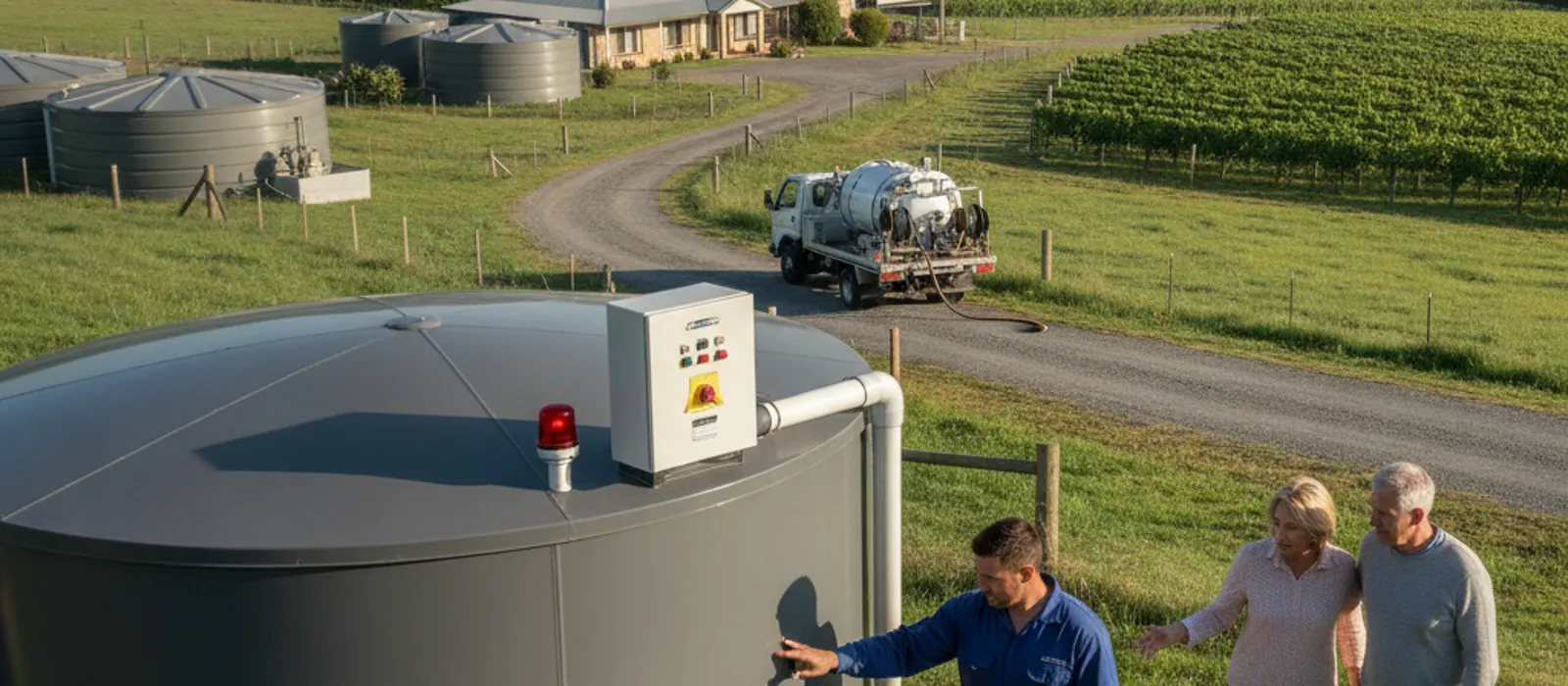
AWTS Alarm Keeps Beeping? What the Red Light Means and What to Do
The red light came on late on a Friday, the beeping woke the whole house, and someone pulled the fuse at the switchboard so everyone could get some sleep. Seven weeks later that system needed a $1,150 air blower and a $580 desludge, because nothing about the original fault had gone away while the power was off.
If your AWTS alarm keeps beeping, the control box has worked out that one of two things has stopped happening. Either air is no longer reaching the aeration chamber, or water is no longer leaving the system. Both are usually fixable for a few hundred dollars in the first week. Neither is fixed by silencing the buzzer.
What the Red Light Is Actually Telling You
Most aerated wastewater treatment systems sold in NSW, including the Fuji Clean, Taylex, Biocycle, Ecomax and Envirocycle families, run a single alarm circuit off the control box. One buzzer, one red lamp, and five or six possible faults sitting behind them.
That is the part homeowners find maddening. The lamp tells you the system has dropped out of normal operation. It does not tell you which component gave up.
Almost every control box has a mute or silence button that stops the buzzer and leaves the red lamp on. Using it is fine. Switching the whole circuit off at the board is not, because the blower and the irrigation pump go off with it while the tank keeps filling.
A muted alarm is a reminder that something is waiting on you. A powered down control box is an untreated system quietly sending poorly treated effluent to your irrigation area.
If the lamp has been on for more than a day, call 0468 278 123 and we will narrow it down over the phone before anyone drives out.
Five Faults Behind an AWTS Alarm That Keeps Beeping
1. A failed air blower or a perished diaphragm
This is the most common cause by a wide margin. The linear diaphragm blower runs 24 hours a day, every day, and the rubber diaphragms inside it are a wear part. In Hunter Valley conditions, with summer heat and dust off gravel driveways, two to four years is a realistic life.
You will usually hear it before the alarm tells you. A healthy blower makes a steady low hum. A failing one rattles, buzzes at a higher pitch, or goes silent. Within a few days of the air stopping, the effluent turns grey and the smell changes from earthy to sour.
A diaphragm service kit runs $120 to $250. A full blower replacement is $650 to $1,400 installed, depending on the model and the output rating your system needs. There is more detail on what drives that range in our guide to AWTS air blower replacement cost.
A five bedroom acreage place off Louth Park Road had its alarm going for about seven weeks over summer. The owners had killed the blower circuit at the board to stop the noise. By the time we got there the aeration chamber had gone anaerobic, solids had carried through into the clarifier, and the irrigation line was pushing grey water onto the paddock near the house. The diaphragms had perished early because the intake filter was packed solid with driveway dust. The replacement blower came to $1,150 installed and the system needed a full desludge at $580 to get the biology restarted. Rinsing a foam filter twice a year would have avoided the lot.
2. A high water alarm in the pump-out chamber
The second circuit most systems monitor is a float switch in the pump-out or irrigation chamber. When the water rises above its set point, the alarm sounds. That means water is arriving faster than it is leaving.
Sometimes the cause is upstream and obvious, such as a houseful of visitors. Sometimes the irrigation pump has stopped, the irrigation line is blocked, or sprinkler heads have clogged with mineral scale. Occasionally the float itself has snagged on a cable or fouled with fats.
3. A failed irrigation pump
If the high water light is on and you have never seen the sprinklers run, suspect the submersible pump. These fail from age, from grit, or from being asked to restart hundreds of times a day when a float is faulty. Replacement runs $600 to $1,200 installed.
4. A power interruption the system never recovered from
Storms are the usual culprit around Dungog, Paterson and the Williams River valley. An RCD trips, a fuse blows, or the supply drops out overnight. Many controllers latch the alarm, so the red light stays on after the power returns even though the blower is running again.
That is worth knowing, because it is the one case where a single reset genuinely is the fix. If it trips straight back, stop resetting it. A shorted pump or blower will keep tripping the RCD, and repeated restarts can finish off a motor that was still repairable.
5. Straightforward hydraulic overload
Nothing is broken. The system is simply being asked to treat more water in a day than it was sized for.
A Pokolbin holiday cottage running an AWTS through a full wedding season alarmed almost every Sunday night from October through to March. The unit was sized for a five person household and the cottage was sleeping fourteen, with back to back laundry loads on changeover day. There was no faulty part to replace. The fix was staggering the washing across the day, fitting flow restrictors, moving to a quarterly service contract at $120 a visit, and one desludge at $650 to clear the solids the overload had carried through. Holiday letting changes the maths on every on-site system.
What You Can Safely Check Before You Ring Anyone
None of this requires opening anything. Six minutes with a torch will usually tell us most of what we need.
- Listen at the blower housing. A steady low hum means it is running. Silence means no power or a dead unit. A loud rattle or vibration usually means diaphragms on the way out.
- Check the switchboard. Look for a tripped RCD or circuit breaker. Reset it once. If it trips again, leave it off and call a licensed electrician.
- Think back 48 hours. Power cut, storm, a house full of guests, three loads of washing, a leaking toilet cistern running all night.
- Walk the irrigation area. Look for a boggy patch, ponding, or sprinklers that never seem to run.
- Notice the smell. Earthy is normal. Sour, sulphurous or genuinely septic means aeration has stopped.
- Write down when it started and exactly what the lamp or display is showing.
Now the things not to do. Do not lift the tank lids. Hydrogen sulphide builds up in the headspace of a tank that has lost aeration, it deadens your sense of smell before it does anything else, and an on-site tank is a confined space in the legal sense of the term.
Do not reach into the pump chamber to free a float. Do not open the control box or touch any wiring, because that is electrical work and it needs a licensed electrician. And do not sit there resetting the alarm every hour, because each restart on a failing pump shortens whatever life it has left.
What It Costs to Fix an AWTS Alarm Fault in the Hunter Valley
These are the ranges we quote across Maitland, Cessnock, Singleton, Port Stephens, Muswellbrook and Dungog as at August 2026. The final figure depends on the model, the access, and what the fault has already damaged.
| What the alarm turned out to be | What you usually notice | Typical fix | Typical cost (AUD) |
|---|---|---|---|
| Perished blower diaphragm | Rattle or new noise at the blower, sour smell | Diaphragm service kit fitted | $120 to $250 |
| Air blower failed outright | No hum, no bubbling, alarm stays on | Blower replaced | $650 to $1,400 installed |
| Irrigation pump failed | High water alarm, sprinklers never run | Submersible pump replaced | $600 to $1,200 installed |
| Float switch stuck or faulty | Alarm with no other symptom, or intermittent alarms | Switch cleaned or replaced | $250 to $650 |
| Sludge carryover after a long fault | Cloudy discharge, blocked filter, repeat alarms | Full AWTS desludge | $450 to $750 |
| Servicing badly overdue | Alarm plus a reminder letter from council | Quarterly service contract | $90 to $150 per visit ($360 to $600 a year) |
| Saturated or failing irrigation area | Alarm returns days after the pump was repaired | Trench rejuvenation or eco-air jetting | $1,500 to $4,500 |
Same-day, after-hours or emergency attendance adds $150 to $300 to whatever the job is. There is no travel surcharge anywhere in the Maitland, Cessnock, Singleton or Port Stephens corridors. Access and depth change the price, distance does not, and either way you get the number before we start.
We diagnose before we replace. A blocked inlet baffle, a perished diaphragm or a faulty float switch sitting in the $250 to $650 band is the fix, not a $20,000 system replacement. Where a system genuinely is at the end of its life, the installation work is carried out by licensed plumbing and drainage contractors we work with, and their NSW licence number appears on every quote.
Call 0468 278 123 or send us the details and we will price the visit before anyone gets in the truck. Routine AWTS servicing and maintenance bookings are usually scheduled within 48 hours.
When an AWTS Alarm Is Urgent and When It Can Wait Until Morning
Ring the emergency line straight away if the alarm is running alongside any of these:
- Sewage backing up into a shower, toilet or laundry gully
- Effluent surfacing or pooling anywhere on the block
- Liquid at or near the top of the tank access
- An alarm during or immediately after flooding
- An alarm you cannot restore power to at all
Any of those gets same-day or next-morning vacuum truck response through our emergency septic service. If it is a backup inside the house, there are a few things worth doing in the first ten minutes, and we have set those out in what to do if your septic is backing up.
If the light is on but everything else looks and smells normal, you are not in an emergency. Book a technician for the next day or two and cut your water use hard in the meantime. Delay the laundry, keep showers short, skip the dishwasher, and do not run the irrigation manually to try to drop the level.
That last one matters. Pushing partly treated effluent onto a lawn is exactly the outcome the alarm exists to prevent.
Why Silencing the Alarm Turns Into a Council Problem
Every owner of an on-site system in NSW holds an Approval to Operate from their council under the Local Government Act 1993. For an AWTS, that approval is conditional on quarterly servicing by an authorised service technician, with a report going to council after each visit. Cessnock takes those reports through an online lodgement channel for quarterly AWTS service reports, and the other Hunter councils accept them by email or post.
Here is where the alarm becomes paperwork. If a technician attends and the system is in alarm, that goes on the report. An unresolved fault on two consecutive quarterly reports is what triggers a rectification letter, and councils can and do require the system to be brought back into compliance.
The systems themselves are accredited by NSW Health rather than by council, and the accreditation covers the unit, not the person servicing it. NSW Health publishes the accredited AWTS register and the conditions attached to each model, which is worth a look if you have inherited a system and do not know what you are running.
A system on a quarterly contract rarely reaches the point of alarming in the first place, because the blower filter gets cleaned, the diaphragms get checked, the sludge depth gets measured and the chlorine gets topped up before any of them become a fault. We cover what that costs and what is included in our breakdown of AWTS servicing cost in the Hunter Valley. We send the service report to your council after each visit.
If your alarm is going now, ring 0468 278 123. It is a five minute conversation and it usually saves the difference between a $200 part and a $600 desludge.
Frequently Asked Questions
Can I turn the alarm off until the technician gets here?
Use the mute or silence button on the control box. That stops the buzzer and leaves the red lamp on, which is exactly what you want. Do not switch the system off at the switchboard or pull the fuse, because that stops the blower and the irrigation pump while wastewater keeps arriving in the tank.
How long can an AWTS keep running with the alarm on?
A few days will not usually cause lasting damage. A few weeks will, because once aeration stops the treatment biology dies off and solids start carrying through to parts of the system that were never meant to see them. That is the difference between a $650 blower and a $650 blower plus a $580 desludge. If the fault is a high water alarm rather than a blower, treat it as more urgent, because there is a real overflow risk.
Why is my AWTS alarm still beeping after the power came back on?
Many controllers latch the alarm, so it stays on after a supply interruption even once everything is running normally again. One reset usually clears it. If it comes straight back, or the RCD trips again when you reset it, stop and get it looked at, because that pattern points to a shorted pump or blower rather than a simple power blip.
Does a beeping alarm mean my tank needs pumping out?
Sometimes, but it is not the first thing to check. An AWTS needs desludging every three to five years on top of quarterly servicing, and a tank well past that will alarm repeatedly no matter how many parts you replace. A sludge depth test during the service visit answers it in a few minutes, and a full AWTS desludge runs $450 to $750.
Request Received!
Thank you for reaching out. Our Hunter Valley dispatch team will call you back promptly to confirm details and provide an upfront quote.
Call us directly on 0468 278 123