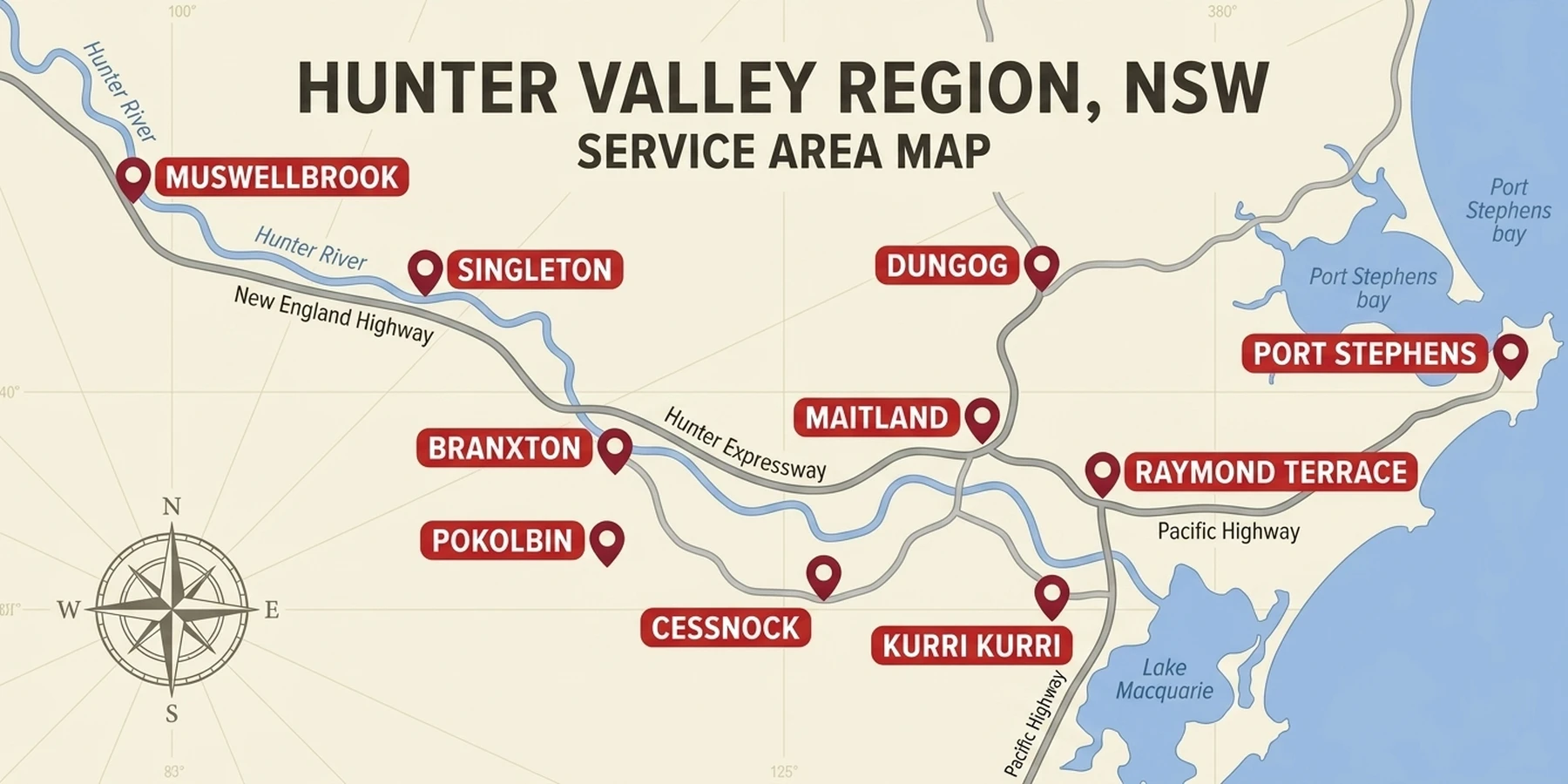
Singleton is where the Hunter opens out. The blocks get bigger, the rainfall drops to about 650 mm a year, the January heat pushes past 31 degrees, and the tank can be a long way from anywhere a truck can park. Singleton Council also runs its own water and sewer business rather than Hunter Water, and its on-site sewage rules have a tier that no other Hunter council offers: a 10-year self-assessment category for the lowest-risk systems.
Hunter Valley Septic services the Singleton local government area with pump-outs, quarterly AWTS servicing, inspections and trench diagnostics, from the rural-residential belt at Wattle Ponds, Glendon, Whittingham and Mount Olive to the villages and farms at Broke, Bulga, Jerrys Plains, Camberwell, Warkworth, Mount Thorley, Belford, Lower Belford, Lambs Valley, Dalwood and Elderslie. Branxton is also inside Singleton Council’s boundary and has its own page at Branxton. Call 0468 278 123 to book.
Who runs the sewer, and where it stops
Singleton Council, not Hunter Water, treats and distributes drinking water and collects and treats wastewater for its area. Council’s sewer serves roughly 14,700 people in the urban footprint of Singleton, Glenridding, Singleton Heights, the Pinnacle, Hunterview, Darlington and Maison Dieu. Everything else is on site. Council also states that it does not supply sewer to Branxton, which is on a Hunter Water rising main; only 412 dwellings in the whole Singleton LGA are on Hunter Water’s water network.
Septic tank waste discharged to Council’s sewer is regulated as liquid trade waste under section 68 of the Local Government Act. That matters to owners only indirectly: the waste we pump from your tank is transported and disposed of under NSW EPA waste rules at a licensed treatment facility that has agreed to accept it, and you get a disposal docket for every load.
Singleton Council’s four inspection tiers
Council inspects on-site systems under its On-site Sewage Management Strategy at a frequency set by risk:
- High risk: inspected once a year.
- Medium risk: every three years.
- Low risk: every five years or more.
- Minimal risk: owner self-assessment every 10 years, with random Council inspections.
Council sends notice about two weeks before an inspection, and you can arrange to be present if the property is locked or there are dogs. The approval to operate itself is valid for one year, and Council sends out an extension each July provided no issues have been identified with the system. There is no risk-tiered approval length as in Maitland; in Singleton the approval is annual and only the inspection interval varies.
A system without an approval to operate is not registered with Council. Registration is done by lodging the application for section 68 approval for an on-site sewage management system, and Council warns that failure to register may result in a penalty infringement notice. If you have bought an older farmhouse and cannot find any council paperwork, that is the form to ask about.
Council also offers a pre-sale or pre-purchase inspection on request, using its request for inspection form and a fee set in its fees and charges. Our own pre-purchase inspection ($250 to $500, with a CCTV line check and written report timed to your cooling-off period) is a separate service; many buyers get both.
Rules for AWTS owners in Singleton
Council’s page for AWTS owners is short and specific. Servicing is required every three to four months by a Council-approved service provider. The system must be operated continuously; the power must not be turned off. A system used at irregular intervals, a weekender or a shearers’ quarters, might need to be serviced before use. Our AWTS servicing is $90 to $150 a visit, with the service report sent to Singleton Council after each visit as your approval requires.
For new systems, Council lodges section 68 applications on the NSW Planning Portal and, citing clauses 40 and 41 of the Local Government (General) Regulation 2021, will only approve NSW Health accredited facilities for households of up to 10 people or 2,000 litres a day. Larger systems, a function venue at Broke say, must be specifically designed. Council lists sand filters and reed beds among the secondary treatment options it accepts, alongside AWTS. An approval to install is needed before a complying development certificate or construction certificate can be issued for a new house on an unsewered lot, and the approval to operate follows a final inspection. Installation, trench construction and sanitary pipework are plumbing and drainage work under NSW law and are carried out by licensed plumbing and drainage contractors we work with; their NSW licence number appears on every quote. Our part is the replacement planning: site assessment, sizing and the paperwork.
Big blocks: access, hose runs and dams
Council’s own inspection scheduling tells you something about distance: building and plumbing inspections beyond 6798 Putty Road (Garland Valley) run on Tuesdays and beyond 1719 Carrowbrook Road (Lake St Clair) on Wednesdays. On properties like that the question is not whether we can reach the tank but how.
The standard pump-out price covers a hose run of up to 45 metres from where the truck can safely park. Beyond that, the extended-hose modifier is $50 to $120, quoted before we start. When you book, tell us the rough distance from the nearest hardstand to the tank and whether the track will carry a loaded truck after rain; on the black soils and alluvial flats along the Hunter a paddock that was firm on Monday can bog a truck on Friday. Buried lids on old homesteads add $75 to $150 if they are more than 300 mm down; a riser at $250 to $450 fixes that permanently.
Farm dams and bores are the other rural consideration. The buffer distances Hunter councils use from the NSW Environment and Health Protection Guidelines are 100 m to permanent surface water, 250 m to a domestic bore and 40 m to other waters including farm dams, intermittent waterways and drainage channels; Upper Hunter Shire next door sets its inspection interval by how many of those buffers a system meets. If your disposal area drains towards a stock dam, expect that to come up at inspection.
Heat, dry spells and the trench
Singleton’s climate helps a trench in one way and hurts it in another. At about 655 mm a year at the Singleton sewage treatment plant station (February wettest at 86 mm, July driest at 24 mm) and 646 mm over 128 years at Jerrys Plains, there is far less rain sitting on a disposal area than on the coast, and hot summers with January maxima around 31.8 degrees drive strong evapotranspiration. That favours evapotranspiration beds and irrigation systems. The downside is the soil: the alluvial flats and black soil country of the Upper Hunter are productive farmland precisely because they hold water, and heavy clays with weak structure are the high-risk soil class in every Hunter council’s risk table. A trench in that soil after a wet February behaves exactly like one in the coalfields. Our trench diagnostics service works out whether a soggy patch is soil, solids carry-over or hydraulic overload before anyone talks about a rebuild.
Council’s advice on frequency is that desludging is required every three to five years depending on use, and that a poorly maintained tank lets solids clog the land application system and lead to expensive reinstatement of the absorption area. On a large rural lot with a big family and a 3,000 litre tank, we measure sludge at each visit and set the interval from the depth.
Mining towns, vineyards and lifestyle blocks
Singleton’s economy shows in its wastewater. The LGA had a median weekly household income of $2,016 at the 2021 census, the highest of the seven Hunter councils we cover, and a population of 24,577. The Broke-Fordwich sub-region is one of Wine Australia’s three recognised Hunter sub-regions, with about 855 hectares of vines and 58 growers in the LGA at the last DPI count; cellar doors and accommodation there carry surge loads that a domestic tank was never sized for, and the larger ones fall outside NSW Health accreditation and need engineered systems and, often, scheduled holding-tank pump-outs. Mining land around Warkworth, Mount Thorley, Bulga and Camberwell brings rental housing on rural lots where nobody is sure when the tank was last done, which is the case for a condition inspection before anything else.
Frequently Asked Questions
How often does Singleton Council inspect septic systems?
Once a year for high-risk systems, every three years for medium, every five years or more for low risk, and a 10-year owner self-assessment with random inspections for minimal risk. Council gives about two weeks’ notice.
Is my approval to operate in Singleton annual?
Yes. It is valid for one year and Council sends an extension each July if no issues have been identified with the system. The fee is set in Council’s annual fees and charges.
I bought a farm at Jerrys Plains and there is no council paperwork. What now?
Register the system by lodging Council’s section 68 application for an on-site sewage management system. Council warns that unregistered systems can attract a penalty notice, and the Regulation gives a buyer 3 months’ grace to operate while applying. Book an inspection first so you know what you are registering.
Can I turn my AWTS off while the house is empty?
No. Singleton Council states the system must be operated continuously and the power must not be turned off. A system used irregularly may need a service before it goes back into use.
How much does a pump-out cost out at Broke or Bulga?
The same base prices as anywhere in our area: $350 to $500 up to 3,000 litres, $400 to $650 for 3,500 to 4,500 litres and $650 to $900 for 5,000 litres plus, with no travel surcharge across the Singleton corridor. Access is what changes the price: hose runs beyond 45 metres add $50 to $120 and deeply buried lids $75 to $150, both quoted first.
Does Singleton Council inspect before a sale?
It can. Council offers a pre-sale or pre-purchase inspection on request with its request-for-inspection form and fee. Our pre-purchase inspection is separate and is written for the buyer, with photos, measurements and costed findings.
Ready to book a pump-out, AWTS service or inspection anywhere in the Singleton area? Call 0468 278 123 or use the booking form with your locality and a note about access. We call back within 24 hours during business hours, and most routine pump-outs are scheduled within 48 hours.
Request Received!
Thank you for reaching out. Our Hunter Valley dispatch team will call you back promptly to confirm details and provide an upfront quote.
Call us directly on 0468 278 123