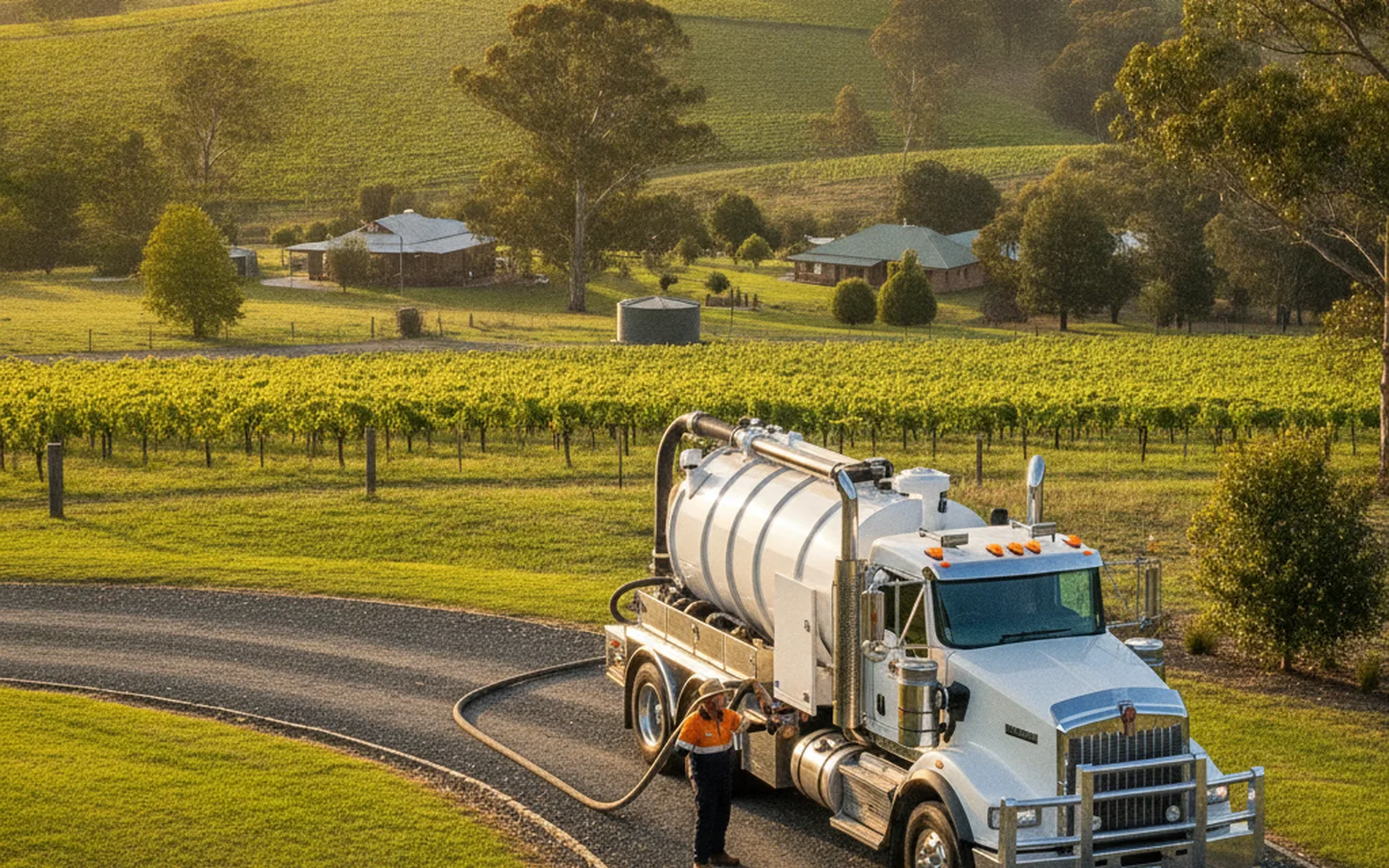
A pre-purchase septic inspection in the Hunter Valley is the one check a rural property buyer cannot get from anyone else. The building and pest report stops at the house. Council will confirm what is on file, but it does not certify condition at sale. The contract for sale's planning certificate under section 10.7 of the Environmental Planning and Assessment Act 1979 has no prescribed item about on-site sewage at all. So the only way to know whether the tank, the trench and the paperwork are what the listing implies is to open the lid, measure, probe and read the file.
Hunter Valley Septic inspects septic tanks, aerated wastewater treatment systems (AWTS), pump-out tanks, absorption trenches and irrigation areas for buyers and sellers across Maitland, Cessnock, Singleton, Port Stephens, Dungog and Muswellbrook. The inspection is $250 to $500 and includes a CCTV line check, tank structural assessment, trench absorption probe and a written report. This page covers what it involves, what to ask the vendor for, what the approval means once you own the place, and how the timing works inside a cooling-off period.
Why the replacement bill is the number to know before exchange
Most of a septic system is out of sight and the failures are slow. A tank that has not been pumped in a decade, an outlet tee that collapsed years ago, or a trench that has been quietly clogging under a lush green strip can all look fine from the verandah. The costs when they surface are the biggest maintenance numbers on a rural property: rejuvenating a clogged trench is $1,500 to $4,500, a new absorption trench is $8,000 to $14,000, and a complete replacement system is $12,000 to $18,000 for a conventional tank with gravity trenches or $15,000 to $25,000-plus for an AWTS. Trench and system installation is carried out by licensed plumbing and drainage contractors we work with, and their NSW licence number appears on every quote.
Set against that, an inspection is small money, and it does two things a buyer needs: it gives your conveyancer a written, costed basis for a conversation with the vendor, and it tells you what your first year of ownership will involve.
What the pre-purchase inspection covers
- Paperwork versus reality. We match the council approval to operate, the section 68 approval to install and any as-built plan against what is actually in the ground: tank type and size, number of bedrooms it was approved for, disposal method and where the disposal area is. Extra bedrooms, a converted shed or a granny flat that never went back to council are common findings.
- The line from the house. A camera through the drainage line between the house and the tank picks up root intrusion, bellies and breaks that cause the slow drains a vendor may have lived with for years.
- The tank. Lid condition and security, sludge and scum depth in each chamber with a sampling tube, inlet and outlet tees, baffle, effluent filter, water level against the outlet, cracks and root entry. On an AWTS: blower, irrigation pump, floats, chlorine and alarm, and the service history against the quarterly requirement.
- The trench or irrigation area. A probe along the trench line, and a look for ponding, boggy ground, odour, a green strip in dry weather, stock damage and vehicle tracks. We note distances to waterways, bores, boundaries and buildings, because those are the things councils rate risk on.
- The report. Photos, measurements, what passes, what needs work now and later, a costed list using our published prices, and a note of which items are licensed plumbing and drainage work. Written so a conveyancer, a vendor and a council officer can all read it.
Where the tank is due, a pump-out on the same visit lets us inspect the tees and baffle with the tank empty; bundling an inspection with a pump-out adds $100 to $200 to the pump-out price. Under-used systems deserve extra care: a holiday let or a house that has sat empty can have an AWTS whose bacteria have died off and a trench that has never carried a full-time load, so a "no problems" history proves less than it seems.
What to ask the vendor for
Ask early, through the conveyancers, for:
- the current council approval to operate, and the date it runs to;
- the section 68 approval to install, and the as-built plan or drainage diagram if one exists;
- AWTS service reports for at least the last two years (the approval conditions require quarterly servicing by a service agent, with the report going to council);
- pump-out dockets, with dates;
- any council audit report or correspondence, including anything unresolved;
- invoices for repairs, riser installation or trench work, with the contractor's licence number where it was licensed work.
Under clause 45(5) of the Local Government (General) Regulation 2021 a council can require an approval holder to produce evidence of compliance whenever it reasonably asks, so a diligent owner has most of this in a folder. If none of it exists, that is itself a finding, and it is the moment to ask council what is on the property's file.
What the approval means once you own the property
The approval to operate belongs to the owner, not the land. The Regulation handles the handover in clause 47: a purchaser may operate the existing system for 3 months after the land is transferred without an approval, and a purchaser who applies for their own approval within 2 months of the transfer may keep operating until council determines it. The vendor's approval does not extend to you. How that plays out depends on the council:
| Council | What a new owner does |
|---|---|
| Maitland City Council | The approval is not transferable; renew it in your own name within 3 months of the transfer. Approvals run 2, 4 or 5 years by risk rating. |
| Cessnock City Council | Council reissues the approval to you once the title transfer is registered. Renewal or extension is $104 in 2026-27. |
| Port Stephens Council | Council reissues the 12-month approval to you after the transfer is registered; it renews each year on the rates notice ($140.00 in 2026-27). Council also offers a pre-purchase inspection on application. |
| Dungog Shire Council | Council reissues the approval on request; it renews annually on the rates notice ($145.60 in 2026-27). |
| Singleton Council | 12-month approval renewed on the rates notice each July if no issues have been identified; unregistered systems must be lodged on the section 68 form. |
| Muswellbrook Shire Council | Annual approval fee on rates ($65.00 in 2026-27); a system 10 years or older with no record is registered for $250 and inspected if there has been no inspection in 10 years. |
Fees come from each council's 2026-27 fees and charges and change every July. The NSW Office of Local Government's Easy Septic Guide puts the general rule simply: the approval relates to the owner, so a new owner should notify council and obtain an approval in their name. Our buyer's guide walks through the whole sequence from contract to first pump-out.
Timing inside a cooling-off period
Tell us the deadline when you book and we schedule to it. Most inspections in our primary service areas are booked within 48 hours; where a deadline genuinely needs a same-day or next-morning visit, we treat it as an emergency dispatch and the $150 to $300 emergency modifier is added to the inspection fee, quoted before we come. Access to the property is arranged through the agent, and we need the lid exposed or permission to dig it out (a lid buried deeper than 300 mm without risers adds $75 to $150). The report is emailed after the site visit. If you are the seller, the same inspection done before listing removes the surprise from the buyer's side and lets you price any work into the sale rather than lose it in negotiation.
Pre-purchase inspection prices
| Item | Price |
|---|---|
| Pre-purchase real estate septic inspection (CCTV line check, tank structural assessment, trench absorption probe, written report) | $250–$500 AUD |
| Inspection bundled with a booked pump-out | +$100–$200 AUD on the pump-out price |
| Same-day or next-morning dispatch for a deadline | +$150–$300 AUD emergency modifier |
| Deep lid excavation (buried more than 300 mm, no risers) | +$75–$150 AUD |
There is no travel surcharge across the Maitland, Cessnock, Singleton or Port Stephens service corridors. For a council compliance audit on a property you already own, see septic inspections and OSSM audits; for what a failing trench looks like on a walk-through, see absorption trench failure signs.
To book a pre-purchase septic inspection anywhere in the Hunter Valley, call 0468 278 123 or use the booking form with the property suburb and your deadline. We call back within 24 hours during business hours.
Frequently Asked Questions
Does a building and pest inspection cover the septic system? ▼
No. A standard building and pest report looks at the house and the timber. It does not open the septic tank, measure sludge, test an AWTS blower or pump, or probe the absorption trench. Councils in NSW do not certify the condition of a system at sale either. If nobody opens the lid before exchange, nobody knows what is under it.
What documents should the vendor give me? ▼
Ask the vendor's conveyancer for the council approval to operate, the section 68 approval to install (and the as-built plan if it exists), the last two years of AWTS service reports, pump-out dockets, any council audit report, and repair invoices. Councils can require an approval holder to produce evidence of compliance on request, so an owner who has been doing the right thing usually has this paperwork. Silence is information too.
Do I need to transfer the approval into my name? ▼
The approval belongs to the owner, not the land, so it does not simply carry over. Clause 47 of the Local Government (General) Regulation 2021 lets you operate the existing system for 3 months after the transfer without an approval, and if you apply for your own approval within 2 months you can keep operating until council decides. In practice Maitland requires you to renew in your name within 3 months, Cessnock and Port Stephens reissue the approval to you once the title transfer is registered, and Dungog reissues it on request.
What if council has no record of the system? ▼
It happens with older properties. The system is then unapproved, and the fix is an application to regularise it: Cessnock calls it an approval to operate an existing system, charged at the new-system fee; Muswellbrook registers systems 10 years or older for $250 and inspects if there has been no inspection in 10 years; Singleton asks you to lodge the section 68 form and warns that unregistered systems can attract a penalty notice. Budget for an inspection as part of that process, and raise it with the vendor before exchange.
Can I negotiate the price if the inspection finds problems? ▼
That is between you, your conveyancer and the vendor, and it depends on the contract. What we provide is the evidence: a written report with photos, measurements and a costed list of what needs doing using our published price list, including which items are licensed plumbing and drainage work. A trench replacement is $8,000 to $14,000 and a complete new system is $12,000 to $18,000 for a conventional tank and trenches or $15,000 to $25,000-plus for an AWTS, so the numbers are worth having before the cooling-off period ends.
Can council inspect it for me instead? ▼
Port Stephens Council offers a pre-purchase on-site sewage management inspection on application, and other councils will tell you what is on the property's file if you ask. A council inspection tells you whether the system meets the approval conditions; it is not a condition report written for a buyer, and timing is set by council's workload rather than your cooling-off date. Many buyers get both.
Is the tank big enough for a granny flat or more bedrooms? ▼
Adding bedrooms or a second dwelling is an alteration to the approved system and needs a further section 68 approval, with a site and soil assessment and often a bigger tank or a secondary treatment system. Our report records the tank size, the number of bedrooms it was approved for and the size of the disposal area, which is the starting point for that conversation with council.
How fast can you inspect during a cooling-off period? ▼
Tell us the deadline when you book. Most inspections are scheduled within 48 hours in our primary service areas, and where a genuine deadline needs a same-day or next-morning visit we treat it as an emergency dispatch, which adds the $150 to $300 emergency modifier to the $250 to $500 inspection fee. The report is emailed after the site visit.