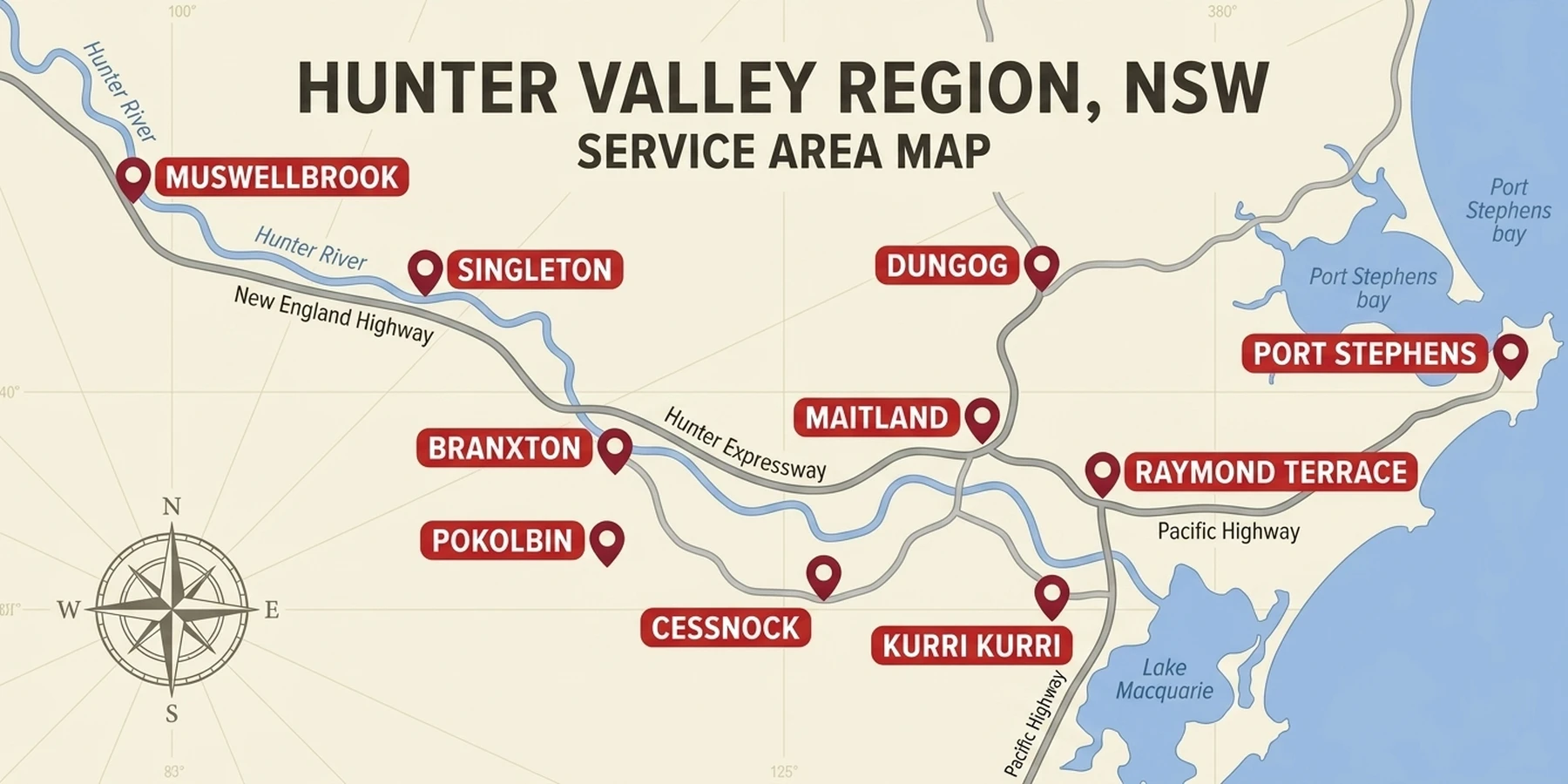
Dungog Shire covers about 2,248 square kilometres, has three rivers running through it, and only two sewered towns. Dungog and Clarence Town are on Hunter Water sewer; Paterson, Vacy, Gresford and East Gresford, Martins Creek and every farm, weekender and eco-cabin in between run on roughly 3,500 on-site sewage systems. Most of that country drains to the Williams River, which Dungog Shire Council describes as the major drinking water source for the Hunter Region, so the council’s inspection program is one of the most thorough in the state.
Hunter Valley Septic services the Dungog local government area with pump-outs, quarterly AWTS servicing, inspections and trench diagnostics, including Wallarobba, Hilldale, Wirragulla, Fosterton, Bandon Grove, Bendolba, Salisbury, Eccleston, Allynbrook, Lostock and Bingleburra. Call 0468 278 123 to book.
The catchment rules: Williams River, Chichester Dam, and the Paterson exception
The Williams River rises in the Barrington Tops forests and runs through mainly agricultural land and the townships of Dungog and Clarence Town before Seaham Weir, where Hunter Water pumps it through the Balickera Canal into Grahamstown Dam. Chichester Dam, at the base of the Barrington Tops World Heritage Area, is the second source. Hunter Water names on-site sewage systems on unsewered properties as a major potential source of pathogens and nutrients in these catchments, and lists agriculture, on-site systems and increasing development density as key threats to water quality in both dams.
The Hunter Water Regulation 2024 gazettes the Chichester Catchment Area and the Williams River Catchment Area as special areas. Clause 6 provides that an owner or occupier in a special area must not erect, install or operate an on-site sewage management facility, with a maximum penalty of 70 penalty units for an individual, except in accordance with a development consent, a Local Government Act approval or an environment protection licence. The earlier Regulation exempted the Williams River catchment from that clause; the 2024 version removed the exemption for consistency, a change the department called administrative because the Dungog Local Environmental Plan 2014 already regulates development in the catchment and Dungog Shire Council remains the consent authority. The upshot for an owner: a council-approved system is lawful in the catchment, an unapproved one breaches the catchment regulation as well as the Local Government Act, and Council must refer applications that could affect water quality to Hunter Water.
The Paterson and Allyn river catchments, which take in Gresford, East Gresford and Vacy (the two rivers meet at Vacy), are not special areas. The Gresford water supply is harvested from those rivers, mostly the Allyn, so the water-quality logic is the same, but the Hunter Water Regulation does not apply there. Council’s own policy still rates a site inside a water catchment as a stand-alone high-risk trigger.
Dungog Shire Council’s inspection program
Council’s On-site Sewage Management Policy (adopted March 2015) rests on a 2014 study that produced land capability maps, a technical manual and a development assessment framework. Land is classed into four hazard classes, low to very high, on two maps, one for installing a system on an existing lot and one for subdivision; the higher the class, the more site investigation an application needs, and owners and consultants can look up the class for any lot.
Council inspects every system in the shire except those classed Low (TS), issues an audit report to the owner after each inspection, and issues an amended approval with new conditions where an inspection changes them. Indicative frequency by risk: very high and high hazard sites annually or every 2 years, medium every 2 years, low every 3 years, Low (TS) every 5 years, and a properly functioning secondary treatment system by exception only, on a complaint or a major fault on a service report. High risk means a lot under 2,000 m², clay or sand with weak structure, a flood-prone site, primary treatment only, groundwater or hardpan within 0.6 m, slope over 20 per cent, a site in a water catchment, or unmet buffer distances. Low (TS), the category that takes a system out of routine inspection, needs a secondary or advanced secondary system installed under a valid approval, operated to its conditions, serviced under a maintenance agreement by a suitably qualified and experienced service agent, with nothing outstanding on its service report; systems move down a category after two consecutive satisfactory inspections.
The approval to operate is valid for 12 months, runs 1 July to 30 June, renews annually with no application and the fee on the rates notice ($145.60 in 2026-27), and is re-issued to a new owner on request. Council’s own comparison is that the approval is like a driver’s licence, belonging to the person rather than the property. Other 2026-27 fees: approval-to-operate inspection $278.45, re-inspection $278.70, pre-purchase inspection and report $312.00, domestic installation application $383.75, domestic alteration $295.85 and an amended plan (change of system type, layout or location with no increase in hydraulic load) $130.85. Section 68 applications go through the NSW Planning Portal with Council’s installation form and, where effluent is disposed of on site, its site, soil, system and environmental assessment form.
Council’s technical manual, prepared by consultants, calculated a sustainable minimum lot size for on-site management of 3,500 to 4,000 m² for typical development and suggested one hectare as a conservative minimum for future unsewered subdivision. The same study picked Gresford and East Gresford, Paterson and Vacy as indicative high-risk villages on the basis of small existing lots, site and soil constraints and observed system failures. If you are on a village block in one of those, expect a shorter inspection cycle and take sludge depth seriously.
Steep blocks, perched water tables and the wet valley
The Williams River valley is the wettest inland part of our area. The nearest open Bureau station, Paterson (Tocal), averages 945 mm a year with March the wettest month at 125 mm, and rainfall on the Barrington Tops exceeds 1,200 mm. Council’s technical manual describes the western rolling hills as residual, colluvial and erosional soils over bedrock that creates shallow, episodic perched water tables discharging to gullies and creeks, while the alluvial, sandy and estuarine flats are underlain by shallow unconfined aquifers. Slope over 20 per cent and groundwater within 0.6 m are both high-risk triggers in Council’s table, and steep bush blocks around Salisbury, Bandon Grove and the Chichester valley routinely have both.
For pump-outs that means access. Standard pricing covers a hose run of up to 45 metres from where the truck can safely park; steep driveways and soft tracks after rain often mean parking further away, and runs beyond 45 metres add $50 to $120, quoted first. On saturated ground we may hold a routine pump-out for a few days, and after any pump-out the tank should be refilled to at least two-thirds so it cannot lift in wet soil.
Flooding is part of Dungog’s history. In April 2015 extreme rain in the Myall Creek catchment produced a flood estimated at around a 1-in-1,000-year event, which killed three people, washed four houses away and flooded some 80 dwellings, many to ceiling height; the June 2007 storm flooded low-lying Hooke Street and Dowling Street at roughly a 1-in-20-year level, and earlier floods came in 1990, 1985 and 1946. Chichester Dam is operated for water storage, not flood mitigation. After a flood, NSW Health’s advice is to keep the system out of use until floodwater has dropped below the disposal area and the whole system has been inspected and repaired by a licensed plumber or an authorised service technician; our inspection and emergency services cover both ends of that.
AWTS in Dungog: the 24-hour rule and holiday homes
Council’s AWTS page is unusually specific. NSW Health field trials showed AWTS units need servicing at a minimum every three months, so the owner must hold an annual service contract for four services at three-monthly intervals; the service agent must be able to attend within 24 hours of being notified of a malfunction; each service covers chlorine replenishment, pumps, blower, alarm, irrigation lines and sprays, sludge levels, chlorine reading and pH, and typically lasts 20 to 25 minutes if there are no problems; and holiday homes left unoccupied need a technician’s service at each start-up. Council records every service report in its wastewater register and asks for pump-out records during investigations, comparing them with water use to judge whether a system is being serviced often enough.
Our AWTS servicing is $90 to $150 a visit ($360 to $600 a year), with the service report sent to Dungog Shire Council after each visit. For the eco-cabins, farm stays and weekenders that make up so much of the shire’s accommodation, we schedule start-up services around occupancy rather than the calendar, and for larger venues on pump-out tanks the holding tank page explains volume-based scheduling.
Frequently Asked Questions
Which Dungog Shire towns are on sewer?
Only Dungog and Clarence Town, both served by Hunter Water treatment works. Paterson, Vacy, Gresford, East Gresford, Martins Creek and all rural properties are on on-site systems. Hunter Water’s growth planning lists Vacy as a growth area, but there is no current sewer scheme for it.
Is it legal to have a septic tank in the Williams River catchment?
Yes, with a council approval. The Hunter Water Regulation 2024 prohibits on-site systems in the Williams River and Chichester special areas except under a development consent, a Local Government Act approval or an environment protection licence, so an approved and maintained system is lawful. Keep the approval current; here a lapse is a breach of two laws, not one.
How often does Dungog Shire Council inspect?
Annually or every 2 years for high-hazard sites, every 2 years for medium, 3 for low and 5 for Low (TS), with a functioning secondary treatment system under a service contract inspected only by exception. Council sends an audit report to the owner after every inspection.
What does the approval to operate cost and when does it renew?
$145.60 in 2026-27 on the rates notice, valid 1 July to 30 June, renewed annually with no application. Council re-issues it to a new owner on request.
My weekender’s AWTS has been off for months. Can I just switch it on?
Council’s guidance is that unoccupied holiday homes need a technician’s service at each start-up, because the bacteria die off and the chlorine runs down while the house is empty. Book the service for the day before you arrive rather than the week after.
How much is a pump-out at Gresford or Vacy?
$350 to $500 up to 3,000 litres, $400 to $650 for 3,500 to 4,500 litres and $650 to $900 for 5,000 litres plus. There is no travel surcharge across our primary service areas; on steep or soft blocks a hose run beyond 45 metres adds $50 to $120, and a lid buried more than 300 mm adds $75 to $150, both quoted before we start.
Ready to book a pump-out, AWTS service or inspection anywhere in Dungog Shire? Call 0468 278 123 or use the booking form with your locality and a note about access. We call back within 24 hours during business hours, and most routine pump-outs are scheduled within 48 hours.
Request Received!
Thank you for reaching out. Our Hunter Valley dispatch team will call you back promptly to confirm details and provide an upfront quote.
Call us directly on 0468 278 123