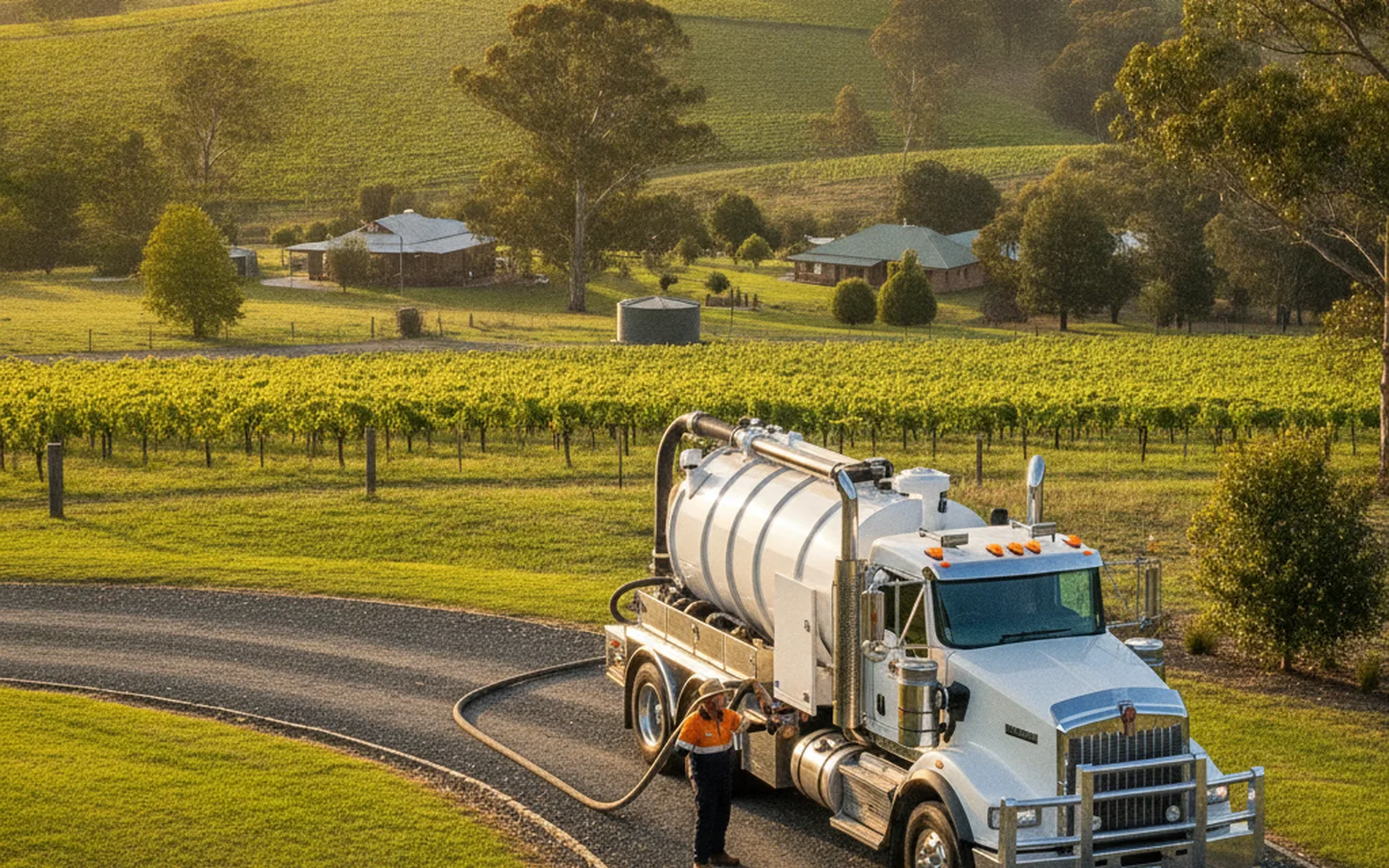
Septic system replacement in the Hunter Valley is rarely a quick swap. Before anyone digs, the block needs a soil assessment, the new system needs a design that fits that soil, and your council has to approve both under Section 68 of the Local Government Act 1993. Get that order wrong and you can pay for a system the council will not let you switch on.
Hunter Valley Septic handles the planning side: working out whether the old system is really finished, arranging the site and soil assessment, sizing the replacement, helping you assemble the Section 68 application and coordinating the job with the installer. The installation, plumbing and drainage work itself is carried out by licensed plumbing and drainage contractors we work with; their NSW licence number appears on every quote. Once the new system is commissioned, we take over the pump-outs or the quarterly AWTS servicing.
First, check whether you need a replacement at all
We diagnose before we replace. If a root-blocked inlet baffle, a faulty air blower diaphragm, or an electrical float switch is the issue ($250 to $650), that is the fix, not a new $20k system. A fair share of "failed" systems turn out to be a tank nobody has pumped in a decade, a crushed outlet pipe, or a trench drowned by stormwater off a new shed roof.
The NSW Office of Local Government's 2025 Onsite Wastewater Management Guidelines say an existing system does not have to meet current design standards unless it fails, it is altered, or the buildings it serves are altered. An old trench is not illegal because it is old. So the first visit is a diagnosis: sludge depth in the tank, the state of the baffles and outlet filter, a probe of the absorption trench (drain field), and a look at where roof and surface water is going. From there the options run, in rising order of cost, from a tank or baffle repair, to trench rejuvenation, to a new trench on the existing tank, to a full replacement.
Step one: the site and soil assessment
Every council in the Hunter asks for the same core information before it will approve a new or replacement system, because clause 26 of the Local Government (General) Regulation 2021 sets the minimum. An application needs a scaled plan showing the tank, the effluent application area and any buildings or environmentally sensitive areas within 100 metres; full specifications of the system; a site assessment covering climate, geology, hydrogeology, topography, soil composition and vegetation; the number of people who will live there; and operation and maintenance details, including what happens in a breakdown. Councils add their own forms on top.
The soil part decides everything else. AS/NZS 1547:2012, as adapted in the OLG Guidelines, sorts soils into six categories: gravels and sands, sandy loams, loams, clay loams, light clays, and medium to heavy clays. The Hunter has all six within a short drive. The alluvial river flats around Maitland and Singleton carry deep loams that can take a conventional trench comfortably, though on the floodplain the flood liability of the disposal area becomes the problem instead. Across the coalfields country around Cessnock, Kurri Kurri and Pokolbin the subsoil is often heavy clay, and the guidelines give no trench loading rate for Category 6 clays at all; the design, they say, "will need to rely on more processes than just absorption by the soil". On the coastal sands of Port Stephens the problem flips. Hunter Water's catchment guidelines note that sand is highly permeable, so any contamination moves to the groundwater table quickly. The risk tables Port Stephens and Dungog councils use rate clay or sand with weak structure as high risk, along with groundwater or hardpan within 0.6 metres of the surface and lots under 2,000 square metres.
The OLG Guidelines put the responsibility for engaging a suitably qualified assessor on the landowner, and describe that person as someone with a tertiary qualification in soil science, geoscience, environmental science or a related field, with professional indemnity insurance. Maitland City Council spells it out: systems with on-site effluent disposal need "a site specific assessment report from an appropriately qualified Environmental Consultant". Cessnock City Council has its own Site and Soil Assessment Report form. We do the on-site diagnosis and the practical assessment (access, levels, where a reserve area can go) and we arrange the formal site and soil evaluation with a consultant who meets the council's requirements. A probe and a bucket test is not a soil report, and we will not pretend it is.
Two more numbers shape the design. Design flow is 150 litres per person per day on reticulated or bore water and 120 litres on tank water (OLG Table 6-2), and NSW Health counts persons from the number and size of bedrooms, with a minimum of five for tank sizing. Buffer distances in the 2025 guidelines are risk-based ranges rather than fixed figures: 50 to 100 metres to permanent surface water, 15 to 100 metres to bores and wells, 15 to 40 metres to farm dams and intermittent drainage, and 1.5 to 15 metres to property boundaries. Maitland's own risk criteria still use fixed figures of 100 metres to permanent water, 250 metres to a domestic bore and 40 metres to non-permanent waterways, so a disposal area inside those distances puts you on a two-year approval cycle.
Conventional tank, AWTS, or something in between
There is no rule that says a replacement has to be an AWTS. The soil report, the lot size and the distance to water decide it. These are the options a Hunter council will actually consider.
Conventional septic tank with absorption trenches
A watertight tank settles the solids and the clarified effluent drains to trenches or a bed. NSW Health sets the minimum all-waste tank at 2,300 litres for five persons and 3,050 litres for ten; the OLG design table runs larger (3,300 litres for six persons, 4,400 for eight) and notes that a bigger tank gives longer retention and cleaner effluent. Any tank over 2,050 litres must have a baffle wall, and an outlet filter is recommended. Trenches suit loams and clay loams with reasonable structure and room for a reserve area. The guidelines prefer pressure-dosed distribution over the old gravity slotted pipe, which tends to overload one end of the trench and fail by creep. This is the cheapest complete system to build and the cheapest to run: no power, no service contract, a pump-out every three to five years.
Evapotranspiration beds and mounds
Where clay will not absorb enough, the designer can move to an evapotranspiration (ETA) bed, which uses sun, wind and plant uptake as well as soil absorption, or to a sand mound, which the guidelines describe as suited to slowly permeable soils, shallow soil over bedrock and high water tables. On Category 6 clays an ETA system is only suitable with secondary treated effluent, which brings you back to an AWTS in front of it. Mounds want a level site and pressure dosing.
Aerated wastewater treatment system (AWTS) with irrigation
An AWTS adds an aeration stage, a clarifier and chlorine disinfection, then pumps the treated effluent to subsurface drip lines or sprays. Councils may only approve models that hold a current NSW Health certificate of accreditation, so the brand list is not ours to invent. The NSW Health AWTS register currently lists the Fuji Clean ACE 1200 (8 persons), the Taylex ABS 1500 and PABS 1500 (10 persons) and Everhard's Aqua Advanced (8 persons, the current model in the Aqua Nova line), among others. The guidelines say drip irrigation of secondary effluent is the preferred method on both sands and heavy clays, that subsurface irrigation carries less risk of human contact than surface spray, and that surface irrigation is unsuitable on slopes over 10 per cent or where the ground stays saturated. Upper Hunter Shire Council does not permit surface irrigation for new systems on blocks under 4,000 square metres.
The trade-off is running cost and obligation. An AWTS needs continuous power (Fuji Clean quotes $200 to $300 a year for its ACE 1200), a minimum 12-month service contract, and a service every three months by a service agent authorised by the manufacturer, with a report sent to council after each visit. That is a condition of the NSW Health accreditation, and clause 45 of the Regulation makes it a condition of your approval to operate. Our quarterly AWTS servicing is $90 to $150 per visit.
Holding tanks and larger systems
A pump-out (holding tank) system is treated by the OLG as a last resort for failing systems where sewer is impossible, and Maitland will not approve one "unless there is no other alternative". If yours is the rare block that needs one, see holding tank pumping. At the other end, any system serving more than 10 persons or more than 2,000 litres a day (a cellar door, cabins, a wedding venue) sits outside NSW Health accreditation and needs an engineer-certified design. Cessnock scales its application fee by treatment capacity for these.
Can council make you install an AWTS?
Not by decree. What councils do is refuse designs the soil report and buffers do not support, and on small lots, heavy clay, shallow groundwater or drinking-water catchments that usually leaves secondary treatment with a designed application area as the only thing that passes. Maitland names AWTS as the preferred method for new applications in unsewered subdivisions. Port Stephens and Dungog rate any primary-treatment-only system as high risk, and Port Stephens will not accept new unsewered lots with under 4,000 square metres of useable land in the Hunter Water catchments. Inside the Tomago Sandbeds, Grahamstown, Williams River and Chichester catchment areas, the Hunter Water Regulation 2024 makes an on-site system lawful only under a council approval, and Hunter Water's development guidelines ask for sewer connection wherever it is possible.
The Section 68 process, council by council
Section 68 of the Local Government Act 1993 requires council approval to "install, construct or alter a waste treatment device or a human waste storage facility" (Part C, item 5) and a separate approval to "operate a system of sewage management" (item 6). Two things follow. A full replacement always needs approval, even like for like: Cessnock allows like-for-like component swaps and tank resealing without one, but changing the treatment system, the disposal location or method, or the connected drainage is an alteration, and Muswellbrook says replacing any part of a failed disposal area needs approval. And you cannot use the new system until council has inspected it and told you in writing that it was installed in accordance with the approval (Regulation clause 34). Installing without approval carries a maximum court penalty of 20 penalty units, which is $2,200, and Cessnock states it cannot grant retrospective approval.
Being inside Hunter Water's area of operations does not remove the need for that approval. And no Hunter council publishes a turnaround time. The Act's 40-day "deemed refusal" period exists so an applicant can appeal, not as a service standard, so treat any promised week count with suspicion. A complete application with a proper soil report is the only thing that reliably shortens it.
| Council | How to lodge | What council adds to the Regulation list | 2026/27 fees (council schedules) | Inspections |
|---|---|---|---|---|
| Maitland City Council | Council's "Application to Install/Construct or Alter a Sewage Management Facility" form | Site plans, dwelling floor plan, system specification, NSW Health accreditation documents, and an environmental consultant's site assessment where effluent is disposed on site | Approval to operate application $182; annual admin charge $119.35; install application about $498 (confirm with Council) | Site, all plumbing and drainage before backfill, trench or irrigation works, then a final inspection before the first approval to operate |
| Cessnock City Council | NSW Planning Portal only | Declaration and Owners Consent form, the checklist documents, and a Site and Soil Assessment Report where applicable; each dwelling in a dual occupancy needs its own system | Install $770 on lots up to 4,000 m² or $539 on larger lots, plus $452 covering up to three inspections | External plumbing, tank and disposal area, final; the owner or installer books each one |
| Singleton Council | NSW Planning Portal | Accredited systems only; the DA must show the system type and location, and an approval to install is needed before a CDC or CC on an unsewered lot | Not published on the pages we read; check Council's fees and charges | Final inspection before the approval to operate, which runs one year and is extended each July |
| Port Stephens Council | Council's on-site sewage management application form | Regulation list; the approval to install is valid for five years | Residential application $395; $225.50 per inspection; approval to operate $140 a year on the rates notice | Site (pre-approval), land application area, final |
| Muswellbrook Shire Council | NSW Planning Portal | Site plan with distances to structures, driveways, pools, dams, watercourses, bores and boundaries; floor plan showing bedrooms; site assessment with soil testing; sizing to AS/NZS 1547:2012; owner's consent | Install $500 including one inspection; approval to operate $65 a year | One included; further inspections $228 each |
| Dungog Shire Council | NSW Planning Portal plus Council's approval-to-install form | "Site, Soil, System and Environmental Assessment" form where disposal is on site; the lot's hazard class (low to very high) sets how much investigation is needed | Domestic install $383.75; approval to operate $145.60 a year | As conditioned; an audit report follows each inspection |
| Upper Hunter Shire Council (Scone, Aberdeen, Merriwa, Murrurundi) | Section 68 form lodged with Council | Regulation list; no surface irrigation on new systems under 4,000 m² | Install $381 including a preliminary inspection; approval to operate $81.50 a year | Several during the install and one on completion |
Fees come from each council's 2026/27 schedule and change every July, so the council's own page has the current figure. Portal applications are lodged from the owner's account on the NSW Planning Portal; we prepare the documents with you and the consultant, and the licensed contractor supplies the plans and specifications for their part.
How the job runs on a Hunter block
- Diagnosis visit. Pump-out if the tank needs it, sludge measurement, baffle and filter check, trench probe, stormwater check. If it is repairable we say so and stop there.
- Site and soil evaluation by a qualified consultant, arranged by us, producing the report the council wants.
- Design and sizing. System type, tank or unit capacity from bedroom count, application area and reserve area, buffers checked against the council's own table. The tank size calculator gives a first pass.
- Fixed written quote from the licensed plumbing and drainage contractor, licence number on it. Every replacement or AWTS installation starts with a thorough site and soil assessment and ends with a fixed written quote. The price changes only if scope changes with prior owner agreement.
- Section 68 application assembled and lodged. Nothing is dug until the approval to install is issued.
- Installation by the licensed contractor, with council's staged inspections booked before backfill. Electrical work is done by a licensed electrician, and an AWTS is commissioned and certified by the manufacturer or its agent, as the accreditation conditions require.
- Final inspection and approval to operate. Then the first quarterly service or the pump-out interval goes in the diary.
A few Hunter-specific things we plan around. Excavators and tankers need a way in, and a trench rebuild on a Wollombi or Bulga block with one gravel track is a different job from a Medowie lot on a sealed road. The wettest months across the Hunter are late summer and autumn, and an empty tank in saturated ground can float: the OLG Guidelines require a pumped tank to be refilled to at least two-thirds for that reason, and installers anchor tanks for the same one. On the Maitland floodplain a system and disposal area that is flood liable sits in the council's high-risk category, so the design lifts blower housings and control panels above flood level and keeps the tank lid at least 100 millimetres above finished ground to keep stormwater out. Irrigation areas have to be signposted, fenced from stock and kept off vegetable gardens. And if a failed Maitland system sits within 75 metres of sewer infrastructure, Council may require connection to the sewer instead of a new on-site system, which is worth checking before you pay for a soil report.
What a replacement costs
These are our standard price lines. The installation lines are quoted by the licensed contractor and appear on their written quote.
| Item | Price (AUD) |
|---|---|
| Baffle / Pipe Repair | $250–$650 |
| Absorption Trench Rejuvenation / Eco-Air Jetting | $1,500–$4,500 |
| New Absorption Trench Installation | $8,000–$14,000 (licensed drainage contractor) |
| Complete AWTS Installation (Fuji Clean / Taylex / Aqua Nova) | $15,000–$25,000+ (licensed contractor) |
| Conventional concrete/poly tank + gravity trenches, complete system | $12,000–$18,000 (licensed contractor) |
| Access riser retrofit | $250–$450 |
| Air blower diaphragm service kit | $120–$250 |
| Council OSSM "Approval to Operate" Compliance Audit | $250–$450 |
| AWTS Quarterly Routine Servicing Contract (after commissioning) | $90–$150 per visit ($360–$600 per year) |
Council fees, the consultant's site and soil evaluation, and any electrical connection or landscaping are separate items, and every quote you get, from us or anyone else, should say whether each is in or out and whether GST is included. Independent cost guides put a conventional NSW system at roughly $8,500 to $24,000 installed, and note that swapping an existing septic for an AWTS tends to cost more than the same AWTS on a new build, so a changeover quote near the top of a range is not unusual. For a first estimate on your own block, use the replacement cost estimator.
When to start planning
Start before the system forces you to. Effluent surfacing over the trench, wet patches that never dry, a sewage smell in the yard, drains that slow again within months of a pump-out, or a tank that needs pumping every year instead of every three to five: these are the signs of trench failure that lead to a replacement conversation. Muswellbrook Shire Council puts the working life of disposal trenches and beds at 15 to 25 years, which is a useful benchmark if you know when yours went in. A council inspection report with a rectification time frame is another trigger, and so is adding bedrooms, because altering the buildings a system serves needs a Section 68 approval to alter.
If you are buying, the Regulation gives a new owner three months to operate the existing system without an approval, and applying for your own approval to operate within two months keeps you covered until council decides. A pre-purchase septic inspection tells you whether you are buying a working system or a replacement project.
To book a replacement assessment anywhere across Maitland, Cessnock, Singleton, Port Stephens, Dungog or Muswellbrook, call 0468 278 123 or use the booking form. We call you back within 24 hours during business hours.
Frequently Asked Questions
How much does septic system replacement cost in the Hunter Valley? ▼
A conventional concrete or poly tank with gravity trenches, as a complete system, is $12,000 to $18,000 AUD. A complete AWTS installation (Fuji Clean, Taylex or Aqua Nova) is $15,000 to $25,000+ AUD. Both are carried out by licensed plumbing and drainage contractors we work with, and both start with a site and soil assessment and end with a fixed written quote. Council fees and the consultant's soil report are separate items.
Do I need council approval to replace my septic tank like for like? ▼
Yes. Section 68 of the Local Government Act 1993 requires council approval to install, construct or alter a waste treatment device, and a separate approval to operate it. Cessnock City Council allows like-for-like component swaps and tank resealing without a new approval, but changing the treatment system, the disposal area or the connected drainage is an alteration that needs approval first. Muswellbrook Shire Council says replacing any part of a failed disposal area needs approval too.
How long does council approval take? ▼
No Hunter council publishes a turnaround time, and we will not invent one. The Act's 40-day "deemed refusal" period is an appeal trigger for the applicant, not a service standard. A complete application with a proper site and soil report is the only thing that reliably shortens the wait, and you cannot use the new system until council has inspected it and confirmed in writing that it matches the approval.
Can the council force me to install an AWTS? ▼
Not as a blanket rule. Councils refuse designs the soil report and buffer distances do not support, and on small lots, heavy clay, shallow groundwater or drinking-water catchments that often leaves secondary treatment with a designed irrigation area as the only option that passes. Maitland names AWTS as its preferred method for new applications in unsewered subdivisions, and Port Stephens and Dungog rate primary-treatment-only systems as high risk. An existing system that is working does not have to meet current standards.
Who lodges the Section 68 application? ▼
The owner or occupier is the applicant. Cessnock, Singleton, Muswellbrook and Dungog take applications through the NSW Planning Portal from the owner's account; Maitland and Port Stephens use their own forms. We assemble the documents with you and the consultant, and the licensed contractor supplies the plans and specifications for their part of the work.
Who actually carries out the installation? ▼
Installation, excavation, trench construction and pipework are plumbing and drainage work under NSW law. That work is carried out by licensed plumbing and drainage contractors we work with; their NSW licence number appears on every quote. Hunter Valley Septic does the diagnosis, site assessment, system sizing, Section 68 paperwork support and job coordination, then the pump-outs or quarterly AWTS servicing once the system is running.
Conventional or AWTS: can I tell before paying for a soil test? ▼
Only roughly. A lot under 2,000 square metres, heavy clay subsoil, groundwater or hardpan within 0.6 metres of the surface, a flood-liable disposal area or a site inside a Hunter Water catchment all push a design toward secondary treatment. A larger block with deep loam and room for a reserve area usually keeps a conventional tank and trenches on the table. The consultant's soil category is what the council will actually assess.
What happens to the old tank? ▼
It is pumped out and decommissioned, not left to rot. Singleton and Muswellbrook councils follow NSW Health Advisory Note 3 for decommissioning, Cessnock requires a licensed plumber and a Notice of Decommission, and Muswellbrook asks for the final pump-out receipts and photographs to be emailed to Council. We do the final pump-out and hand you the disposal docket for that file.