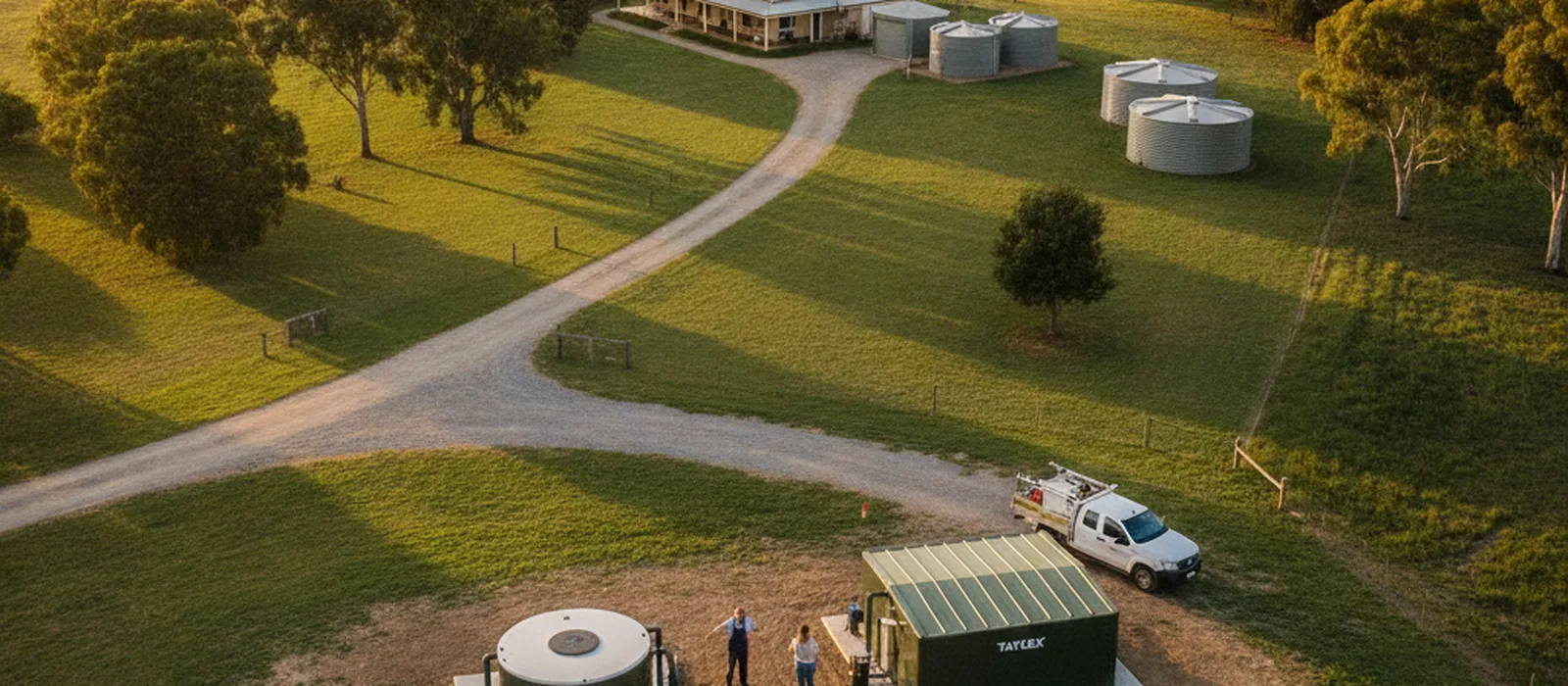
Fuji Clean vs Taylex: Comparing Two AWTS Brands on the NSW Health Register, Power, Servicing and Warranty
Fuji Clean’s ACE 1200 and Taylex’s ABS1500 are the two aerated wastewater treatment systems we are asked about most in the Hunter Valley, and both are on the NSW Health register of accredited systems. The honest short answer is that either will treat a household’s wastewater to the same NSW standard if it is serviced every three months, and the choice usually comes down to the site: a compact fibreglass tank with a 68-watt blower against a large concrete or poly tank with a piston blower and a longer desludge interval. This comparison sticks to what the manufacturers publish, what the NSW Health certificates say, and what owners report; it is not a ranking, and we service both.
The register first
NSW Health accredits system designs, not technicians, under clause 41 of the Local Government (General) Regulation 2021, and councils may only approve accredited systems for ordinary households. Certificates are time-limited, so check the register before signing anything. As at the register update of 14 August 2026:
| Brand and model | Persons | Certificate | Expires |
|---|---|---|---|
| FujiClean ACE 1200 Advanced (one tank) | 8 | STS-AWTS042 | 31 December 2029 |
| Taylex Concrete ABS 1500 Advanced | 10 | STS-AWTS049 | 31 December 2030 |
| Taylex Poly ABS 1500 Advanced | 10 | STS-AWTS050 | 31 December 2030 |
| Taylex Concrete ABSNR-1350 / Poly PABSNR-1350 (nutrient reduction) | 9 | STS-AWTS067 / 068 | 31 December 2027 |
| Taylex Concrete ABSNR-2000 / Poly PABSNR-2000 (nutrient reduction) | 10 | STS-AWTS069 / 070 | 31 December 2027 |
Fuji Clean’s current residential range is the ACE1200 and the larger ACE3000; the CE1500-EX is an earlier model still in service across the Hunter and still supported through distributors. Taylex’s “NR” models are its nutrient-reduction designs, relevant where a council or a catchment authority wants lower nitrogen in the effluent.
The tank
Fuji Clean ACE 1200. A single hand-laminated fibreglass vessel, 4,359 litres, made in Yatala (Queensland) and Mordialloc (Victoria), shipping at 2.53 m by 1.435 m by 2.35 m and 510 kg, with a footprint of about 2.5 m by 0.7 m once installed. Rated for up to 1,200 litres a day, or 8 people at 150 litres each. Inside: a sedimentation chamber, an anaerobic filter chamber, an aerobic contact chamber with net media, a clarifier with airlift return of settled solids, then the chlorinator and pump chamber. It holds 1,104 litres of emergency storage above the operating level.
Taylex ABS1500. One large precast concrete vessel (9,320 litres design capacity, 5,880 operating) or a moulded polyethylene version (7,108 litres design, 6,066 operating), rated for 1,500 litres a day, or 10 people. Chambers: primary about 1,700 litres, secondary about 850, aeration about 2,070 with bio-block media and a disc diffuser, clarifier about 670 with a disc filter and sludge return, and an irrigation chamber of about 620 to 690 litres including 300 litres of chlorine contact. The concrete tank is 2,300 mm high, 2,450 mm across and up to 6.25 tonnes dry; Taylex says the poly tank’s cracks can be repaired with a poly welder.
What that means on a Hunter block: the Fuji is the one for a tight site, a steep driveway or a place where a crane truck is a problem; the Taylex concrete tank is the one that sits still in a high water table or reactive clay, which is why so many Maitland floodplain and coalfields installers favour concrete. A light tank in wet ground is the classic uplift problem the OLG guidelines warn about; both manufacturers require anchoring where appropriate.
Blower, power and noise
| Fuji Clean ACE 1200 | Taylex ABS1500 | |
|---|---|---|
| Blower | MAC100 RII linear diaphragm, 68 W, 100 L/min, runs 24 hours a day | Nitto 80L piston, 86 W, 80 L/min, 40 dB(A), timer controlled |
| Blower consumables | Air filter and diaphragms replaced every 12 to 24 months (manufacturer) | Marketed as having no diaphragms to replace |
| Irrigation pump | FujiSub 550 W, 800 W or 1,000 W, about 0.6 hours a day | Davey D25 or D42 |
| Published power use | ”$200 to $300 per year” (manufacturer) | 2.21 kWh a day whole system, about 807 kWh a year (specification) |
| Disinfection | Chlorine tablets | Chlorine tablets, or UV as an option |
| Alarm | Separate pump and blower alarms, 24-hour mute, battery backup so a power failure alarms | Eco Controller flash codes (3 = high water, 5 = no air flow), 24-hour mute |
On power the two are closer than the marketing suggests. A 68 W blower running continuously is about 596 kWh a year; Taylex’s whole-system figure is about 807 kWh. At a NSW usage rate of 30 to 40 cents a kilowatt-hour that is roughly $180 to $240 for the Fuji blower alone (about $220 to $340 for the whole unit, which brackets Fuji Clean’s own $200 to $300) and about $240 to $320 for the Taylex. Taylex dealers sometimes quote lower figures because the blower is timer-controlled; use the specification sheet, not the brochure. Both manufacturers say the same thing about switching off: never, even on holidays, because the bacteria die and the unit overflows once its emergency storage is used. Our AWTS servicing cost guide works the whole year out.
Servicing and desludging
Both certificates carry the same NSW Health conditions: a minimum 12-month contract with a service agent authorised by the manufacturer, a service every three months, the eight minimum checks, and a Local Council Service Report to council after each visit. Fuji Clean’s manual says the system is to be serviced every three months by a FujiClean authorised service agent; Taylex’s says its systems are required to be serviced quarterly and may only be serviced by licensed wastewater service personnel, and that its servicing sends the report to council on the owner’s behalf. Quarterly servicing is $90 to $150 a visit with us for either brand.
Desludging is where they differ on paper. Fuji Clean recommends a desludge every 3 years, or earlier if the maximum sludge and scum levels are reached, and its agents measure sludge at every service. Taylex’s own documents range from once every 6 years (its approved specification) to 5 to 10 years (brochure) and every 5 years (website). In NSW the governing rule is the OLG’s one-third-of-depth measurement regardless of brand, so treat the manufacturer figures as expectations, not schedules. A full AWTS desludge is $450 to $750 and is not covered by the service fee on either brand.
Warranty
| Fuji Clean | Taylex | |
|---|---|---|
| Tank | 15 years (fibreglass) | 15 years (concrete or poly, including internal walls), from commissioning or 3 months after installation |
| Electrical and mechanical | 2 years | 12 months standard, plus 24 months extended if serviced every quarter by a Taylex accredited service agent (3 years total) |
| Conditions | Only if installed to the manufacturer’s guidelines and serviced by a Fuji Clean authorised agent; consumables (tablets, diaphragm, air filter) excluded; labour, travel and call-out not covered | Failure to service voids the electrical warranty; tanks are non-trafficable (300 kg load rating); lid must stay 100 mm above ground; tanks installed on 100 mm of gravel |
Both are, in practice, warranties for people who keep their service contract. NSW Health’s own certificate condition sets the expected service life at 5 years for mechanical and electrical parts and 15 years for the rest, which is the number to plan around whatever the brand.
What owners say fails first
Owner reviews and forum threads on the Fuji Clean CE1500-EX (the older model) mention the irrigation disc filter clogging, irrigation pump failures at two to three years, diaphragm replacement at roughly $100 a year, quarterly services in the $95 to $167 range elsewhere in Australia, and pump-outs from $300 to $870. Those are anecdotes, not specifications, but they match the parts list on any diaphragm-blower system: filters, diaphragms and pumps are the wear items. Taylex’s design choices (a piston blower, a disc filter on the clarifier, the blower housed outside the tank so it is not drowned by an internal flood) are pitched at exactly those failure modes, at the cost of a much larger and heavier tank. Ozzi Kleen’s certificate documents a failure both brands share: a float cable out of its groove leaves the irrigation pump running dry until it dies, which is one reason the quarterly visit checks the floats.
Which one for your block?
There is no council in the Hunter that specifies a brand. What councils specify is NSW Health accreditation, a site and soil assessment, and, on small lots, poor soils or catchment land, secondary treatment with a designed application area, which both of these provide. The site decides:
- Tight access, steep site, light machinery only: the Fuji’s 510 kg fibreglass tank.
- High water table, reactive clay, floodplain: Taylex concrete, anchored, with the blower housed clear of flood level, and electrical components above the 1-in-100-year flood level as the OLG guidelines require.
- Ten people or a large house: Taylex’s 10-person rating, or Fuji Clean’s ACE3000 rather than the ACE 1200.
- Nutrient-sensitive location (Hunter Water special areas, Williams River, Grahamstown, Tomago Sandbeds): ask about Taylex’s NR models and about the nutrient-reduction designs from other manufacturers on the register; Hunter Water names nitrogen and phosphorus among the key catchment risks from on-site systems.
- Noise near a bedroom: Taylex publishes 40 dB(A) for its blower; Fuji Clean publishes no figure. Both blowers can be housed away from the house.
Either way, the system that lasts is the serviced one. We service both brands, measure sludge at every visit and send the report to your council; and if you are choosing between them for a new build, our replacement planning service starts with the soil report rather than the brochure, with installation carried out by licensed plumbing and drainage contractors we work with, whose NSW licence number appears on every quote. For the septic-versus-AWTS decision itself, see septic tank vs AWTS.
Frequently Asked Questions
Are both Fuji Clean and Taylex accredited by NSW Health, and until when?
Yes. As at the 14 August 2026 register, the FujiClean ACE 1200 (STS-AWTS042) is accredited to 31 December 2029 and the Taylex ABS 1500 concrete and poly (STS-AWTS049 and 050) to 31 December 2030; Taylex’s NR models run to 31 December 2027. Certificates are renewed, but check the register before buying.
Which uses less power?
Close, once you use specifications rather than brochures. The Fuji Clean 68 W blower runs continuously (about 596 kWh a year, and Fuji Clean quotes $200 to $300 a year for the whole unit); Taylex publishes 2.21 kWh a day for the ABS1500, about 807 kWh a year, though its blower is timer controlled. At 30 to 40 cents a kilowatt-hour, both land between roughly $180 and $340 a year.
Which is quieter?
Taylex publishes 40 dB(A) for its Nitto piston blower; Fuji Clean does not publish a noise figure for the MAC100 diaphragm blower. Both are small blowers that can be housed away from living areas.
What is an NR model and when would I need one?
Taylex’s ABSNR and PABSNR models are nutrient-reduction designs that lower nitrogen in the effluent. They are worth asking about in the Hunter Water drinking-water special areas and other nutrient-sensitive catchments, where Hunter Water lists nitrogen and phosphorus among the key risks from on-site systems. Your council and the site assessment decide whether one is required.
Is the service cost different between the brands?
Not with us: $90 to $150 a visit for either, covering the same NSW Health minimum checks. Parts differ: the Fuji diaphragm blower needs a diaphragm and filter kit every 12 to 24 months ($120 to $250); the Taylex piston blower does not.
Concrete or poly in clay or a high water table?
Concrete, generally. Heavy tanks resist uplift in wet ground, which is why the OLG guidelines require a desludged tank to be refilled immediately and why installers on the Maitland floodplain favour concrete. Taylex offers both; Fuji Clean’s ACE 1200 is fibreglass and relies on correct anchoring.
Sources and further reading
- NSW Health, Register of accredited AWTS: certificate numbers, person ratings and expiry dates.
- NSW Health, Secondary Treatment System Accreditation Guideline (2018): the servicing conditions common to both brands.
- Fuji Clean Australia, ACE 1200 information pack and fujiclean.com.au: dimensions, blower, pump and running-cost statements.
- Taylex, Accreditations and taylex.com.au: model range, warranty and servicing statements.
- NSW Office of Local Government, Onsite Wastewater Management Guidelines (April 2025): desludging rule, flood positioning, chlorine disinfection.
- Local Government (General) Regulation 2021 (NSW), clauses 40 and 41: why councils may only approve accredited systems.
Request Received!
Thank you for reaching out. Our Hunter Valley dispatch team will call you back promptly to confirm details and provide an upfront quote.
Call us directly on 0468 278 123