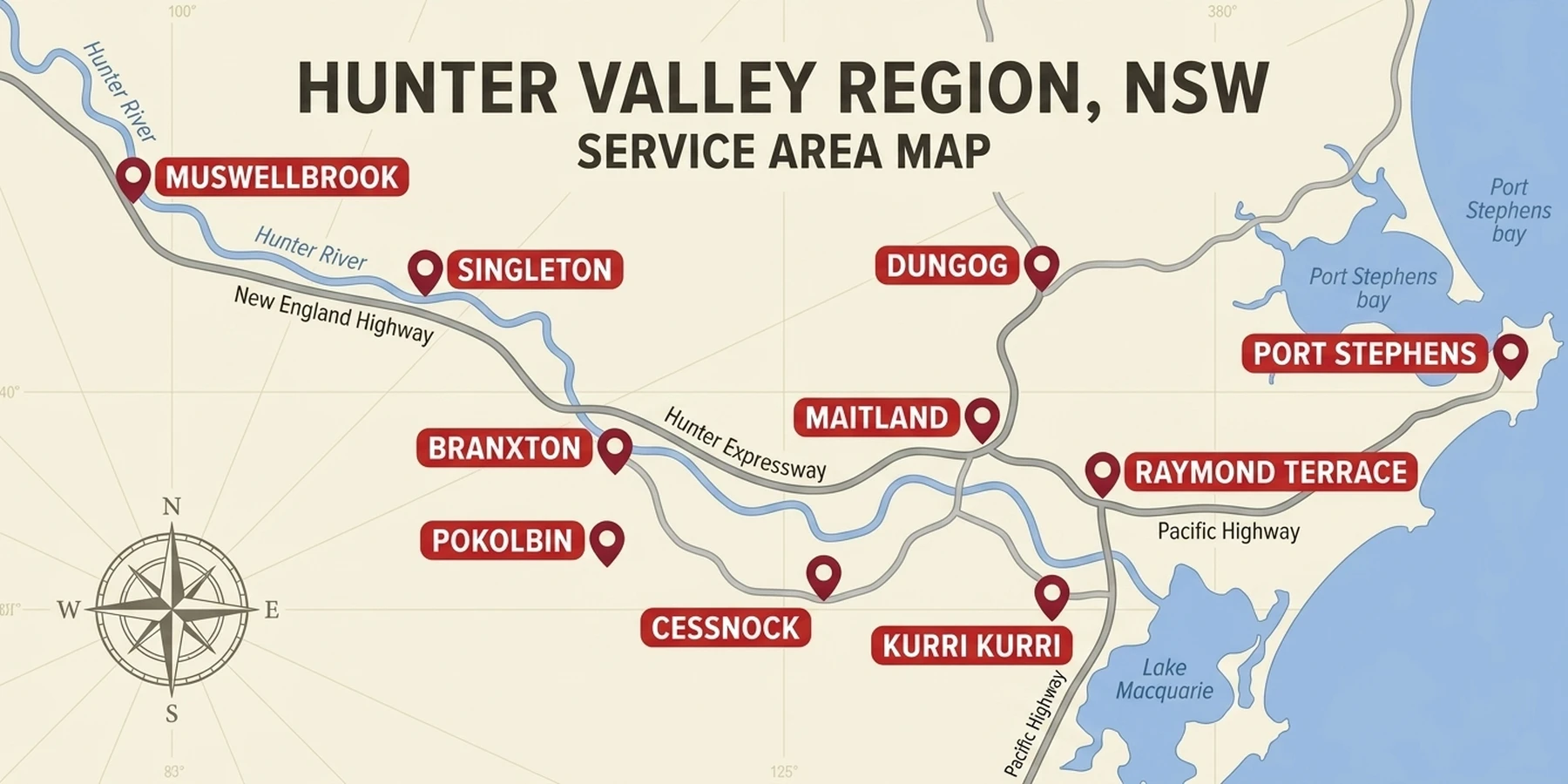
Raymond Terrace itself is mostly on Hunter Water sewer; Port Stephens Council rates the town as moderate reliance on on-site systems and Hunter Water runs a treatment works there. The country around it is another matter. Williamtown, Nelsons Plains, Seaham and East Seaham, Balickera, Eagleton, Hinton, Wallalong, Woodville, Butterwick, Duns Creek, Brandy Hill, Glen Oak, Twelve Mile Creek, Heatherbrae and Tomago are all on Port Stephens Council’s high-reliance list, which means most homes there run a septic tank, an aerated wastewater treatment system (AWTS) or a pump-out tank. That belt sits where the Hunter and Williams rivers meet, beside the region’s biggest drinking-water storage, and partly inside a PFAS management area, so a tank here comes with more rules than most.
Hunter Valley Septic covers the whole Raymond Terrace rural belt for pump-outs, AWTS servicing, inspections and trench diagnostics. Note that Hinton, Wallalong, Butterwick, Glen Oak and Brandy Hill carry Maitland postcodes but sit in Port Stephens Council’s area; the rules on this page apply to them, not Maitland’s. Call 0468 278 123 to book.
Two rivers and a floodway
The Hunter and Williams rivers join just upstream of Raymond Terrace, and the Hunter Valley Flood Mitigation Scheme, built after the 1955 flood that killed 14 people, runs a floodway at Raymond Terrace and declared floodplains at Hexham, Tarro, Woodville, Tomago and Fullerton Cove. Any works on or near the levees or within a declared floodplain must be referred to the state water department under section 256 of the Water Management Act 2000, which can include a tank replacement or trench on the river flats at Woodville or Nelsons Plains. It has held through the floods of 1971, 1977, 2007, 2011 to 2013, 2015, 2021, 2022 and May 2025; in July 2022 flood warnings were issued for the Hunter River at Raymond Terrace as well as Maitland and Singleton.
Port Stephens Council classes a flood-prone site as high risk for on-site sewage, and the state guidelines for flood-prone sites want the electrics and controls above the 1-in-100-year flood line, a sealed treatment tank, and a pressure-dosed application area above the 1-in-20-year line. On the flats, that is the starting point for any replacement planning, and after a flood NSW Health’s advice is to keep the system out of use until the water has dropped below the disposal area and the whole system has been inspected by a licensed plumber or an authorised service technician. If a tank is pumped out in saturated ground it should be refilled promptly so it does not float and snap its pipes.
Rainfall is coastal: Williamtown RAAF averages 1,134 mm a year, and March is the wettest month (127 mm), September the driest (60 mm). Autumn is when the flats are wettest and trenches are under most stress.
Grahamstown Dam and the catchment rules
Grahamstown Dam is an off-river storage formed by an embankment across the Grahamstown Moors between Raymond Terrace and Medowie, built between 1955 and 1965 and enlarged in 2005, holding up to 182,000 million litres and supplying around half of Hunter Water’s drinking water. On average 37 per cent of its inflow is Williams River water pumped from Boag’s Hill near Clarence Town through the 9 km Balickera Canal, Seaham Weir holding the fresh water above the tidal reach. The Grahamstown Catchment Area and the Williams River Catchment Area are special areas under the Hunter Water Regulation 2024. Clause 6 makes it an offence (up to 70 penalty units for an individual) to put in or run an on-site sewage system on land in a special area unless it is covered by a development consent, a Local Government Act approval or an environment protection licence.
So a council-approved system in Balickera or Seaham is lawful; an unapproved one breaches the catchment regulation as well as council rules. Hunter Water lists on-site systems among the key threats to water quality in the dam, says Grahamstown’s water quality has been declining, and in its own fact sheet asks residents of the catchment to properly maintain and inspect their septic systems. Council must refer development that may significantly affect catchment water quality to Hunter Water, and Hunter Water says it supports, in principle, upgrades to existing on-site systems on developed lots.
The Williamtown PFAS management area
Williamtown, Fullerton Cove and parts of Salt Ash sit inside the NSW EPA’s Williamtown Management Area, in three zones set in 2017 after an expert review led by the NSW Chief Scientist. The EPA’s precautionary advice is that in the primary zone groundwater, bore water and surface water should not be used for any purpose, and that in the secondary and broader zones they should not be used for drinking, cooking, pools or paddling; town water is safe to drink and use throughout the area. The EPA also states that drain-clearing works do not pose a significant risk if normal occupational hygiene practices are followed.
For a septic owner in the zone, the consequences are practical rather than dramatic. Households run on mains water, so that is the flow the tank handles. Bores are not used, so the 250-metre bore buffer in the council criteria is about neighbours’ bores and the catchment rather than your own. And anyone working around drains, including us, follows the EPA’s handling advice. We do not speculate about PFAS and effluent; the EPA’s published advice is the reference.
Port Stephens Council’s approval and inspection cycle
Every on-site system in the Port Stephens area needs an approval to operate that renews each year, 1 September to 31 August, with the $140.00 fee (2026-27) on the rates notice and no application required. Council inspects on a 1, 2, 3 or 5-year cycle by risk. A good deal of the river-flat and Grahamstown-fringe country ticks Council’s high-risk boxes: a block under 2,000 m², weak-structured clay or sand, flood-prone ground, a primary-only system, a water table within 0.6 m, catchment land, or buffers that fall short. Council’s Low (TS) category rewards a secondary treatment system that was approved, is on a maintenance agreement and has nothing outstanding on its service reports: such systems are managed by exception rather than routinely inspected, and any system can drop a risk level after two clean programmed inspections in a row. When a property changes hands Council reissues the approval to the new owner once the Land Titles Office notifies it, and Council offers its own pre-purchase inspection on written request ($427.00), separate from our pre-purchase inspection.
Our AWTS servicing here is $90 to $150 a visit with the service report sent to Port Stephens Council after each visit, which is what earns the Low (TS) category. Our inspections are $250 to $450 for a council compliance audit, and a routine pump-out runs from $350 for the smallest domestic tanks to $900 for 5,000-litre-plus systems (the full band table is on that page), with no travel surcharge in the Port Stephens corridor. Each load goes, under NSW EPA waste rules, to a licensed treatment works that has agreed to take it, and you keep the disposal docket. Where the fix is a new trench, a distribution box or sanitary pipework, that is licensed plumbing and drainage work; it is carried out by licensed plumbing and drainage contractors we work with, and their NSW licence number appears on every quote.
Frequently Asked Questions
Is Raymond Terrace on sewer?
The town is: Hunter Water runs the Raymond Terrace wastewater treatment works and Port Stephens Council rates the town as only moderately reliant on on-site systems. The rural localities around it (Williamtown, Nelsons Plains, Seaham, Balickera, Hinton, Wallalong, Woodville and the rest) are high reliance, meaning most properties are on tanks.
Hinton has a Maitland postcode. Which council’s rules apply?
Port Stephens Council’s. Hinton, Wallalong, Butterwick, Glen Oak and Brandy Hill are in the Port Stephens local government area, so the approval renews annually on the rates notice and the risk-based inspection cycle applies.
Can I install a septic system in the Grahamstown catchment?
Yes, with a council approval. The Hunter Water Regulation 2024 prohibits on-site systems in the special areas except under a development consent, a Local Government Act approval or an environment protection licence, and Council refers catchment applications to Hunter Water. An approved, serviced system is lawful; a lapsed approval is a problem worth fixing quickly.
What should I do with my septic system after a flood on the Williams or Hunter?
Keep it out of use until the water has dropped below the disposal area, then have the whole system inspected before using toilets or drains, as NSW Health advises. Do not leave a pumped tank empty in wet ground. Book a post-flood inspection and, if sewage is backing up, an emergency pump-out.
Does living in the Williamtown PFAS zone change my septic system?
Not the system itself. It changes water use: the EPA’s advice is not to use bore or surface water in the primary zone for any purpose, and not for drinking, cooking or pools in the other zones, so your household and your tank run on mains water. Work around drains follows the EPA’s hygiene advice.
How do I get out of Port Stephens Council’s inspection cycle?
Run a secondary treatment system under a valid approval with a maintenance agreement and clean quarterly service reports. Council’s Low (TS) category manages such systems by exception rather than routine inspection, and two consecutive satisfactory inspections can move a system down a risk category.
Ready to book a pump-out, AWTS service or inspection around Raymond Terrace? Call 0468 278 123 or use the booking form with your locality and a note about access and flood history. You will hear back within 24 hours in business hours, and a routine job is usually on the run within 48 hours.
Request Received!
Thank you for reaching out. Our Hunter Valley dispatch team will call you back promptly to confirm details and provide an upfront quote.
Call us directly on 0468 278 123