Quarterly AWTS servicing in the Hunter Valley is the one job an aerated system owner cannot put off. The unit depends on an air blower running around the clock, a submersible irrigation pump, a chlorinator, and a population of bacteria that dies off if the air stops for long. Every three months an authorised AWTS service technician has to test, top up and record all of it, then send the service report to your council. This page covers the checks, the paperwork, the repairs that come out of it, and what each part costs.
We service the common NSW Health accredited brands on rural blocks from Cessnock and Maitland through to Singleton, Port Stephens, Dungog and Muswellbrook. Hours are Monday to Friday 7:00 to 18:00 and Saturday 8:00 to 16:00, with an emergency line outside those times.
Why it is every three months, and who actually says so
Plenty of sites call quarterly servicing "council law". The real chain is a bit more roundabout, and knowing it helps when you read your approval to operate.
NSW Health does not license service technicians. What it does is accredit AWTS designs: each model on the NSW Health register of accredited AWTS holds a certificate with conditions attached. Two of them matter here. The owner must enter into a minimum 12-month contract with a service agent employed or authorised by the manufacturer, and the system must be serviced at three-monthly intervals. Clause 45 of the Local Government (General) Regulation 2021 then makes those certificate conditions a condition of the approval to operate your council issued under section 68 of the Local Government Act 1993. So the interval comes from NSW Health, and the council enforces it through your approval.
The Hunter councils say it in their own words. Cessnock City Council states that quarterly servicing is a requirement of both the accreditation and the approval to operate. Muswellbrook Shire asks for servicing at generally three-month intervals by an approved service agent. Dungog Shire wants an annual contract covering four services, and Singleton Council says every three to four months by a council-approved provider. None of them accredits technicians, and we do not claim to be accredited either.
What a quarterly service covers
The NSW Health accreditation guideline sets eight minimum checks for every three-monthly service:
- The chlorinator and the disinfectant: how many tablets are left, whether the feeder is eroding them evenly, and a top-up.
- The pump and air blower: airflow, noise, temperature and the blower's air filter.
- The alarm system: we lift the high-water float and confirm the buzzer and light in the house panel both respond.
- Slime growth on the filter media. Too little means the aeration chamber is starved; heavy growth sloughing off means solids are carrying over.
- The sludge return system: confirming the airlift or venturi is moving settled solids from the clarifier back to the primary chamber.
- The effluent irrigation pump: float switch, discharge pressure and the check valve.
- The land application area: ponding, run-off, odour, effluent leaving the block, blocked or broken sprays or drip lines, and the warning signs the OLG guidelines require on every surface-irrigated area.
- On-site testing for free residual chlorine, pH and dissolved oxygen.
Beyond the eight, we measure sludge and scum depth in the primary chamber with a sludge judge, because the council service report asks outright whether desludging is needed and a visual look cannot tell you. We also clean the irrigation disc filter (Fuji Clean specifies a filter of at least 130 micron ahead of drip lines, and it is the part owners most often report clogging), flush the drip lines where there is a flush valve, and clean or swap the blower air filter. A visit with nothing wrong takes around half an hour; Dungog Shire's guidance puts it at 20 to 25 minutes.
The effluent standard your system is tested against
Every accredited AWTS certificate carries the same in-service standard for a random grab sample of final effluent: BOD5 under 30 mg/L, suspended solids under 45 mg/L, E. coli under 100 cfu per 100 mL, and free residual chlorine above 0.2 and below 2.0 mg/L. The chlorine figure is the one we check on the spot, and it tells us whether the tablets are dosing correctly for the amount of water your household is putting through.
On chlorine itself: the standard AWTS tablet in Australia is trichloroisocyanurate in an erosion feeder, which needs no power supply. Whether a plain pool-shop tablet is acceptable depends on the brand. Ozzi Kleen's manual allows jumbo pool chlorine tablets if you run out between services; Econocycle and Super-Treat say to use nothing but the manufacturer's recommended product. Our rule is simple: use only the tablet your manufacturer or service agent specifies, never mix tablet types in the one feeder, and never tip pool chlorine or bleach down the sink to "help". Strong disinfectants in the drain kill the treatment bacteria, and Aqua Nova's manual warns that recovering from that can mean pumping out both tanks.
The service report: what is in it and where it goes
This is the part nobody explains. The NSW Health guideline requires two forms at every service. The manufacturer's service sheet records the readings and any parts fitted, and you get a copy. The second is the NSW Health Local Council Service Report, which asks a fixed set of questions: was the system serviced to the manufacturer's requirements, is it functioning correctly, does the sludge measurement call for desludging, were the alarms tested and functional, was the final effluent tested and disinfected, are chlorine tablets remaining, is there ponding, run-off or effluent leaving the premises on the land application area, and has the owner taken the actions recommended last time.
We send that report to your council after each visit, as your approval to operate requires. Cessnock City Council asks for it within seven days of the service. Maitland, Singleton, Port Stephens, Dungog and Muswellbrook ask for it to be forwarded to council, and the Office of Local Government's 2025 guidelines set 14 days as the norm. Two things follow. Legally the owner is the one who must make sure council receives the report, so we give you a copy too. And the service agent is obliged to tell council if an owner does not act on recommended repairs, which is why we do not promise a compliant outcome. We do the service and the paperwork; you act on what the report says.
A clean service history pays off. Port Stephens and Dungog both place a secondary system that is serviced under a maintenance agreement with no outstanding issues in a "Low (TS)" category that is managed by exception instead of routine council inspection. Maitland City Council's low-risk criteria, which bring a five-year approval renewal, start with an AWTS that has a satisfactory history and regular service reports; a unit without that history is rated high risk and renewed every two years.
What goes wrong, and the repairs we do
NSW Health's certificates expect five years of service life from mechanical and electrical parts and fifteen from the tank, so a blower or pump failing somewhere in year five to eight is normal wear. Manufacturer warranties on those parts run two to three years, and every one of them is conditional on quarterly servicing by an authorised agent.
Air blowers
Most Hunter units run a small linear diaphragm blower: Fuji Clean's MAC100 on the ACE 1200 is rated at 68 watts and runs 24 hours a day, and Everhard's Aqua Advanced uses two XP-80 units. Diaphragms and air filters are consumables. Fuji Clean puts their replacement interval at 12 to 24 months, and a diaphragm service kit is the cheap fix that saves a blower. Taylex fits a Nitto piston blower (86 watts) with no diaphragms at all. When a blower is past a kit, we replace it with the model the certificate specifies or an equivalent with the same airflow. Keep the blower housing above flood level: Envirocycle treats water damage to a blower in heavy rain as owner negligence, which matters on Hunter River and Williams River floodplain blocks.
Irrigation pumps and float switches
The irrigation pump is a small submersible (a Davey D25 or D42 on a Taylex, a FujiSub on a Fuji Clean, a Reefe on an Envirocycle) controlled by a float. The commonest failure is the float rather than the pump: Ozzi Kleen's certificate describes the float cable slipping out of its groove so the pump never switches off, runs dry and burns out. Under our repair-first rule a faulty float switch is a $250 to $650 fix, not a new pump. Where the pump itself has gone, replacement is $600 to $1,200 installed. Any hard-wired electrical work is done by a licensed electrician, as the accreditation conditions require.
Alarms and blackouts
Every brand's manual gives the same three steps when the alarm sounds: mute it, cut water use, call your service agent. The mute lasts 24 hours on Fuji Clean and Taylex units and 9 hours on an Ozzi Kleen. In a power failure the blower and pump stop and the tank stores the incoming flow; Fuji Clean's ACE 1200 holds at least 1,104 litres before it overflows. An Aqua Nova alarm will not sound during a blackout, while the Fuji Clean panel has a battery and will. Once power returns, check the blower has restarted; Econocycle's advice if it has not is to switch off for ten minutes and try again. Never turn the system off for holidays. Fuji Clean warns that prolonged loss of power kills the bacteria, Taylex's manual says never switch it off, and Singleton Council writes the same instruction into its OSSM page.
Looking after the irrigation area between visits
Treated AWTS effluent may go to above-ground spray, mulch-covered surface drip or shallow subsurface drip, whichever your council approved, and never onto vegetables or fruit or back into the house. Keep the warning signs up. Keep stock, vehicles and children off the area; Muswellbrook Shire requires irrigation areas restricted to lawn and shrubs, signposted and fenced. Keep vehicles off the tank too: Everhard tests its tanks to a 500 kg top load and says no traffic within 600 mm, and Taylex tanks are rated non-trafficable at 300 kg. If you spot ponding, a sour smell or unusually lush green strips, ring us before the next scheduled visit.
Brands and models we service
- Fuji Clean: ACE 1200 (NSW Health certificate STS-AWTS042) and ACE 3000, plus the earlier CE1500-EX still common on Hunter blocks. Hand-laminated fibreglass tanks made in Yatala and Mordialloc.
- Taylex: ABS 1500 concrete and PABS 1500 poly (STS-AWTS049 and 050) and the ABSNR 1350 and 2000 models. Taylex says it was founded in 1969 and was the first company to make home sewage treatment plants in Australia.
- Ozzi Kleen: RP10 and the RP10A and RP10S variants, a single poly tank with cyclic aeration and a sludge tube instead of a separate septic chamber.
- Everhard Aqua Advanced, and the older Aqua Nova units it replaced.
- BioCycle Pro and Econocycle EcoPro, the same Warragamba-built design sold under two names.
- Garden Master Elite, from Wastewater Australia, whose head office is at Rutherford in the Maitland LGA.
- Envirocycle Oxyfix from Heatherbrae in the Port Stephens LGA, and the older Envirocycle Model 10 units that were built for UV disinfection and four-monthly servicing (today's certificates require three-monthly).
- Super-Treat ST10, Ultraclear, BioSeptic, Alpha Treat and Rivatec.
Certificates are time-limited and a model can drop off the register, so if you are buying a property with an unfamiliar unit, check it against the NSW Health list or ask us to during a pre-purchase septic inspection. Our comparison of the two most common brands is in Fuji Clean vs Taylex.
AWTS servicing prices
| Service | Price (AUD) |
|---|---|
| Quarterly Routine Servicing Contract, per visit (including chlorine replenishment, sludge test, blower filter cleaning, and council OSSM compliance log submission) | $90–$150 per visit ($360–$600 per year) |
| Air Blower Replacement | $650–$1,400 installed |
| Submersible Irrigation Pump Replacement | $600–$1,200 installed |
| Full AWTS Desludge & Total Pump-Out | $450–$750 |
| Air blower diaphragm service kit | $120–$250 |
| Repair-first fixes: root-blocked inlet baffle, faulty air blower diaphragm, electrical float switch | $250–$650 |
There is no travel surcharge across the Maitland, Cessnock, Singleton or Port Stephens LGA service corridors. The desludge is a separate vacuum truck job and is never part of the quarterly fee; every manufacturer's manual says the same. Electricity is the other running cost: Fuji Clean publishes $200 to $300 a year for the ACE 1200, and Taylex rates the ABS 1500 at 2.21 kWh a day, roughly 807 kWh a year. For a full first-year budget with parts, read our AWTS servicing cost guide; to weigh an AWTS against a tank and trenches, see Septic tank vs AWTS.
What is not included, and who does licensed work
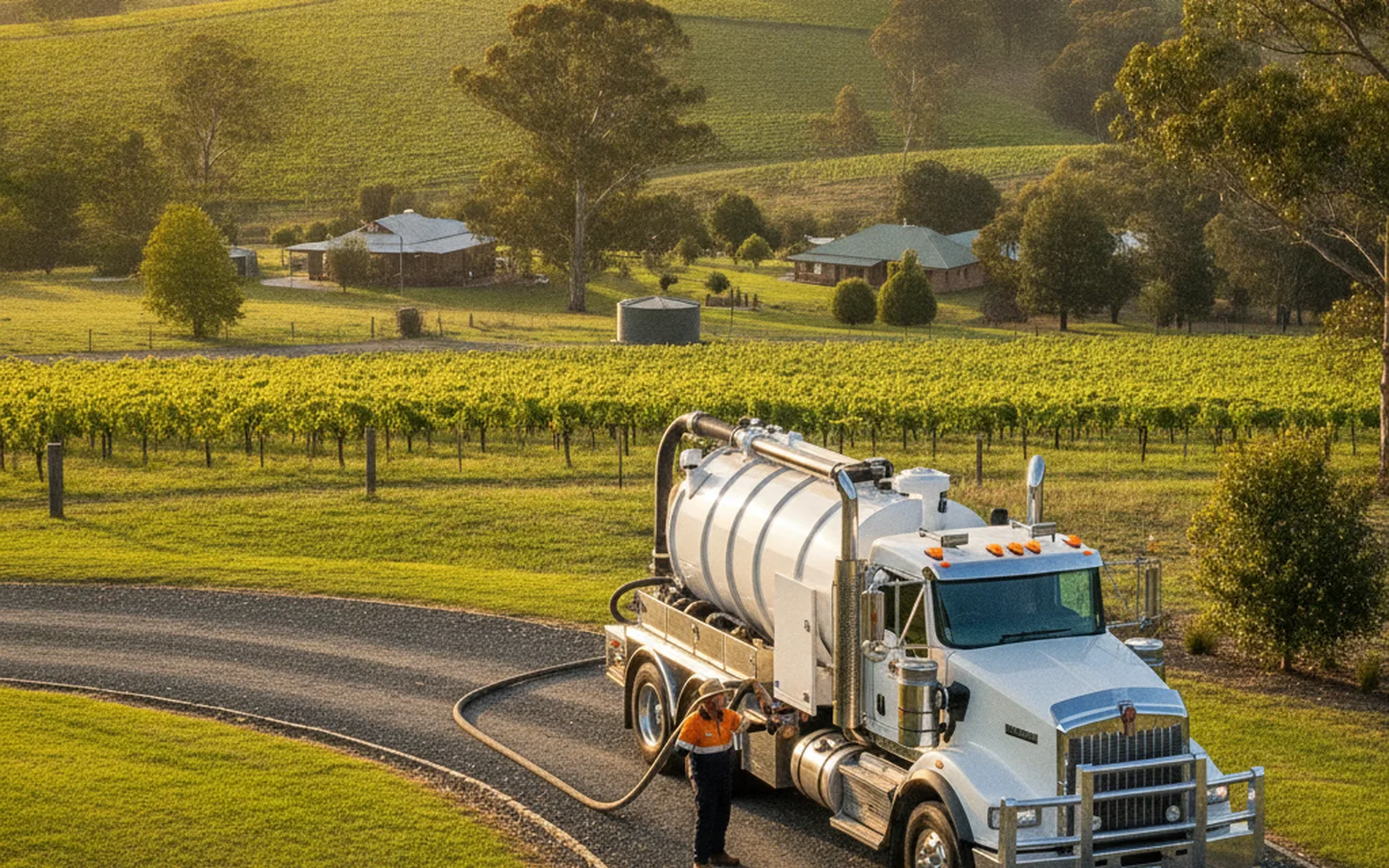
Servicing keeps an existing system within its accreditation. It does not cover installing or replacing an AWTS, laying or rebuilding an irrigation or trench area, or work on the sanitary pipework to and from the tank. That is plumbing and drainage work under NSW law and is carried out by licensed plumbing and drainage contractors we work with; their NSW licence number appears on every quote. Hard-wired electrical work is a licensed electrician's job. The desludge is done with our vacuum truck, the same one that handles conventional septic pump-outs, and the waste is transported and disposed of under NSW EPA waste rules at a licensed treatment facility that has agreed to accept it, with a disposal docket for every load.
Servicing across the Hunter
The biggest concentration of AWTS units we see is on the unsewered lots around Cessnock, where small lots and slow-draining soils push new builds toward secondary treatment and where the seven-day report window applies. Around Port Stephens the payoff for a tidy service history is real, because well-serviced units drop out of routine council inspection. On Maitland floodplain blocks the standing advice is about blower height and what to do once water has been over the lid. On Dungog farm stays and holiday cabins, Dungog Shire asks for a technician service at each start-up after the place has sat empty, which we can line up with your booking season.
To book a quarterly contract, a one-off service before settlement, or a repair, call 0468 278 123 or use the booking form. Tell us the brand and the last service date and we will call you back within 24 hours during business hours.
Frequently Asked Questions
Is quarterly AWTS servicing actually mandatory in NSW? ▼
Yes, but the rule comes from the system's NSW Health accreditation rather than from a servicing law. Every accredited AWTS design carries a certificate condition that the owner holds a service contract and has the unit serviced at three-monthly intervals by a service agent employed or authorised by the manufacturer. Clause 45 of the Local Government (General) Regulation 2021 makes those certificate conditions a condition of your council approval to operate, which is why Cessnock, Muswellbrook and Dungog all state the three-monthly service on their OSSM pages (Singleton says every three to four months).
How much does AWTS servicing cost in the Hunter Valley? ▼
Our quarterly routine servicing contract is $90 to $150 AUD per visit, or $360 to $600 AUD a year, and that covers chlorine replenishment, the sludge test, blower filter cleaning and the service report to council. Parts are extra: an air blower replacement is $650 to $1,400 AUD installed and a submersible irrigation pump is $600 to $1,200 AUD installed. A full desludge of the primary chamber is a separate vacuum truck job at $450 to $750 AUD.
Where does the service report go, and do I get a copy? ▼
After each visit we complete the manufacturer's service sheet and the NSW Health Local Council Service Report, then send the council copy to your council as your approval to operate requires. Cessnock City Council asks for it within seven days; the other Hunter councils follow the 14-day norm in the NSW Office of Local Government guidelines. Legally it is the owner's job to make sure council receives it, so you always get your own copy as well.
What happens if I skip a service or two? ▼
Three things, usually in this order. The chlorine tablets run out and the effluent going onto your lawn is no longer disinfected; the manufacturer's warranty on the blower and pump lapses, because Fuji Clean, Taylex and Ozzi Kleen all tie it to quarterly servicing by an authorised agent; and council notices the missing report. Cessnock charges a $181 re-inspection fee in 2026-27 where an owner fails to act on a service report, and Maitland rates an AWTS without a satisfactory service history as high risk, which shortens the approval renewal to two years.
Can I service my own AWTS? ▼
Not under the accreditation conditions. The NSW Health guideline says the owner must not service the system unless the manufacturer has authorised them, and the service agent has to have completed a servicing course and given their details and credentials to council. You can and should keep an eye on it between visits: listen for the blower, check the alarm light, and look for ponding or odour on the irrigation area.
Does an AWTS keep working in a blackout? ▼
Not properly. The blower and irrigation pump stop, so nothing is aerated or pumped out and the tank simply stores what comes in. Fuji Clean's ACE 1200 holds at least 1,104 litres of emergency storage and Ozzi Kleen quotes about 1,000 litres, so cut water use right down until power returns, then check the blower has restarted. Never switch the power off yourself, even on holiday, because a long stretch without air kills the treatment bacteria.
How often does an AWTS need to be pumped out? ▼
When the measured sludge says so. We check sludge depth in the primary chamber at each service, and the 2025 OLG guidelines call for a desludge once sludge and scum reach one-third of the chamber depth or come within 150 mm of the inlet or outlet. Fuji Clean recommends every three years and Taylex says five to ten; for a full-time household three to five years is typical. The desludge is $450 to $750 AUD and is not part of the quarterly fee.
What should I do when the AWTS alarm goes off? ▼
Press the mute button on the panel (it sounds again after 24 hours on Fuji Clean and Taylex units and after 9 hours on an Ozzi Kleen), cut household water use to a minimum, and call us on 0468 278 123. A high-water alarm usually means the irrigation pump or its float switch has failed; a low-air alarm points to the blower. Do not open the tank lids to investigate.