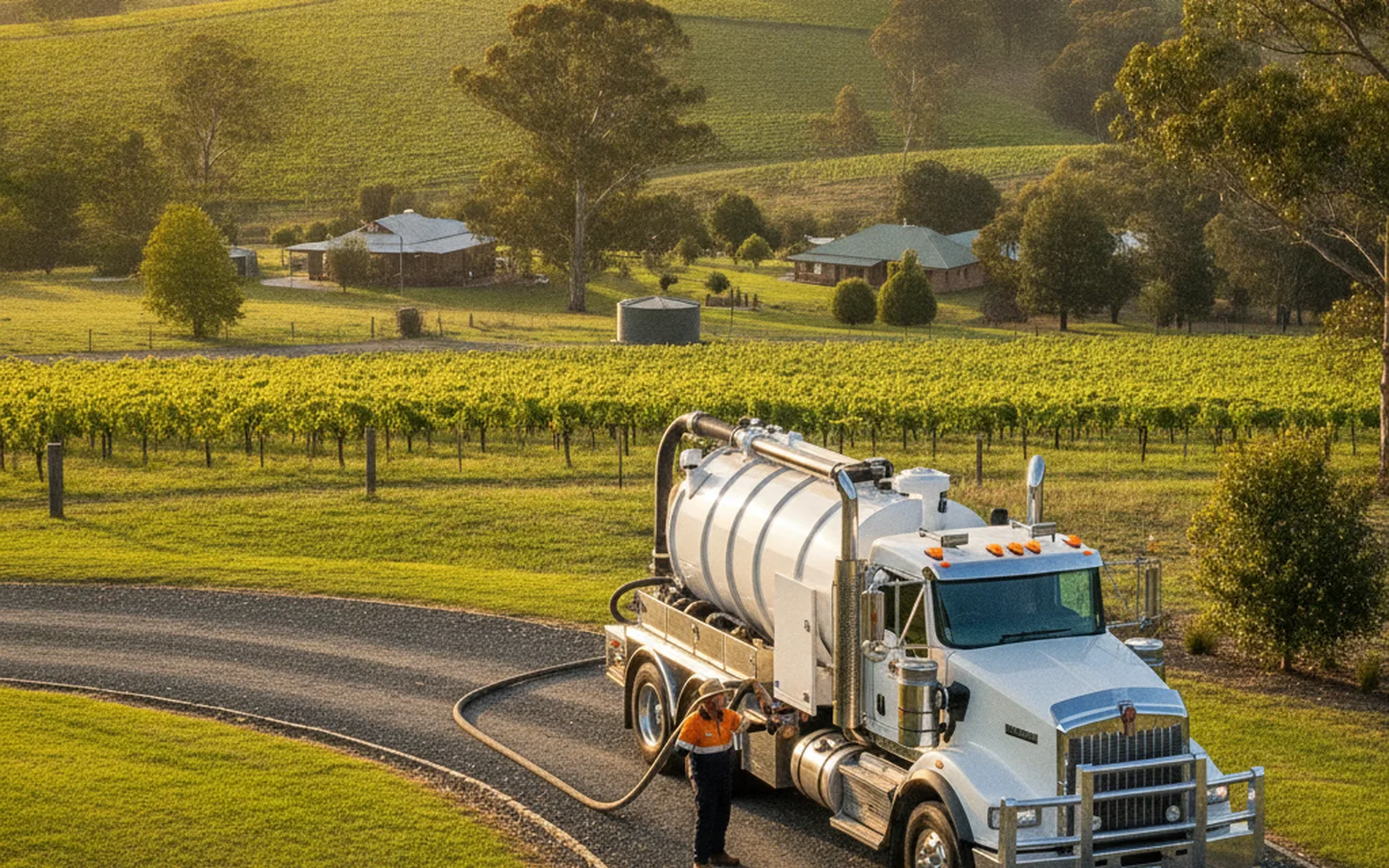
Septic tank pumping in the Hunter Valley is the one maintenance job a conventional septic system cannot skip. Every shower, flush and load of washing sends solids into the tank, where the heavy fraction settles as sludge and the fats and soap float as scum. The tank only works while there is enough clear liquid between those two layers for wastewater to settle. Once the solids take up too much of the depth, they wash out into the absorption trench (drain field) and clog it, and a clogged trench costs far more to put right than a truck visit.
Hunter Valley Septic runs routine pump-outs and desludging for concrete and poly septic tanks across Maitland, Cessnock, Singleton, Port Stephens, Dungog, Muswellbrook, Kurri Kurri and the rural acreages between them. Most routine septic pump-outs are scheduled within 48 hours, and there is no travel surcharge across the Maitland, Cessnock, Singleton or Port Stephens LGA service corridors. What you pay depends on tank size and access, not on how far out you are.
This page covers what the job involves, how to tell when your tank is due, what to do before the truck arrives, where the waste ends up, and the full price list.
What happens on the day
A pump-out is not just a hose in a hole. The sequence on a typical Hunter property runs like this.
- Find and open the tank. If you have risers, this takes a minute. If the lid is under turf or a garden bed, we probe for it and dig it out. Lids buried deeper than 300 mm without risers carry a modifier (see the price table), and we agree it with you before a spade goes in.
- Measure the sludge and scum. We drop a sludge judge (a clear sampling tube) into each chamber so you can see how much of the tank was solids. The OLG guidelines are blunt that sludge levels cannot be judged by looking at the surface, and they note that some tanks show no scum layer at all while carrying a heavy sludge blanket underneath.
- Pump all three layers: scum, liquid and sludge. A hardened crust gets broken up so it goes through the hose rather than sitting on top. Compacted sludge in a tank that has gone seven years or more without a pump-out sometimes needs high-pressure back-pulsing to shift; that is the heavy-sludge modifier, and again, quoted first.
- Leave a little behind on purpose. The OLG guidelines say roughly 10 per cent of the sludge should be retained to regenerate the bacteria that digest waste. A tank scoured back to bare concrete restarts from nothing.
- Look inside while it is empty. We check the inlet and outlet tees (the square junctions), the baffle wall between the chambers, the lid seal, and the outlet filter if one is fitted. Cracks, root intrusion or a collapsed tee get noted, and we tell you what it would cost to fix and who does that work.
- Close up and hand over. The lid is resealed and secured so children cannot open it, and you get a disposal docket for the load. The pumping itself usually takes 30 to 60 minutes; allow longer for a buried lid or a long hose run.
We never climb into a tank. Under the NSW Confined Spaces Code of Practice, putting your head or upper body through the lid counts as entering a confined space, and hydrogen sulphide from disturbed sludge settles at the bottom. Keep kids and pets away from open lids while we work, and no smoking or naked flames near the tank.
Pump-out, desludge, clean or inspection: which one are you booking?
Operators use these words loosely, which is how people end up paying for less than they expected.
- A pump-out and a desludge are the same job when done properly: all three layers removed, crust broken, a small sludge seed left. If someone quotes a cheap price to pump the liquid and leaves the sludge, you have paid to empty the part of the tank that was not the problem.
- A clean is a marketing word for the same job, sometimes with a hose-down of the walls. It does not mean chemical cleaning, and nothing should be added to the tank.
- An inspection is a separate service with a written report. Every pump-out includes a look at the tees and baffles, but a report for a property sale or a council approval to operate is a different job with its own price line. A pre-purchase or council OSSM inspection bundled with a pump-out adds $100 to $200, and a standalone council compliance audit is $250 to $450.
How often: the one-third rule, not the calendar
The intervals people quote (every three years, every five years) are rules of thumb. The actual NSW standard is a measurement. The NSW Office of Local Government's 2025 Onsite Wastewater Management Guidelines say a tank must be desludged no later than when the combined sludge and scum reaches one-third of the tank depth, or when either layer comes within 150 mm of the base of the inlet or outlet. The guidelines add that roughly every three to five years is common for a full-time household with a correctly sized tank.
Why the spread? NSW Health's tank-sizing method allows 80 litres of sludge and scum per person per year against a 1,550 litre sludge allowance, which works out at about every four years for a tank sized for five people, and shorter for more. A couple in a large tank can go longer; a family of six in a 3,000 litre tank cannot. The table pulls together what the official sources say.
| Source | Desludging guidance |
|---|---|
| OLG Onsite Wastewater Management Guidelines (2025) | Desludge at one-third of tank depth, or within 150 mm of the inlet or outlet; three to five years is common at full occupancy |
| The Easy Septic Guide (OLG) | Pump every 3 to 5 years; a tank not pumped in 3 to 5 years is listed as a warning sign |
| NSW Health vessel accreditation guideline | About every 4 years for a tank sized for 5 people; shorten the interval for more occupants |
| Upper Hunter Shire Council | A family of 4 needs a pump-out at least every 5 years; do not wait until the tank is full |
| AWTS primary chamber (manufacturer manuals) | Desludging every 3 to 5 years on top of quarterly servicing; Fuji Clean recommends every 3 years, Taylex 5 to 10 years |
Holiday lets, cellar doors and function venues around Pokolbin fill faster than a house with the same tank because the load arrives in weekend surges. We do not put a fixed interval on those. We measure at each visit and set the next date from the sludge depth, and venues on holding tanks are scheduled by volume rather than by the calendar. Guessing is how trenches die.
If you are not sure when your tank was last done, the warning signs of a full tank are slow drains, gurgling, odour near the tank or trench, and wet patches over the trench in dry weather. Better still, book a measurement. It is cheaper than waiting for a backup.
Getting the truck to your tank
Access is what changes a pump-out price in the Hunter, not distance. Three questions decide it.
How close can the truck get? The standard price covers hose runs up to 45 metres from where the truck can safely park. That reaches most house tanks from a driveway, and a fair number from the road on smaller blocks. Beyond 45 metres the extended-hose modifier applies ($50 to $120). The OLG guidelines put a tanker's access track at roughly 5 metres wide as a general rule, so a narrow gateway, low branches or a soft paddock after rain can mean a longer hose run rather than a closer park. On the large lots around Singleton and Muswellbrook, tell us the rough distance from the nearest hardstand to the tank when you book and we will price it up front.
Can the lid be found? The OLG guidelines say a tank lid should sit at least 100 mm above finished ground level unless the tank has sealed risers, and NSW Health requires access to be extended to ground level if the tank is buried. Plenty of older concrete tanks in the Cessnock coalfields villages and around Kurri Kurri went in decades ago and have since been lawned, paved or gardened over. If the lid is more than 300 mm down with no riser, the excavation modifier ($75 to $150) covers the digging. An access riser retrofit ($250 to $450) ends that charge for good and makes the next council inspection painless.
What is the ground like? On the Maitland floodplain and the coastal sands around Port Stephens the water table can sit high for weeks after rain. That matters less for the pumping than for what happens afterwards (see refilling below). On the heavier clays of the coalfields, digging out a buried lid after a wet week is slow going, and we may suggest coming back in a few days rather than churning your lawn into a bog.
Before the truck arrives: a short checklist
These are the same things Muswellbrook Shire Council asks owners to do before one of its own on-site system inspections, and they are all it takes for us to do the job while you are out.
- Unlock gates, or send us the code, and move vehicles off the driveway or track the truck will use.
- Restrain dogs and keep children away from the tank area for the visit.
- Mark the lid. A peg, a tent stake or a photo with a landmark saves probing time. If you have never found it, say so and we will locate it (this may count as buried-lid excavation).
- Clear pot plants, mulch, timber and vegetation off the lid and the metre or so around it.
- Tell us what is in the tank. Grease-trap waste, chemical toilet contents and trade waste are handled differently from a normal household tank.
- Leave a hose within reach of the tank. You will want it straight after we finish.
After the pump-out
Refill the tank. The OLG guidelines say a desludged tank must be immediately filled with water to at least two-thirds full, or to the outlet level, to stop hydrostatic uplift, which is a light, empty tank lifting out of wet ground. It sounds unlikely, but the guideline exists because it happens, and it matters most on floodplain and sandy sites with a high water table. A garden hose into the inlet lid does the job while you get on with something else. Some manufacturers' manuals go further and warn against pumping out during or straight after heavy rain, so if your block is saturated we may suggest holding off.
Check the outlet filter. If your tank has an effluent filter on the outlet tee, the OLG guidelines say to check it regularly and wash the biofilm and solids off into a bucket or straight back into the inlet of the tank. The Easy Septic Guide gives the same advice and recommends having a plumber fit one if you do not have it, because a filter keeps solids in the tank and extends the life of the trench. We look at it at every pump-out and tell you if it needs replacing.
Skip the additives. The Easy Septic Guide is direct on this: no amount of additives will help a septic system that needs pumping out or has a failing trench. Your tank reseeds itself from the sludge we left and the waste you send it.
Keep the docket. It belongs with your approval-to-operate file, and it is the evidence councils ask for. The OLG's model approval conditions require owners to keep receipts for pump-outs, services and repairs and produce them if council asks. A buyer's solicitor will ask for the same thing.
Where the waste goes
This is the question almost nobody asks and everybody should. Your tank's contents are transported and disposed of under NSW EPA waste rules at a licensed treatment facility that has agreed to accept it, and you get a disposal docket for every load. Household septic tank waste is not a trackable waste under the POEO (Waste) Regulation 2014, so there is no EPA manifest for a domestic pump-out. The rule that does apply is section 143 of the Protection of the Environment Operations Act 1997: waste may only be taken to a place that can lawfully receive it. Treatment works only accept loads from contractors with a written agreement, and every delivery is logged at the plant. Nothing is tipped on land, into a stormwater drain or down a sewer manhole.
Timing is worth knowing. Hunter Water's treatment plants accept tanker loads between 7am and 3pm on weekdays only, and Hunter Water does not take waste that originates outside its area of operations, so Upper Hunter loads go to council-run plants under a separate liquid trade waste approval. A late-afternoon or weekend pump-out is held in the sealed truck and disposed of on the next business day. That is normal, and it has no effect on when we can come to you.
Septic tank pumping prices in the Hunter Valley
Prices are set by tank volume, with a short list of modifiers for access and condition. There is no travel surcharge across the Maitland, Cessnock, Singleton or Port Stephens service corridors, and every modifier is quoted before we start.
Routine septic pump-outs (by tank volume in litres)
| Tank Capacity | Tank Type | Typical Price Range |
|---|---|---|
| Up to 3,000 Litres | 2–3 Bedroom Domestic | $350–$500 AUD |
| 3,500 – 4,500 Litres | 3–5 Bedroom Standard Domestic | $400–$650 AUD |
| 5,000+ Litres | Large Rural / Commercial / Dual-Tank | $650–$900 AUD |
Modifiers (added to base)
| Modifier | Amount |
|---|---|
| Emergency / same-day / after-hours dispatch | +$150–$300 AUD |
| Pre-purchase or OSSM council inspection bundled with pump-out | +$100–$200 AUD |
| Deep lid excavation (buried >300mm without risers) | +$75–$150 AUD |
| Difficult access / extended hose run (>45m) | +$50–$120 AUD |
| Heavy hardened sludge (not pumped in 7+ years) | +$75–$150 AUD |
Not sure what size your tank is? Common domestic tanks run from about 3,000 to 5,000 litres, which puts most Hunter homes in the first two bands. Our septic tank size calculator estimates capacity from bedrooms and occupants, and the pump-out cost calculator applies the modifiers above so the number you see is the number we quote. AWTS owners: a full AWTS desludge and total pump-out is $450 to $750 and is separate from the quarterly service, which is covered on the AWTS servicing page.
What a pump-out will not fix
A pump-out buys time; it does not repair a system. If sewage is backing up into the house or effluent is surfacing over the trench, that is an emergency call-out with same-day or next-morning response, and the pump-out is the first step rather than the cure. If the trench has clogged from years of solids carry-over, the options are jetting and biomat rejuvenation of the existing trench or a new trench, and our guide to absorption trench failure signs explains how to tell which you are looking at. Trench construction, distribution-box and sanitary pipework repairs are plumbing and drainage work under NSW law and are carried out by licensed plumbing and drainage contractors we work with; their NSW licence number appears on every quote. Lid, riser and effluent-filter work, jetting of existing trenches, and the pump-out itself are ours.
To book a septic tank pump-out anywhere in the Hunter Valley, call 0468 278 123 or use the booking form with your suburb and a rough idea of tank access. We call you back within 24 hours during business hours with a price, and most routine jobs are on the truck's run within 48 hours.
Frequently Asked Questions
How often should I pump out my septic tank in NSW? ▼
NSW Office of Local Government guidance is every 3 to 5 years for a full-time household with a correctly sized tank. The real trigger is sludge depth: the 2025 OLG guidelines say a tank must be desludged once sludge and scum together reach one-third of the tank depth, or come within 150 mm of the inlet or outlet. More people in the house means a shorter interval, so a big family on a small tank may be closer to 3 years.
How much does a septic tank pump-out cost in the Hunter Valley? ▼
A tank up to 3,000 litres is $350 to $500, a 3,500 to 4,500 litre tank is $400 to $650, and 5,000 litre plus rural, commercial or dual-tank systems are $650 to $900. That includes transport and treatment-plant disposal fees, and you get a disposal docket for the load. Modifiers apply only for after-hours dispatch, deeply buried lids, hose runs over 45 metres or hardened sludge, and we quote them before we start.
Do I need to be home when you pump the tank? ▼
No, as long as the lid can be found, the gate is unlocked and dogs are secured. If the truck can park within 45 metres of the tank and the lid is not buried, we can do the job while you are at work and email your receipt and disposal docket. If we have never seen the property before, a quick phone chat about where the tank sits saves everyone time.
Can you pump only half the tank to save money? ▼
We do not offer it, and the OLG guidelines do not support it either. The sludge that damages trenches sits at the bottom, so pumping the top half removes mostly liquid and leaves the problem behind. A full desludge, leaving roughly 10 per cent of the sludge to reseed the bacteria, is the only version of the job worth paying for.
Where does the sewage go after a pump-out? ▼
Your tank's contents are transported and disposed of under NSW EPA waste rules at a licensed treatment facility that has agreed to accept it, and we give you a disposal docket for the load. Household septic waste is not a trackable waste under the POEO (Waste) Regulation 2014, so there is no EPA manifest; the docket is the paperwork. Treatment plants in the Hunter Water area take tanker loads on weekdays between 7am and 3pm, so a late or weekend load stays sealed in the truck until the next business day.
Will council ask for my pump-out receipts? ▼
It can. The OLG model approval-to-operate conditions ask owners to keep receipts for pump-outs, services and repairs and hand them over if council requests them, and Muswellbrook Shire Council asks for final pump-out receipts when a system is decommissioned. Keep our docket with your approval-to-operate paperwork; it is also useful evidence when you sell.
Can you reach my tank if the truck cannot get close? ▼
Usually. The standard price covers hose runs up to 45 metres from the truck, which reaches most house tanks from a driveway or paddock gate. Runs beyond 45 metres are quoted as a difficult-access modifier of $50 to $120 before we start, and we will tell you on the phone if we think your block needs it.
Should the tank be refilled after pumping? ▼
Yes. The OLG guidelines say a tank must be filled with water to at least two-thirds full, or to the outlet level, straight after desludging so it cannot lift in wet ground. A garden hose through the inlet lid does the job. There is no need for starters, enzymes or additives; the Easy Septic Guide says they will not help a tank that needs pumping.