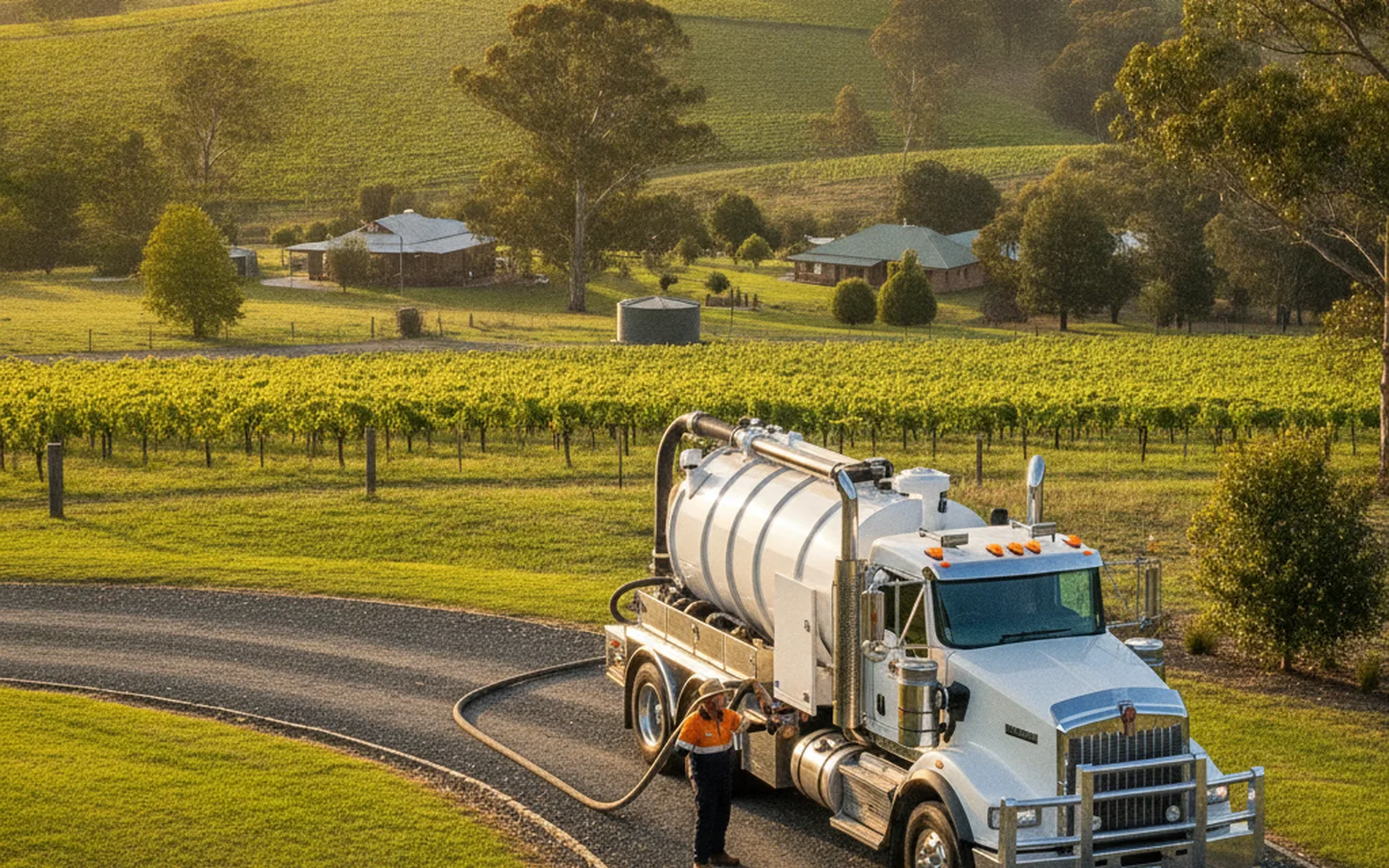
Holding tank pumping in the Hunter Valley covers two very different jobs. One is the domestic pump-out system: a house on a small or difficult block in Maitland, Port Stephens or Cessnock where the council allowed a sealed collection well instead of an absorption trench, and a tanker has to empty it every week or two. The other is the commercial holding tank: the cellar door at Pokolbin that fills over a long weekend, the site shed on a Singleton mine access road, the amenities block behind a wedding marquee. Hunter Valley Septic pumps both, on a fixed schedule or on demand, and hands you a disposal docket for every load.
This page explains how each kind of tank works, when Hunter councils will and will not approve one, how to run a domestic pump-out system without meeting the alarm at midnight, how we schedule commercial tanks by volume, and what the job costs. Domestic prices are the same ones published on our septic tank pumping page; commercial tanks are quoted per job.
Septic tank or holding tank: which one have you got?
A conventional septic tank settles solids and lets the liquid effluent run out to an absorption trench (called a drain field in the US) or an evapotranspiration bed. The soil does the rest. A holding tank has no outlet to the soil. Everything that goes down the drain stays in the tank until a vacuum truck removes it.
In NSW the domestic version is usually called a pump-out system. The Office of Local Government's 2025 Onsite Wastewater Management Guidelines describe it as wastewater treated to a primary standard in a septic tank, then displaced into a collection well with enough storage for periodic collection by a liquid waste contractor. NSW Health also accredits a single pump-out design that combines the septic tank and the collection well in one large vessel. Either way, the give-away on your property is a standpipe near the boundary or driveway: a length of pipe with a screw-on cap or cam-lock fitting that a tanker hose clips onto, so nobody has to drag hose across the yard. The Guidelines specify a draw-off line of at least 75 mm Class 9 PVC buried out to the boundary, a standpipe with a screw-on adaptor or cam-lock and end cap, and a stop valve where the standpipe outlet sits lower than the lid.
If you are not sure what you have, check your council approval to operate. It names the system type. Port Stephens Council lists effluent pump-outs among the system types on its books alongside septic tanks and AWTS units, and Maitland City Council's list of systems found in its area includes effluent pump-out systems too.
When Hunter councils allow a pump-out system
Not often. The OLG Guidelines tell councils that domestic pump-out systems "should only be considered as a last resort, and only where existing OWMS are failing and a connection to sewer is not possible" (OWMS being on-site wastewater management systems), that a new development relying on one should be treated as over-development of the site and not approved, and that "many councils do not accept pump-out systems". You can read the section yourself in the Onsite Wastewater Management Guidelines, section 5.8.2.
Maitland City Council's on-site sewage management policy says the same thing in its own words: it will not approve a pump-out system unless there is no other alternative, and it names an AWTS as the preferred method for new applications in unsewered subdivisions. Maitland also treats a pump-out system with an unsatisfactory history as a high-risk trigger, which drops the approval to operate from a five-year term to a two-year one.
Where a pump-out system does exist, the paperwork is the same as for any other on-site system. Under section 68 of the Local Government Act 1993 you need the council's approval to install "a human waste storage facility" (Part C, item 5 of the Table) and a separate approval to operate it (item 6). Clause 40 of the Local Government (General) Regulation 2021 lists "holding tanks and collection wells used for the receipt and storage of effluent" among the products that must carry NSW Health accreditation before a council can approve them, and NSW Health publishes a register of accredited septic tanks and collection wells for exactly that reason. Our guide to council OSSM inspection rules in NSW explains how the approval cycle works in each Hunter council.
Commercial tanks sit under different rules. NSW Health accreditation does not apply to a facility treating non-domestic sewage, sewage from premises normally occupied by more than 10 people, or an average daily flow above 2,000 litres. Above those limits the Guidelines expect the design to be certified by an engineer or another suitably qualified consultant as meeting the relevant standard (AS 1546.1 for a septic tank or collection well). Cessnock City Council's 2026-27 fee schedule scales its commercial application fee by design flow, with steps at 2,000, 5,000 and 10,000 litres a day, so a cellar door and a five-cabin accommodation property are assessed as the businesses they are. Clause 26 of the Regulation, which lists the plans and reports that must accompany an application to install, does not apply to a facility that will stay on site for no more than 12 months, so for an event or a construction compound ask the council what it wants before the tank arrives rather than after.
Running a domestic pump-out system without drama
The NSW Easy Septic Guide, still published by the Office of Local Government, gives the routine in three lines: a pump-out system in full-time use should be pumped out every one to two weeks depending on the number of people, inspected every one to two years, and never allowed to get more than two-thirds full. It also says every collection well should have a dipstick with a full level marked on it. Dip the well on the same day each week and you will know your rhythm within a month.
Newer wells have the arithmetic built in. The OLG Guidelines size a collection well for a weekly pump-out at a minimum of seven days of flow plus two days of emergency storage, and require a high water level alarm with both a buzzer and a strobe or similar light that triggers when less than 48 hours of storage remains. If you mute it, it must come back on after 24 hours. So when the alarm goes off you have two days, not two hours. Call us that day and it is a routine visit; leave it until the buzzer resets and it becomes a same-day emergency at emergency rates.
The septic chamber ahead of the well still needs desludging like any other septic tank. The Guidelines say a tank must be desludged no later than when sludge and scum together reach one-third of its depth, or come within 150 mm of the inlet or outlet, which for a full-time household usually works out at every three to five years. Ask us to measure the sludge depth on a routine visit and we will tell you when a desludge is due, so you do not pay for one you do not need.
Keep every docket. The OLG model approval conditions require pump-out, service and repair receipts to be retained and produced if the council asks, and the Guidelines tell councils to investigate any property that records no pump-outs. Dungog Shire Council's policy goes a step further: during an investigation it requests the pump-out records for a pump-out system and compares them with the property's water use to judge whether the servicing frequency adds up. The Guidelines also let a council levy an annual charge or special rate for a pump-out service regardless of how often the tank is emptied, so check your rates notice.
Commercial holding tanks in wine country and the Upper Hunter
Pokolbin, Lovedale, Rothbury and Mount View are in Cessnock City Council's area, where any property not connected to Hunter Water's network has to manage its wastewater on site under an approved system. A 2013 NSW Department of Primary Industries profile put the Hunter at over 120 wineries, 65 restaurants and 180 accommodation properties, ranging from small bed and breakfasts to 5,000-bed establishments, with more than 2.8 million visitors spending over $1 billion (2010 to 2012 industry figures), and it notes that the Pokolbin vineyards are supported by large-scale events. Much of that trade lands on weekends and event days. A cellar door restaurant, a function centre or a cluster of guest cabins can put a surprising volume through its tank in two days, and a holding tank copes with that surge better than an absorption trench can, provided somebody is watching the level.
We schedule these tanks by volume rather than by the calendar. Tell us the tank capacity and your bookings and we work back from there: a pump after a wedding weekend, a pump before a long weekend, a standing fortnightly run through the quieter months. Cessnock's fee schedule separates light commercial systems (three or fewer accommodation cabins on one land application area, flows generally up to 2,000 litres a day) from complex commercial systems of 10,000 litres a day or more, and the tanks follow the same split, so a holding tank behind three cabins and one under a function centre get very different schedules. Our Pokolbin service area page has the local detail.
West of Branxton the ground changes and so does the council. Broke and Bulga (the Broke-Fordwich sub-region), Jerrys Plains, Mount Thorley and Warkworth are all in Singleton Council's area. Here the holding tanks we pump are more often site sheds and portable amenities on mine and road projects, caravan park dump points and event sites. Singleton Council runs its own sewerage system rather than relying on Hunter Water, and its liquid trade waste rules specifically cover septic tank waste and the contents of chemical toilets and caravan cassettes discharged at established sites, which matters for where the load can go (more on that below). Our Singleton page covers access on large rural lots.
Port Stephens Council brings a third situation. Its area holds the Tomago Sandbeds and Grahamstown Dam, and the Hunter Water Regulation 2024 makes it an offence to install or operate an on-site sewage management facility inside those special areas without a council approval (or a development consent or environment protection licence). Hunter Water's own development guidelines add that most commercial and industrial developments in the drinking water catchments that are remote from sewer will need their trade wastewater tankered to a licensed treatment facility. So a commercial holding tank at Medowie or Williamtown may well be the approved design rather than a stopgap, and Port Stephens Council tracks pump-out systems by their pump-out figures. Our Port Stephens page has the catchment detail.
Where the waste goes
Household septic and holding tank waste is not a trackable waste under the NSW Protection of the Environment Operations (Waste) Regulation 2014, so there is no EPA manifest and no EPA transport licence for a domestic pump-out. What the law does require, under section 143 of the POEO Act 1997, is that the load is taken only to a place that can lawfully receive it. Your tank's contents are transported and disposed of under NSW EPA waste rules at a licensed treatment facility that has agreed to accept them, and you get a disposal docket for every load.
Two practical points follow. Hunter Water, which runs the treatment works for the Cessnock, Maitland, Port Stephens and Dungog council areas and the Branxton end of Singleton, accepts tanker loads only from carriers holding a written tankered waste agreement, logs each delivery on its e-docket system, and takes deliveries between 7am and 3pm on weekdays. A Saturday pump-out therefore rides in the sealed truck until Monday morning. Hunter Water also refuses waste from outside its area of operations, so a load from Broke or Jerrys Plains goes to Singleton Council's system under its liquid trade waste approval instead. Hunter Water charges the carrier per kilolitre and council-run plants set their own trade waste charges, which is why a large commercial tank is quoted per job rather than from the domestic table.
What a holding tank pump-out includes
- Access check by phone before we roll: where the standpipe or lid is, whether the truck can get within 45 metres of it, and whether the driveway takes a tanker. The OLG Guidelines say a tanker needs roughly a 5 metre wide access road.
- Connection at the standpipe cam-lock or, on older wells, through the lid. Nobody from our crew enters the tank; under the SafeWork NSW Confined Spaces Code of Practice, putting your head or upper body through the lid counts as entry, and hydrogen sulphide from disturbed sludge settles in the bottom of a tank.
- Pumping the well down. On a weekly domestic run the load is liquid effluent and the job is quick; on a commercial tank or a neglected well there is sludge to break up and it takes longer.
- Dipstick and alarm check. We confirm the float and the alarm reset, note the level we found the tank at against the last visit, and tell you if the interval needs to shorten.
- Cap the standpipe, close and secure the lid so children and stock cannot open it, and leave the ground as we found it.
- Disposal docket for the load, emailed or handed over. File it with your approval to operate.
Holding tank pumping prices in the Hunter Valley
A single pump of a domestic collection well is priced by tank capacity, using the same table as a septic tank. Commercial holding tanks, and any tank larger than the table covers, are quoted per job on capacity, access and schedule. We do not publish or charge a per-kilolitre rate.
| Tank Capacity | Tank Type | Typical Price Range |
|---|---|---|
| Up to 3,000 Litres | 2–3 Bedroom Domestic | $350–$500 AUD |
| 3,500 – 4,500 Litres | 3–5 Bedroom Standard Domestic | $400–$650 AUD |
| 5,000+ Litres | Large Rural / Commercial / Dual-Tank | $650–$900 AUD |
| Modifier (Added to Base) | Amount |
|---|---|
| Emergency / same-day / after-hours dispatch | +$150–$300 AUD |
| Deep lid excavation (buried >300mm without risers) | +$75–$150 AUD |
| Difficult access / extended hose run (>45m) | +$50–$120 AUD |
There is no travel surcharge across the Maitland, Cessnock, Singleton or Port Stephens council areas. What moves the price is access or depth, not distance: a lid buried deeper than 300 mm, a hose run beyond 45 metres from the truck, or hardened sludge that needs high-pressure back-pulsing. Any of those is quoted before we start, never added afterwards. For a quick figure on a domestic tank, try the pump-out cost calculator.
When to book
Most routine pump-outs are scheduled within 48 hours. A sewage backup, an active high-water alarm or a tank overflowing at the standpipe gets same-day or next-morning vacuum truck response through our emergency septic service, with the dispatch modifier above. For a standing weekly, fortnightly or monthly run we agree the day and you do not need to be home, provided the standpipe or lid is reachable and any gate is unlocked or on a code we know. Call 0468 278 123, Monday to Friday 7am to 6pm and Saturday 8am to 4pm, or use the booking form.
What we do not do
Installing a collection well, laying the draw-off line and standpipe, altering the sanitary drain from the house, or converting a pump-out system to a septic tank or AWTS is plumbing and drainage work. It is carried out by licensed plumbing and drainage contractors we work with; their NSW licence number appears on every quote. A conversion also needs a section 68 approval to alter from your council before anything is dug, and the council will want a site and soil assessment showing the block can take a land application area (Cessnock City Council treats a change of treatment system or disposal method as an alteration needing approval first). We coordinate the assessment and the paperwork; see septic system installation for how that runs. If your block was approved for a pump-out system because the soil failed, be realistic: an AWTS with a designed irrigation area is the usual way off the weekly truck, and the site report decides whether it is possible.
To set up a schedule or book a one-off pump, call 0468 278 123 or leave your details at the booking form. Tell us the tank size if you know it, and whether there is a standpipe. We call you back within 24 hours in business hours.
Frequently Asked Questions
What is the difference between a septic tank and a holding tank? ▼
A septic tank settles solids and discharges the liquid to an absorption trench or bed, so the soil disposes of the water. A holding tank (in NSW usually a pump-out system with a collection well) has no outlet to the soil; everything stays in the tank until a vacuum truck removes it. That is why one is pumped every three to five years and the other every week or two.
How often does a holding tank need to be pumped? ▼
The NSW Easy Septic Guide says a domestic pump-out system in full-time use should be pumped every one to two weeks, depending on how many people live there, and never be allowed past two-thirds full. Commercial holding tanks are scheduled by capacity and trade: a cellar door or function venue may need a pump after every busy weekend and only a fortnightly run in the quiet months.
What is a standpipe or cam-lock connection? ▼
It is the tanker connection point for a pump-out system: a buried draw-off line of at least 75 mm PVC runs from the collection well to a vertical pipe near the boundary, finished with a screw-on adaptor or cam-lock fitting and an end cap. The OLG Guidelines specify it so the truck can connect from the road without dragging hose across the property. If yours is missing, damaged, or sits lower than the well lid without a stop valve, tell us before the visit.
How do I know when the tank is two-thirds full? ▼
Dip it. The Easy Septic Guide says every collection well should have a dipstick marked with a full level, and the tank needs pumping once it is more than two-thirds full of liquid. Wells built to the current OLG Guidelines also have a high water alarm with a buzzer and light that trips when less than 48 hours of storage is left; if it sounds, call that day and it is still a routine job.
Do I need a council approval to operate for a pump-out system? ▼
Yes. A collection well is a human waste storage facility under section 68 of the Local Government Act 1993, so it needs a council approval to install and a separate approval to operate, exactly like a septic tank or AWTS. The approval conditions generally require you to keep pump-out receipts and produce them on request, and Maitland City Council shortens the approval term for a pump-out system with an unsatisfactory history.
Can I convert a pump-out system to a septic tank or AWTS? ▼
Sometimes. It needs a section 68 approval to alter from your council, backed by a site and soil assessment showing the block can take a land application area; if the pump-out system was approved because the soil or lot size failed that test, an AWTS with a designed irrigation area is usually the only candidate. The installation is carried out by licensed plumbing and drainage contractors we work with, and we coordinate the assessment and paperwork.
What happens to the waste after you pump my holding tank? ▼
It is transported and disposed of under NSW EPA waste rules at a licensed treatment facility that has agreed to accept it, and you get a disposal docket for every load. Household septic waste is not a trackable waste under the POEO (Waste) Regulation 2014, so there is no EPA manifest; the treatment works logs each delivery from carriers holding a written agreement. Hunter Water's plants take loads on weekdays between 7am and 3pm, so a weekend load waits in the sealed truck until the next business day.
Do you offer scheduled pump-out contracts for wineries, venues and site sheds? ▼
Yes. We run weekly, fortnightly and monthly schedules and adjust them around your bookings, so a wedding weekend gets a pump before and after while quiet months drop back. Domestic collection wells are charged per visit from the tank-volume table on this page; commercial holding tanks are quoted per job on capacity, access and frequency, with no per-kilolitre rate.