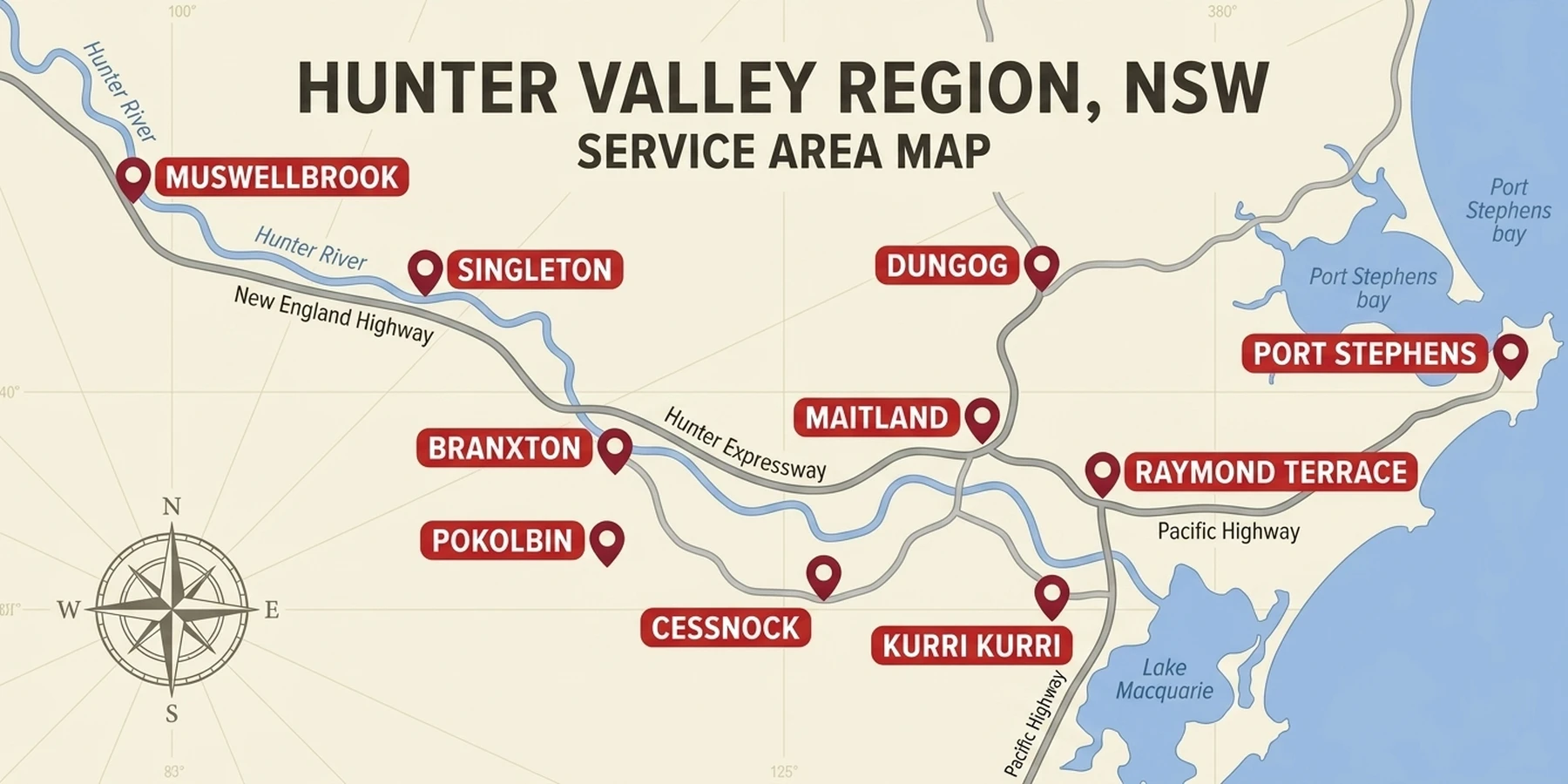
Kurri Kurri is a town with a sewer and a fringe without one. Hunter Water runs a wastewater treatment works at Kurri Kurri, so the town grid and the newer estates are reticulated, but drive five minutes in any direction, to the old coalfield villages of Weston, Abermain, Pelaw Main, Stanford Merthyr and Heddon Greta, or out to the rural lots at Loxford, Cliftleigh, Mulbring, Buchanan, Sawyers Gully, Neath, Cedar Creek, Richmond Vale, Buttai and Mount Vincent, and a large share of properties manage their own wastewater. Since the Hunter Expressway opened in 2014 and put Kurri Kurri within an easy commute of Newcastle, a lot of those properties have changed hands to people who have never owned a septic tank.
Hunter Valley Septic services the Kurri Kurri district with pump-outs, quarterly AWTS servicing, inspections and trench diagnostics. All of it sits inside Cessnock City Council’s area, whose full approval process is on our Cessnock page. Call 0468 278 123 to book.
Finding the edge of the sewer
There is no published map of every unsewered street, and a sewered lot and a tank lot can share a fence line. Three checks settle it.
- Your Hunter Water bill. Properties without reticulated sewer pay no Hunter Water wastewater service charge. Hunter Water says about 2,500 residential lots across 22 Lower Hunter townships have town water but no sewer.
- Your rates notice. Cessnock City Council levies an annual approval-to-operate charge on every property with an on-site system.
- The yard. A concrete lid or two, a green AWTS control box on an outside wall, sprinklers in a fenced patch of lawn, or an unusually green strip in dry weather.
If you are on a tank, plan for it to stay that way. Hunter Water says extending backlog sewer to unsewered townships is not viable at present, because under the pricing regulator’s 2018 method existing owners bear most of the cost, in many cases more than $60,000 to $100,000 per property. If a property does get connected, Cessnock requires a licensed plumber to decommission the old system and a notice of decommission lodged with Council, after which the annual charge comes off the rates.
Old villages, old tanks
The coalfield villages around Kurri Kurri were laid out for miners’ cottages, and many of their tanks went in decades ago. The pattern we see on these blocks is consistent: a concrete tank of 3,000 to 4,500 litres, a lid that has been lawned, paved or gardened over, an outlet tee that may have corroded away, and an absorption trench of unknown length somewhere under the back yard. Sometimes the disposal area is a lot smaller than the house now needs, because bedrooms were added without anyone going back to Council; in Cessnock, changing the connected drainage or the disposal method is an alteration that needs section 68 approval, while like-for-like repairs, resealing and pump-outs do not.
Soil varies more here than in most of the valley. The Hunter Expressway’s route out of Kurri Kurri crosses the Buchanan floodplain and the Kurri Sand Swamp Woodland, which tells you the district has sandy, seasonally wet ground as well as the clay the coalfields are known for. Both clay and sand with weak structure sit in the high-risk soil class in Hunter council risk tables, and a water table within 0.6 metres of the surface is a high-risk trigger on its own. Cessnock Airport, a few kilometres south-west, averages 743 mm a year with February the wettest month; a trench on the low ground at Loxford or Buchanan will be at its wettest from February to April.
What a first-time acreage buyer here should check
Most of our Kurri Kurri calls come from people who bought recently. Before exchange, or in the first month if it is too late for that, work through this list.
- Ask for the approval to operate. In Cessnock, Council reissues it to the new owner once NSW Land Registry Services sends the notice of transfer, so there is no transfer form; but the vendor’s copy tells you the conditions and whether it was current. If there is no approval at all, the fix is an application for approval to operate an existing system, charged at the new-system fee.
- Ask for the service reports and pump-out dockets. For an AWTS, Cessnock requires a service report to Council within seven days of every quarterly service. No reports usually means no servicing.
- Find the lid. If the vendor cannot show you, budget for a locate-and-dig; a lid more than 300 mm down without a riser adds $75 to $150 to a pump-out, and a riser at $250 to $450 ends that for good.
- Get it inspected. A pre-purchase inspection is $250 to $500 and includes a CCTV check of the line from the house, sludge measurement, tees and baffle, a trench probe and a written report. It is the only way to know whether the tank was pumped in 2024 or 2004.
- Check the bedroom count against the system. More bedrooms than the system was approved for is a common Kurri Kurri finding, and it is a conversation with Council, not with us.
Our buyer’s guide covers the legal side: under the Regulation you can operate the existing system for 3 months after settlement without an approval, and if you apply within 2 months you can keep operating until Council decides.
Living with a tank on a small block
A village lot in Weston or Abermain is often well under the 4,000 m² that Cessnock’s LEP now requires for any new unsewered subdivision, and a small disposal area on tight ground has no spare capacity. Three habits keep it alive. Pump on sludge depth, not the calendar: Council recommends every three to five years, and the NSW guideline is to desludge once sludge and scum reach one-third of tank depth. Keep the trench area clear of vehicles, sheds and vegetable beds. And fix the small things when they show up: a broken lid, a missing effluent filter or a collapsed outlet tee costs $250 to $650 and is the difference between a working trench and a $8,000 to $14,000 replacement built by a licensed contractor.
Our services on these blocks are pump-outs ($350 to $500 up to 3,000 litres, $400 to $650 for 3,500 to 4,500 litres, no travel surcharge across the Cessnock corridor), AWTS servicing with the report sent to Cessnock City Council within seven days, inspections, tank repairs and trench diagnostics. Trench construction, distribution boxes and sanitary pipework are plumbing and drainage work in NSW and are carried out by licensed plumbing and drainage contractors we work with; their NSW licence number appears on every quote.
Frequently Asked Questions
Is Kurri Kurri on sewer?
The town is: Hunter Water operates the Kurri Kurri wastewater treatment works. Many properties in the surrounding villages and on rural lots are not. If your Hunter Water bill has no wastewater charge and your rates notice has Cessnock’s on-site sewage charge, you are on a tank.
Will Hunter Water extend the sewer to Heddon Greta or Loxford?
Not on current plans. Hunter Water says backlog sewer is not viable at present because existing owners would bear most of the cost, often more than $60,000 to $100,000 a property. Treat your on-site system as permanent.
I just bought an old cottage in Weston and cannot find the septic tank. What do I do?
Book an inspection. We locate the tank, dig out the lid if needed, measure the sludge, check the tees and baffle, camera the line from the house and probe the trench, then give you a written report with costed findings. If you have no approval to operate, the report is also what Cessnock will want to see with your application.
Do I need Council approval to fix a broken outlet tee or lid?
No. Cessnock allows like-for-like replacement of components, crack repairs, resealing, pump-outs and chlorine restocking without a new approval. Where the tee connects to the sanitary drain the work is done by a licensed plumbing and drainage contractor we work with.
How often should a small village block be pumped out?
Cessnock City Council says every three to five years; on a small block with a small disposal area we measure sludge at each visit and set the next date from the depth. A full-time family of five in a 3,000 litre tank is at the short end of that range.
What does a quarterly AWTS service cost around Kurri Kurri?
$90 to $150 a visit, $360 to $600 a year, covering the NSW Health minimum checks, chlorine, blower, pump and alarm tests, with the service report sent to Cessnock City Council within seven days of each visit as your approval to operate requires.
Ready to book a pump-out, AWTS service or inspection around Kurri Kurri? Call 0468 278 123 or use the booking form with your suburb and a note about tank access. We call back within 24 hours during business hours, and most routine pump-outs are scheduled within 48 hours.
Request Received!
Thank you for reaching out. Our Hunter Valley dispatch team will call you back promptly to confirm details and provide an upfront quote.
Call us directly on 0468 278 123