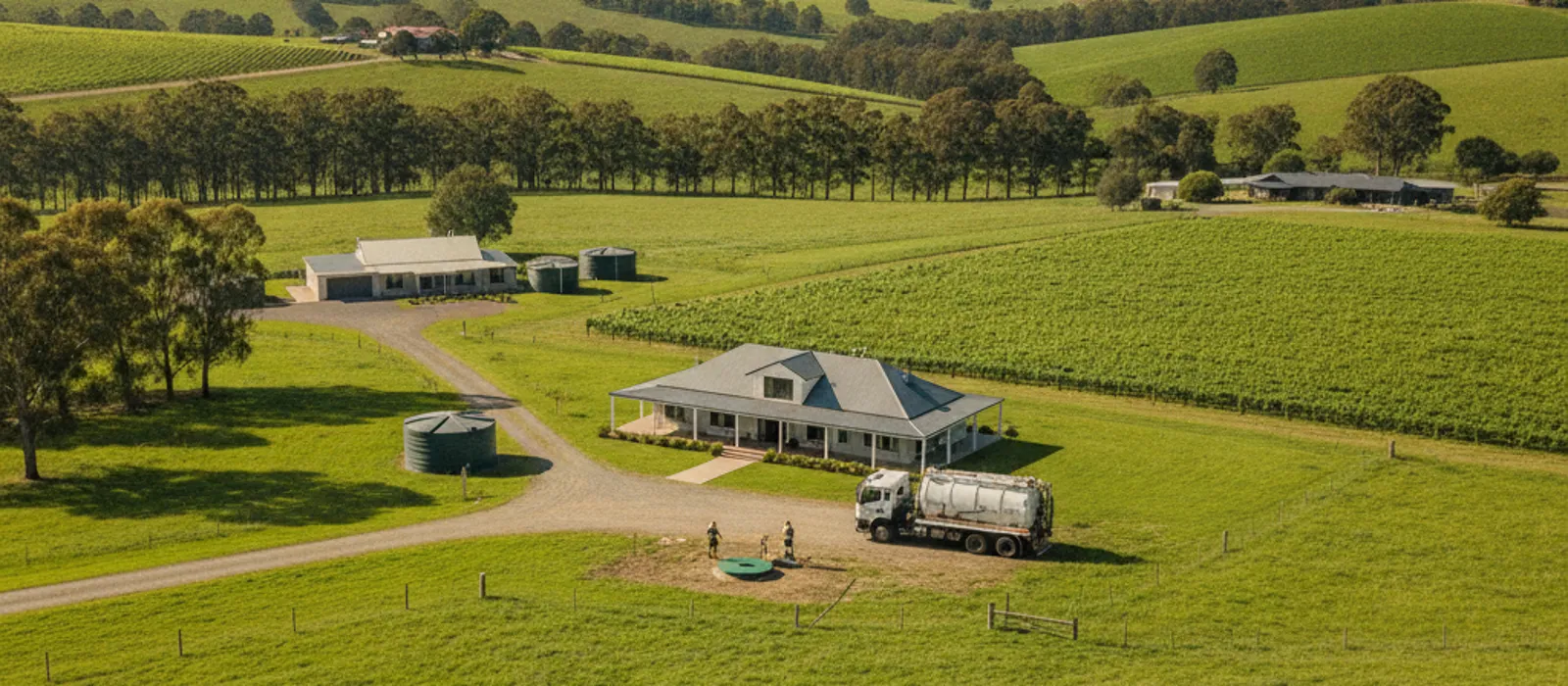
Holiday Rental Septic Management in the Hunter Valley
The worst moment for a septic system to give up is 4pm on a Friday, with six guests already on the road and no way to get a truck up the driveway before dark. One three-bedroom cottage in the vineyard country refunded a whole long weekend because the tank backed into the laundry, and the refund plus the after-hours vacuum truck cost more than three years of servicing would have.
Holiday rental septic management is a different job from looking after the system at the house you live in. Your own household puts a steady, predictable load through the tank. A short-term let puts nothing through it for ten days, then eight people through it in 48 hours, then nothing again. Both extremes are hard on the system, and the second one is what usually breaks it.
This is a guide to running an on-site system under holiday letting conditions across the Maitland, Cessnock, Singleton, Port Stephens, Muswellbrook and Dungog council areas: pump-out intervals based on guest nights, what a year of servicing really costs, the guest habits that kill trenches, and where the council sits in it.
Why a Holiday Rental Punishes a Septic System
A septic tank is not a bin. It is a settling chamber, and it works by holding wastewater still long enough for solids to sink and grease to float, so that only the clearer middle layer flows out to the absorption trench.
That settling needs time. When ten people shower, flush and run three loads of washing across a Saturday, flow spikes and retention time collapses. Solids that should have settled get pushed out to the trench, where they build a biomat layer that slowly seals the soil. That damage is cumulative and invisible until the ground goes soggy.
Commonly used NSW design figures sit around 120 to 150 litres per person per day, so a house sleeping eight can push well past 1,000 litres on a peak day against a system sized for a family of four. Treat that as a planning estimate. The real number depends on tank volume, trench length, soil type and slope, none of which can be judged from a photo.
Aerated wastewater treatment systems (AWTS) have the opposite problem too. The bugs in an aeration chamber need a steady feed. A cottage that sits empty for three weeks can starve its biology, then get slammed with a full house, and the clarifier throws solids into the irrigation line. Long vacancies are as rough on an AWTS as full weekends.
If your place is booked out through vintage or school holidays and nobody has looked in the tank for years, ring 0468 278 123 and book a pump-out and inspection in the shoulder season, before the calendar fills. Routine jobs are scheduled within 48 hours.
Setting a Pump-Out Interval by Guest Nights, Not Years
The standard NSW guidance is a pump-out every three to five years for a normal household of two to four people. That advice quietly assumes a household. It does not survive contact with a property that sleeps eight and runs at 60 per cent occupancy.
A rough planning method that works: add up your guest nights for the year, then divide by 365 to get an equivalent permanent occupancy. A cottage sleeping eight, booked 60 per cent of the year with an average of five guests, comes to about 1,100 guest nights, or roughly three residents worth of load. A busier place sleeping ten can land at five or six. Once you are past four equivalent residents, pull that three to five year window in to nearer two to three years.
That is a budgeting rule of thumb, not a measurement. The honest answer comes from a sludge depth check at the tank, which costs nothing extra alongside a pump-out. Our septic tank pumping page explains the day, and how often to pump a septic tank in NSW goes deeper into intervals.
Here is what waiting looks like. A four-bedroom acreage place near Louth Park, run as a farm stay for most of the last decade, had not been pumped in nine years. The 4,500 litre tank was better than two thirds solids, the top crust had hardened past what the hose could break, and the lid sat about 400mm under a garden bed built over it.
That job came to $900: $650 base for the tank size, $150 for hardened sludge, $100 to dig out the buried lid. A $350 access riser went in on the same visit, so the lid now sits at ground level. That takes the excavation charge off every future pump-out and lets a technician check the tank in two minutes between bookings.
What Holiday Rental Septic Management Costs Across a Year
Owners are usually surprised in both directions. Routine care costs less than they feared, and the failure they were ignoring costs far more than they assumed.
| Item | Price range (AUD) | Typical frequency for a holiday let |
|---|---|---|
| Septic pump-out, up to 3,000L tank | $350-$500 | Every 2-3 years under heavy guest load |
| Septic pump-out, 3,500-4,500L tank | $400-$650 | Every 2-3 years under heavy guest load |
| Septic pump-out, 5,000L+ or dual tank | $650-$900 | Every 2-4 years |
| AWTS quarterly service contract | $90-$150 per visit ($360-$600/year) | Four visits a year, required by council |
| Full AWTS desludge | $450-$750 | Every 3-5 years on top of servicing |
| Inspection bundled with a pump-out | +$100-$200 | Once before a peak season |
| Access riser retrofit | $250-$450 | One-off, pays for itself |
| Emergency, same-day or after-hours response | +$150-$300 on the base price | Only when something has already gone wrong |
| Air blower diaphragm service kit | $120-$250 | As needed on an AWTS |
| Air blower replacement, installed | $650-$1,400 | Every several years on a hard-worked AWTS |
| Absorption trench rejuvenation (eco-air jetting) | $1,500-$4,500 | Only if the trench is failing |
| New absorption trench | $8,000-$14,000 | Licensed drainage contractor, last resort |
As a planning figure, budget around $600 to $1,000 a year for a holiday cottage on an AWTS, and $250 to $400 a year for a conventional tank on a two to three year cycle. Those are averages spread across the years, not quotes. Access and depth move the price, not distance: there is no travel surcharge anywhere in the Maitland, Cessnock, Singleton or Port Stephens corridors, and any loading is quoted before we start.
Put your own tank size into the septic pumping cost calculator for a closer number, or call 0468 278 123 and describe the property.
Guest Habits That Cost You an Absorption Trench
Guests do not treat a rental the way they treat home, and most have never lived on a septic system. They flush wipes labelled flushable, which are not. They pour barbecue fat down the sink after a big group dinner. They put sanitary items and nappies down the toilet because there is no bin in the bathroom.
All of it ends up in the tank, and grease and wipes are exactly what block an inlet baffle or an effluent filter. The good news is that a blocked baffle or jammed filter is a $250 to $650 repair, not a new system. We work repair-first, and a failed part on a sound tank is almost never a reason to spend $20,000.
The bigger risk on an AWTS is chemicals. A fast turnover clean using a litre of bleach, a bathroom spray and a drain cleaner can knock the aeration chamber’s bacteria flat, and it takes weeks to recover while still discharging to your irrigation area. Ask your cleaner to use small amounts of ordinary detergent and keep bleach out of the drains.
Three fixes cover most of it. Put a lidded bin in every bathroom, put a short polite sign above each toilet listing what cannot be flushed, and give your cleaner a one-page sheet covering products as well as rooms. Make sure nobody is tipping pool or spa backwash into the system either, because that volume alone can flood a trench in an afternoon.
Chlorine on an AWTS goes in the disinfection chamber, not down the toilet. Under heavy occupancy it disappears far faster than the label suggests, which we cover in how often to top up AWTS chlorine tablets.
That was the story at a Pokolbin cottage running an AWTS through a wedding season. Most weekends from September to November had 10 to 12 guests, the chlorine was emptying in about five weeks instead of lasting the quarter, and a high-water alarm went off on a Sunday morning mid-booking. The blower was struggling on tired diaphragms, and a $180 service kit fixed it that day. The owner moved to a monthly chlorine top-up between quarterly services and had no further alarms that season. If yours is beeping now, AWTS alarm causes explains what each alarm means.
Council Rules, Approval to Operate and Short-Term Letting
Every owner of an on-site sewage management system in NSW must hold an Approval to Operate from their council. That comes from the Local Government Act 1993, and it applies to Maitland, Cessnock, Singleton, Port Stephens, Muswellbrook, Upper Hunter and Dungog alike.
Letting the property out does not create a separate septic approval, but it changes the picture. The load goes up, and councils take a closer interest in properties housing more people than the system was approved for. If you have added a cabin, a granny flat or extra bedrooms to lift capacity, that is a genuine Section 68 question, and it needs answering before the guests arrive rather than after a neighbour complains.
If you run an AWTS, councils require quarterly maintenance by an authorised service technician, with the report lodged to council. We carry that out as a service contract and send the service report to your council after each visit. Cessnock takes lodgements through an online channel, and the other Hunter councils accept email or post. Full detail sits on our AWTS servicing and maintenance page.
If your Approval to Operate has lapsed or you have inherited a property with no paperwork at all, a compliance audit runs $250 to $450 and produces the written record the council wants to see.
One more piece worth knowing. Tank waste is transported and disposed of under NSW EPA waste rules at a licensed treatment facility that has agreed to accept it, and you get a disposal docket for every load. The duty behind that sits in section 143 of the Protection of the Environment Operations Act 1997. Keep those dockets in your property file, because they are the cleanest proof you have that the system has been maintained.
Building a Holiday Rental Septic Management Routine
The owners who never have a bad weekend are not lucky. They have a routine, and it is short.
On turnover day the cleaner does a two minute walk. Check the ground over the trench or irrigation area for wet patches or unusually green grass, look at the AWTS control box for a warning light, and have a sniff near the tank lid. Anything odd gets reported that day, not at the end of the month.
Monthly, top up the chlorine on an AWTS if occupancy has been heavy. Quarterly, the service visit happens and the report goes to council. Annually, review your guest nights and decide whether the pump-out is due earlier than the calendar suggests.
Book that pump-out in the shoulder season, not the week before a long weekend. Trucks get booked out over school holidays and vintage, and a job you could have had done quietly in June becomes an emergency in October.
If the property sits on river flat near the Hunter or the Paterson, have a flood plan for the system as well as the house. A submerged tank needs a different approach and should not be pumped while the ground is still saturated.
Genuine emergencies, meaning a sewage backup, an active high-water alarm or an overflow, get a same-day or next-morning vacuum truck. Routine work is scheduled within 48 hours and business-hours enquiries get a callback within 24. Save the number in your house manual, then book through the contact form, call 0468 278 123, or read our emergency septic service page before you need it.
Frequently Asked Questions
How often should I pump out the septic tank at a holiday rental?
Work from guest nights rather than the calendar. A standard household tank goes three to five years between pump-outs, but a busy short-term let usually needs one every two to three years. The honest answer for your property comes from a sludge depth check. Expect $400 to $650 for a 3,500 to 4,500 litre tank.
Do I need to tell the council that my septic property is a short-term rental?
You still need the same Approval to Operate that every on-site system in NSW requires, and letting the property does not replace it. What does need council attention is any change that increases load, such as a new cabin, granny flat or extra bedrooms, which can require a fresh Section 68 assessment. If your approval has lapsed, a compliance audit at $250 to $450 will get the paperwork straight.
Can guests and cleaners use normal cleaning products in an AWTS house?
Ordinary detergents in small amounts are fine, but bleach, drain cleaner and heavy disinfectant poured down the sink will damage the bacteria the system depends on. A single hard turnover clean can set an aeration chamber back for weeks while it keeps discharging to your irrigation area. Brief your cleaner in writing and keep bleach out of the drains.
What should I do if the system backs up while guests are staying?
Stop all water use in the house immediately, including washing machines and dishwashers, and keep guests away from any wet ground outside. Ring us on 0468 278 123 and describe what you are seeing, because a backup with an alarm points to a different fault than a backup without one. A genuine emergency gets a same-day or next-morning truck, with an after-hours or same-day loading of $150 to $300 on top of the standard pump-out price.
Request Received!
Thank you for reaching out. Our Hunter Valley dispatch team will call you back promptly to confirm details and provide an upfront quote.
Call us directly on 0468 278 123