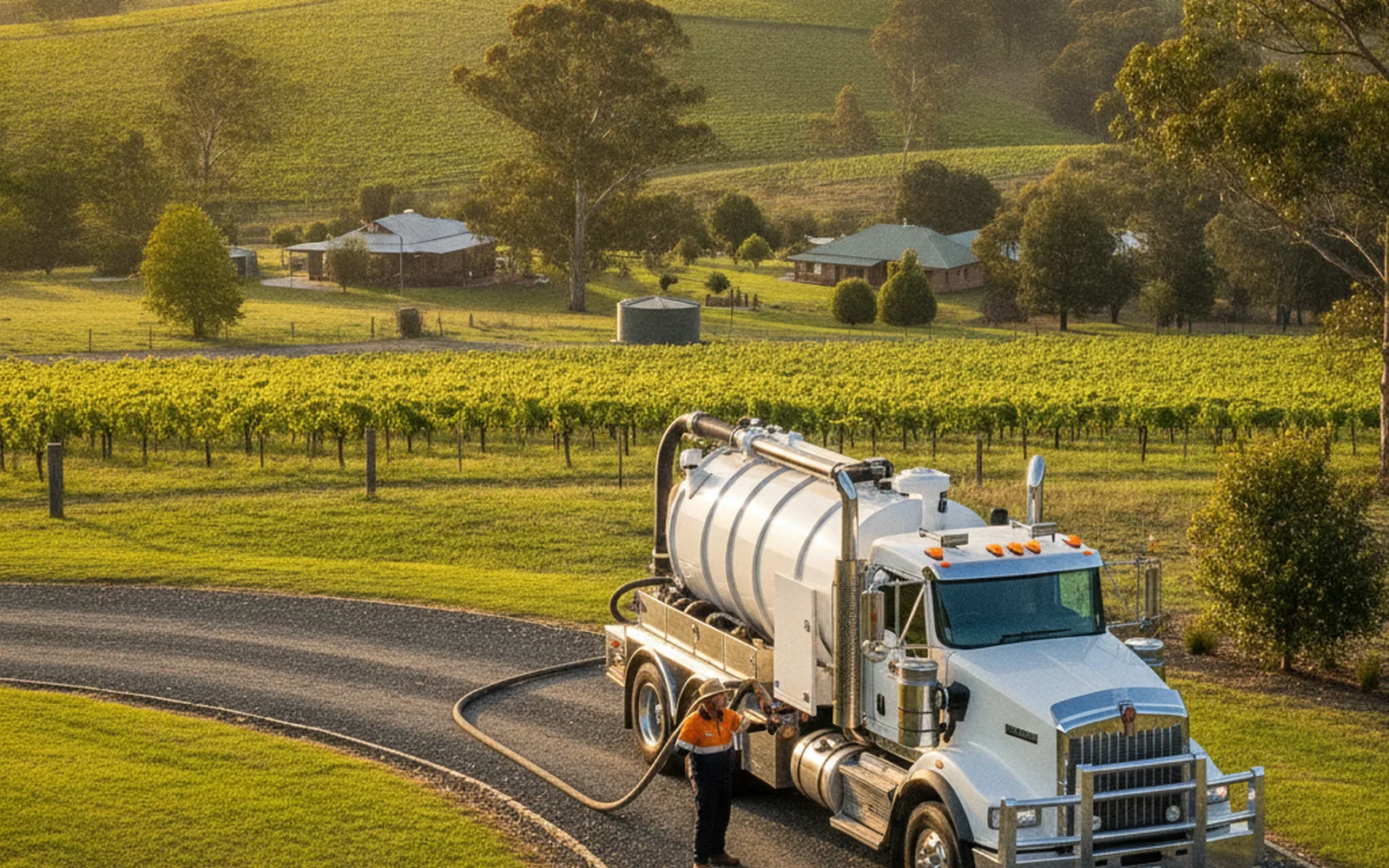
Septic Truck Access: How Close Does the Truck Need to Get and How Far Can the Hose Reach?
The truck does not need to park beside your tank. It needs firm ground, a gate it can fit through and a clear line to the lids, and the suction hose does the rest. For our pump-outs, a hose run of up to 45 metres from the truck is part of the base price. Beyond 45 metres, an extended hose run adds $50 to $120, quoted before work starts.
Most of what makes a pump-out slow or dearer is settled before the truck arrives: where it can park, whether anyone can find the lids, and whether the dog is shut in. Below is a practical checklist for a Hunter Valley property, from the front gate to the tank lid.
What the truck actually needs
A vacuum truck is a heavy, wide vehicle carrying a full tank of waste on the way out. Three things matter to the driver.
A way in. The gate has to be unlocked and wide enough. The NSW onsite wastewater guidelines, in their section on pump-out systems, say that as a general rule a tanker truck needs an access road about 5 metres wide. Most rural driveways are narrower than that, and trucks manage on all sorts of tracks, but it is a fair picture of the size of the machine. Low branches, overhanging gutters, tight turns around a shed and soft verges are the usual problems.
Firm ground to stand on. A truck sitting on gravel, a concrete apron or a dry, well-grassed paddock is fine. A boggy lawn or a track that has not dried out since the last storm is not. We would rather run a longer hose than drive across ground that is soft after rain, because a bogged truck helps nobody and the ruts can damage drainage lines under the lawn.
A spot that is not over your system. The truck stays off the absorption trench area, and so should every other vehicle. Compaction crushes pipes and turns a clogged trench into a failed one. If you are not sure where the trenches run, tell us, and park the truck on the driveway side.
How far can the hose reach?
This is the question behind most searches for how far a septic truck can pump. The honest answer is that distance is quoted, not capped. Our base pump-out price is set by tank size, and it already covers a hose run of up to 45 metres from the truck to the tank. Past that, an extended hose run adds $50 to $120, always quoted before we start.
Here is how that sits with the rest of the price list.
| Tank capacity | Typical pump-out price | Applies to |
|---|---|---|
| Up to 3,000 litres | $350 to $500 | 2 to 3 bedroom domestic |
| 3,500 to 4,500 litres | $400 to $650 | 3 to 5 bedroom standard domestic |
| 5,000 litres and over | $650 to $900 | Large rural, commercial or dual tank |
| Access modifier | Added to the base price |
|---|---|
| Extended hose run (over 45 metres) | +$50 to $120 |
| Deep lid excavation (buried more than 300 mm, no risers) | +$75 to $150 |
There is no travel surcharge across the Maitland, Cessnock, Singleton or Port Stephens service corridors, so a long driveway costs you only if the hose has to stretch past 45 metres. Distance down the road does not.
The checklist before the truck arrives
You do not need to be an expert. Work through this list the day before.
Unlock and open every gate. On a rural block there can be three: the road gate, a paddock gate and one near the house yard. If you are not going to be home, tell us when you book how access will work and who to call.
Shut in dogs and keep children away. A dog that is friendly with visitors can still bolt through an open gate or get tangled in a suction hose. Keep pets inside or well away from the work area until the lids are back on, and keep children away from the open tank. The NSW Easy Septic Guide, cited in our visit guide, warns that septic tanks contain toxic and explosive gases and asks that lids be secured so children cannot open them.
Mark the lid, or at least the tank. Our guide on how to find a septic tank lid covers the paperwork and the walk-the-ground clues. If you know roughly where it is, stick a stake or a bright marker in the ground. Please do not prise the lid open yourself.
Check the weather. A paddock that has had a week of rain can be a problem. If the ground looks soft, ring and tell us. We may suggest a different parking spot, a longer hose or a different day.
Wet paddocks and soft ground
Heavy clay around Maitland and Cessnock holds water and turns into a slippery mess after rain, and low-lying blocks near the river flats can stay boggy for days. Sandier country around Port Stephens drains faster but can be loose underfoot for a heavy truck, and a truck on soft sand can bog just as easily as one in clay.
A few ways to deal with it:
- Park on the hardest surface near the tank: a gravel apron, a concrete slab, a sealed road verge. The hose will make up the difference.
- If the tank sits well away from any firm ground, accept the extended hose modifier rather than risk getting a truck stuck. It costs $50 to $120. A bogged truck and a deep wheel rut across a trench line are worse.
If you are not sure whether a spot will hold a truck, send a photo of the access route when you book or describe it on the phone. It takes a minute and saves a wasted trip.
Buried lids: the other access problem
Hose length is the visible part of access. The other is whether the operator can get into the tank at all. Many older Hunter tanks have lids buried under lawn, garden beds or later paving, with no risers.
If a lid is buried more than 300 mm with no riser, it has to be dug out before the hose goes in. That adds $75 to $150 to the job, quoted before we dig. We also have to do it carefully, because the inlet and outlet pipes sit close to the lid and old concrete lids can be cracked or cemented in place.
What you can do ahead of time:
- Find the tank and mark it. Council records, an old pump-out docket or the previous owner can narrow it down. Ask your council for the on-site sewage file, which sometimes includes the original site plan.
- Clear the top. Move pot plants, pavers, garden furniture and timber off the likely lid area.
- Do not dig deep yourself. A shallow scrape to expose a lid edge is fine. Digging with a mattock over an unknown tank is how pipes and lids get broken.
If the same lid has to be dug out every few years, an access riser is worth thinking about. A riser retrofit is $250 to $450 as a one-off. It brings the opening up to ground level so the next pump-out is quicker, cleaner and does not carry the $75 to $150 dig. Our guide to septic tank risers in NSW works through when it pays for itself. Lids and risers are our work. Anything that touches the drainage, such as a broken inlet pipe, is carried out by licensed plumbing and drainage contractors we work with; their NSW licence number appears on every quote.
What to tell the operator when you book
You do not need all of this, but the more you give, the closer the price on the phone will be to the final one.
- Septic tank or AWTS. An AWTS has more than one chamber and a control box and blower nearby. The primary chamber is desludged much like a septic tank, and a full AWTS desludge and total pump-out is $450 to $750.
- Tank size, if you know it. It may be on the council approval or an old invoice. If you do not know, we measure and charge the band it falls in.
- When it was last pumped. A tank that has gone 7 or more years carries a heavy hardened sludge modifier of $75 to $150, because compacted sludge has to be broken up before it flows up the hose.
- Where the tank is and how deep the lid is. If it is under lawn and you have no riser, say so.
- How far it is from where the truck can park. A rough guess in metres is fine. Anything near or over 45 metres, mention it.
- Gates, locked areas, steep drives, dogs, stock. One sentence each.
- Anything going wrong now. Slow drains, smells, a high-water alarm or sewage backing up. A sewage backup, an active high-water alarm or an overflow gets same-day or next-morning vacuum truck response, and an emergency or after-hours dispatch adds $150 to $300.
For the visit itself, our guide to what happens during a septic tank pump-out walks through each step, from opening the lids and measuring the sludge to refilling the tank and handing over the disposal docket.
On the day
The driver will usually walk the route first and decide on the parking spot and hose path. If you are home, join that walk: you know about the soft patch near the shed and the buried irrigation line.
Once the lids are open, nobody leans in or climbs into the tank. SafeWork NSW lists tanks and pits as confined spaces, and the gases inside can kill. After pumping, the tank is refilled with water straight away (the NSW guidelines require at least two-thirds, or to the outlet level, to avoid hydrostatic uplift in wet ground), the lids are secured and you get the disposal docket for the load.
If you want to book a visit, see our septic tank pumping page or call 0468 278 123. Most routine pump-outs are scheduled within 48 hours.
Frequently asked questions
How far can a septic truck pump?
There is no fixed cut-off we quote. Hose runs of up to 45 metres from the truck are covered in the base pump-out price, and an extended hose run beyond that adds $50 to $120. The operator quotes the distance before work begins, so tell us roughly how far the tank is from where the truck can park.
Does the septic truck need to drive onto my property?
Usually yes, as close as firm ground allows. If the driveway is too narrow, too soft or blocked by a locked gate, the truck parks on the road or at the nearest solid spot and the hose covers the rest. That is why the 45 metre line matters for the price.
What if my paddock is too wet for the truck?
Tell us when you book. We would rather run a longer hose from a gravel drive or the road edge than risk bogging a truck or rutting the ground over your drainage. If the whole route is waterlogged, we may suggest waiting for it to dry. The extended hose modifier is $50 to $120.
Will I be charged extra if my tank lid is buried?
If the lid is more than 300 mm down with no riser, deep lid excavation adds $75 to $150, quoted before we start. A lid under a few centimetres of turf is usually not enough to trigger it. A riser retrofit, $250 to $450, takes the dig out of every future visit.
Should I keep my dog inside?
Yes, on the day of the visit. Dogs are curious about open tanks and hoses, and gates are left open when trucks come and go. Keep pets and children away from the work area until the lids are secured again.
Sources and further reading
- NSW Office of Local Government, Onsite Wastewater Management Guidelines (April 2025): the general rule that a tanker truck needs an access road about 5 metres wide, refilling a desludged tank to at least two-thirds to avoid hydrostatic uplift, and keeping lids sealed and accessible.
- NSW Office of Local Government, The Easy Septic Guide: toxic and explosive gases in septic tanks, and securing the lid so children cannot open it.
- SafeWork NSW, Confined spaces: tanks and pits as confined spaces, and why nobody should lean or climb into an open tank.
Request Received!
Thank you for reaching out. Our Hunter Valley dispatch team will call you back promptly to confirm details and provide an upfront quote.
Call us directly on 0468 278 123