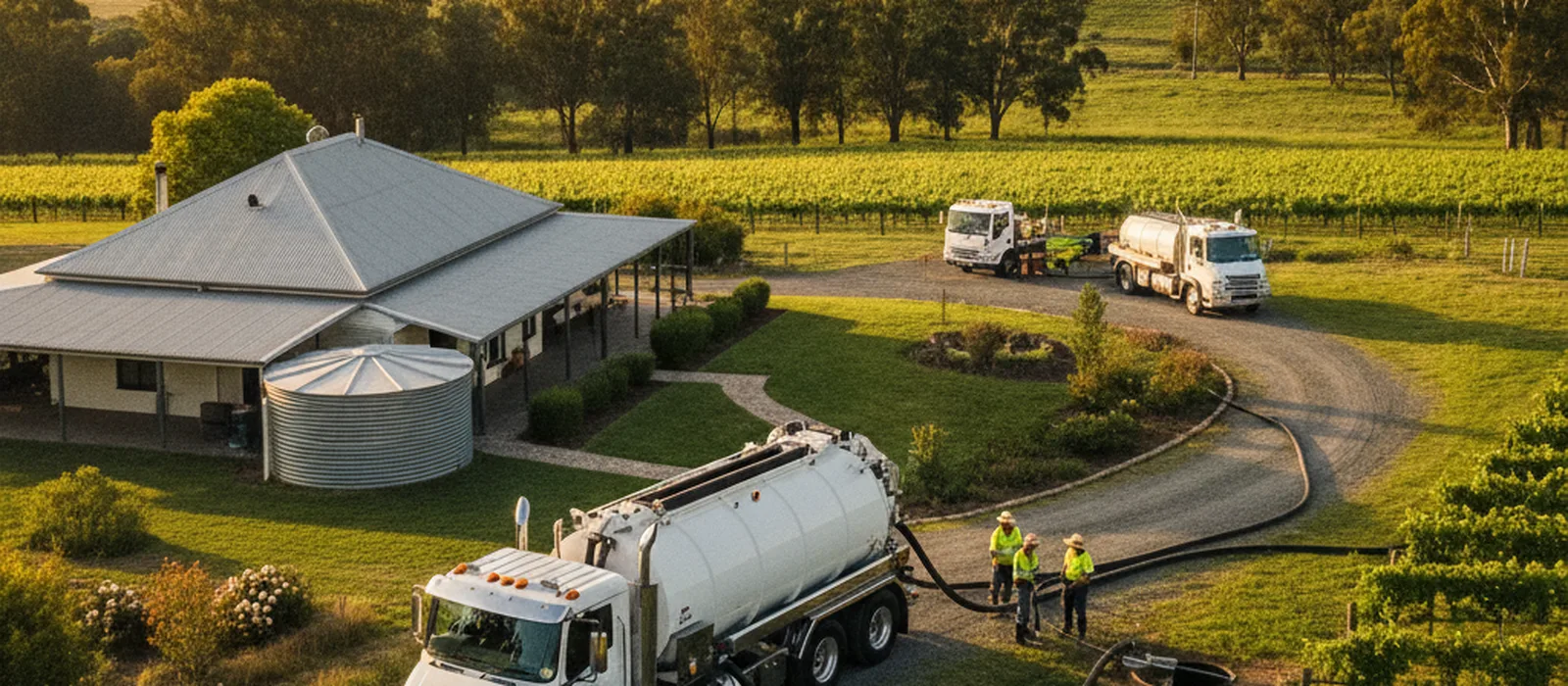
Commercial Septic Pump-Out in the Hunter Valley: Wineries, Cellar Doors, Cafes and Function Venues
A commercial septic pump-out in the Hunter Valley follows the same steps as a home job, but the tank is usually larger, often two tanks in series, and the timing has to fit around trading. Tanks of 5,000 litres and over, which covers most large rural, commercial and dual-tank systems, are $650 to $900 AUD for the pump-out, quoted before work starts.
This guide is for owners and managers of cellar doors, wineries with a restaurant or tasting room, cafes, function venues and farm stays that rely on an on-site system. It covers what is different about a commercial tank, what the work costs, how to schedule around events and vintage, what paperwork to keep, and the two things we do not do.
What is different about a commercial system
A home septic tank is sized for a household that uses water in a steady pattern. A venue is the opposite. It can sit quiet for days and then put hundreds of litres through the system in a single lunch service or wedding reception.
Three differences matter in practice.
Size. Commercial and larger rural premises more often have tanks of 5,000 litres or more, or two tanks working in series. That is the band where the price moves from the domestic ranges to $650 to $900. Tell us the tank volume, or the number of tanks and lids, when you book. If you do not know, we measure it on the day.
Load pattern. The NSW Office of Local Government (OLG) guidelines use design flows per person per day, 120 litres on tank (rainwater) supply and 150 litres on town or bore water, for sizing a system. A venue’s flow is not a household’s, and your council works out the right figure for your use when it assesses the approval, so treat these as an indication of scale only.
How often a commercial tank needs pumping
The OLG rule is that a tank must be desludged no later than when sludge and scum together reach one-third of its depth, or when either layer comes within 150 mm of the inlet or outlet. The commonly quoted three to five years is a household figure. For a business, more people use the tank, so it fills with sludge faster, and the right interval comes from measuring the sludge, not from the calendar.
The practical approach is to have the sludge depth measured at each visit and set the next date from that reading. A busy venue may find the answer is every year or two, a quiet cafe may be able to stretch it. Our guide to how often to pump a septic tank in NSW explains how the measurement works. The reading is taken with a sampling tube lowered to the floor of each chamber.
Where a venue has two tanks in series, both need pumping. The first collects most of the solids, and the second catches what carries over, so emptying one and leaving the other only solves half the problem.
If your system is an aerated wastewater treatment system (AWTS) rather than a conventional tank, councils require quarterly servicing by an authorised service technician, with a report sent to council after each visit. That is a service contract at $90 to $150 per visit ($360 to $600 a year), and a full AWTS desludge and total pump-out is $450 to $750, normally every three to five years on top of the servicing.
Pricing for commercial pump-outs
The base price is set by tank volume. These are the ranges we quote across the Hunter.
| Tank capacity | Typical use | Price (AUD) |
|---|---|---|
| Up to 3,000 litres | Small cafe, small cottage | $350 to $500 |
| 3,500 to 4,500 litres | Mid-size domestic or small venue | $400 to $650 |
| 5,000 litres and over | Large rural, commercial or dual tank | $650 to $900 |
Modifiers get added to the base when they apply:
| Modifier | Amount (AUD) |
|---|---|
| Deep lid excavation (buried more than 300 mm, no risers) | add $75 to $150 |
| Extended hose run (over 45 metres from the truck) | add $50 to $120 |
| Heavy hardened sludge (not pumped in 7 or more years) | add $75 to $150 |
| Inspection or council compliance check bundled with the pump-out | add $100 to $200 |
| Emergency, same-day or after-hours dispatch | add $150 to $300 |
Access and depth change the price, not distance. There is no travel surcharge across the Maitland, Cessnock, Singleton or Port Stephens corridors, and anything extra is quoted before work starts. A cellar door set well back from the road is the usual case for the hose-run modifier, so measure the distance from where the truck can park to the lid.
If your tank is much larger than 5,000 litres, or you have several tanks on site, give us the volumes when you book. We will quote it before the truck arrives.
Scheduling around events, trading hours and vintage
The cheapest pump-out is the one booked in a quiet week. The worst is the one forced by a backup in the middle of a booking.
Check the calendar before you book. Look at your function bookings, tastings and harvest period, and choose a gap before the busy run, not during it. Most routine septic pump-outs are scheduled within 48 hours, so a gap of a few days is workable, but do not wait until the week before a big event to find out the sludge is high.
Tell us when you trade. Our hours are Monday to Friday 7:00 to 18:00 and Saturday 8:00 to 16:00. If the vacuum truck would block a car park or a kitchen delivery route at 11am on a Friday, say so, and we can look at an earlier slot or a day when you are closed. The truck needs a clear path to the lid and room to run the hose.
Allow for harvest and vintage. During the busiest weeks, a winery has staff, contractors and visitors on site, and everything is stretched. Book the pump-out ahead of the season, not in the middle of it. Our related guide for short-term lets, holiday rental septic management in the Hunter Valley, covers the same idea of pumping in the shoulder season for properties whose load swings sharply.
Know the emergency path. A sewage backup, an active high-water alarm or an overflow gets a same-day or next-morning vacuum truck response, with a loading of $150 to $300 on the base price. Our emergency septic service page explains what to do before the truck arrives. The first step is to stop water use and keep guests away from any wet ground.
What goes in the tank, and what does not
Commercial kitchens and bars send different material down the drain than a home does, and a septic tank is not built for most of it.
- Cooking oil and fat. Fat floats as scum and passes to the trench in quantity. Collect it in a container for disposal, and ask your council what it accepts from businesses.
- Cleaning chemicals. Bleach, disinfectants and solvents in quantity kill the bacteria that digest the sludge. This is especially important with an AWTS, where the bacteria are the treatment process.
- Wipes and sanitary items. Public toilets collect these. A lidded bin in each cubicle and a clear sign prevent a blocked inlet or jammed filter.
- Winery process water. The wastewater from washing tanks, barrels and equipment in a winery is a different thing from toilet and kitchen waste. It is not something a septic tank is designed for, and the right way to manage it is a question for your council and the NSW EPA. We pump septic tanks and AWTS. We do not manage winery process wastewater.
The two services we do not provide
To avoid any confusion when you book:
- Grease traps. If your kitchen has a grease trap, its cleaning and servicing is a separate service that we do not provide. A grease trap is not a septic tank, and an operator who services one is doing a different job.
- Trade waste. Commercial trade waste approvals, and the work to set up or maintain them, are also not something we do. If your business discharges trade waste, your council or the relevant water authority is the place to start.
We do not want you to book a septic pump-out expecting those to be covered. If you have a grease trap as well as a septic tank, you will need a separate provider for the trap.
Installation, replacement and any repair that connects to drains is plumbing and drainage work, carried out by licensed plumbing and drainage contractors we work with; their NSW licence number appears on every quote. We do the pump-out, the sludge measurement, the inspection and the reporting.
Records, dockets and council approval
Every owner of an on-site sewage management system in NSW must hold an Approval to Operate from their local council, under the Local Government Act 1993. For a business, it is worth checking that the approval matches what you now do: the number of seats, the function capacity, any new accommodation or an extended kitchen. A change that increases the load on the system can be a Section 68 question, and it is better to ask council before the new capacity opens than after. Your council sets what it requires of a commercial premises, and what it requires differs between councils.
Keep every disposal docket. A docket is provided for every load, and the tank waste is transported and disposed of under NSW EPA waste rules at a licensed treatment facility that has agreed to accept it. The legal duty behind that sits in section 143 of the Protection of the Environment Operations Act 1997, which says waste may only be delivered to a place that can lawfully accept it. The OLG model approval conditions require pump-out and repair receipts to be kept and shown to council if asked, and councils ask owners to keep them as evidence of maintenance.
Keep each docket with the date, tank volume and sludge reading, and keep AWTS service reports with them. If you want a record that the system is compliant, a council OSSM compliance audit is $250 to $450, and bundling an inspection with a pump-out adds $100 to $200.
Staff should not open the tank: leaning into the opening counts as confined-space entry under the NSW Confined Spaces Code of Practice, and tanks contain toxic and explosive gases.
To book a commercial pump-out, or to ask what size tank your venue is likely to have, call us on 0468 278 123. We call back within 24 hours on business-hours enquiries.
Frequently asked questions
How much does a commercial septic pump-out cost in the Hunter Valley?
A tank of 5,000 litres or more, which covers most large rural, commercial and dual-tank systems, is $650 to $900. Smaller venue tanks fall in the domestic bands of $350 to $500 up to 3,000 litres and $400 to $650 for 3,500 to 4,500 litres. Access modifiers apply on top, and the price is quoted before work begins.
Do both tanks need pumping if I have two septic tanks?
Yes. In a two-tank system the first tank holds most of the solids and the second catches what carries over, so both need desludging. Pumping one and skipping the other leaves a full tank passing solids to the trench. A dual-tank system falls in the 5,000 litre and over price band.
Can you pump out grease traps or handle trade waste?
No. Grease trap servicing and commercial trade waste are separate services that we do not provide. We pump out septic tanks and AWTS. If your business has a grease trap as well as a septic system, you need a separate provider for the trap.
What paperwork should a business keep for septic pump-outs?
Keep the disposal docket for every load, AWTS service reports if you have an AWTS, and your council Approval to Operate. Councils ask owners to keep receipts as evidence of maintenance. Your council sets how long to keep them, and keeping them for the life of the system is a sensible default.
Sources and further reading
- NSW Office of Local Government, Onsite Wastewater Management Guidelines (April 2025): the one-third and 150 mm desludging rule, design flow per person per day, why sludge cannot be judged by eye, and model approval conditions on keeping pump-out receipts.
- Local Government Act 1993 (NSW): the approval to operate an on-site sewage management system and the Section 68 approval process.
- Protection of the Environment Operations Act 1997 (NSW): section 143, the duty to deliver waste only to a place that can lawfully accept it.
- SafeWork NSW, Confined spaces: head or upper body through an opening counts as entering a confined space.
Request Received!
Thank you for reaching out. Our Hunter Valley dispatch team will call you back promptly to confirm details and provide an upfront quote.
Call us directly on 0468 278 123