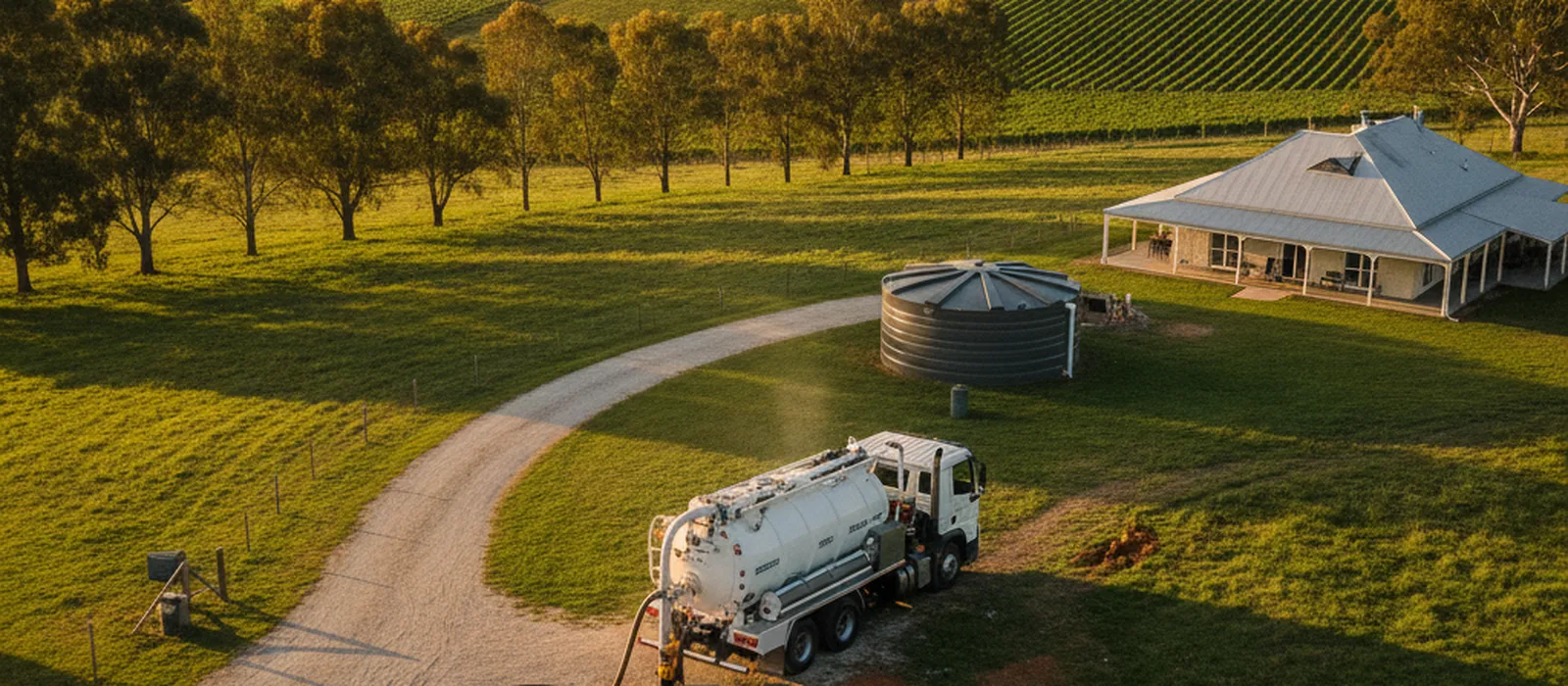
What Happens During Septic Tank Pumping: The Visit From Start to Finish
Septic tank pumping is a short, fairly quiet job. The lids come off, the sludge and scum are measured, the tank is emptied of all three layers through a suction hose, the inlet, outlet and baffle get a look while the tank is open, and then it is refilled with water and closed up. You get a disposal docket for the load before the truck leaves.
How long the visit takes, and what it costs, is mostly settled before anyone arrives: can the lids be found, how close can the truck get, and how long since the last pump-out. Here is the visit in order.
If you already know you need one, book a septic pump-out or call 0468 278 123. Most routine pump-outs are scheduled within 48 hours.
Before we arrive: getting the property ready
Find the lids, or at least the tank. Many older concrete tanks in the Hunter have lids buried under soil, turf or a garden bed, with no risers. If you know roughly where the tank is, mark it with a stake. If you have no idea, check the house plans or council approval, or follow our guide on how to find a septic tank lid. Please don’t prise the lid open yourself.
Clear a path for the truck. A vacuum truck is heavy and wide. Unlock the gate, move the trailer or horse float, and think about where it can park on firm ground. The NSW onsite wastewater guidelines, in their section on pump-out systems, say that as a general rule a tanker truck needs an access road about 5 metres wide. We would rather run a longer hose than cross a lawn that is soft after rain, and we never park over the absorption trench.
Sort out pets and children. Keep dogs and kids inside or well away from the work area until the lids are back on.
Tell us what you know when you book. Tank size if you have it (it is sometimes on the council approval), the date of the last pump-out, septic tank or AWTS, and anything going wrong now, such as slow drains, odour or an alarm. None of it is essential, but it gets you a closer price on the phone.
What can change the price on the day
Our routine pump-out prices are set by tank volume, not distance: $350 to $500 for up to 3,000 litres, $400 to $650 for 3,500 to 4,500 litres, and $650 to $900 for 5,000 litres and over, which covers large rural, commercial and dual-tank setups. There is no travel surcharge across the Maitland, Cessnock, Singleton or Port Stephens service corridors.
A few site conditions can add to that base. They are always quoted before work starts.
| Extra | When it applies | Typical amount | How to avoid it |
|---|---|---|---|
| Deep lid excavation | Lids buried more than 300 mm with no risers | +$75 to $150 | Fit risers so it doesn’t happen next time |
| Extended hose run | Truck can’t get within 45 metres of the tank | +$50 to $120 | Clear a route so the truck can park closer |
| Heavy hardened sludge | Tank not pumped in 7 or more years, needing high-pressure back-pulsing | +$75 to $150 | Keep to a 3 to 5 year pump-out cycle |
| Emergency, same-day or after-hours | Sewage backing up, an active high-water alarm, or overflow | +$150 to $300 | Pump on schedule, before it gets that far |
| Inspection bundled with the pump-out | Pre-purchase or council OSSM inspection done at the same visit | +$100 to $200 | Worth adding if you need the report anyway |
An access riser retrofit is $250 to $450 and takes the digging out of every future visit. Full price detail, including where the money goes, is in our septic tank pump-out cost guide.
Step 1: finding and opening the lids
Most domestic septic tanks have two chambers. For accredited tanks, NSW Health’s accreditation guideline requires a baffle or partition wall that divides the tank in roughly a 2:1 ratio (very old tanks may differ). Solids mostly settle in the first chamber, but both get pumped, so we need to reach both openings.
If the lids are under soil, we probe to find the edges and dig them out. Old concrete lids can be heavy, cracked or cemented in place. We will point out a damaged lid, because one that can’t be closed securely is a safety problem.
With the lids off, the tank is left to vent for a little while. The NSW Easy Septic Guide is plain about why: septic tanks contain toxic and explosive gases, and you should never smoke or use a naked flame near an open tank. SafeWork NSW lists tanks and pits as confined spaces, where contaminated air and low oxygen can kill. Nobody leans or climbs into the tank during a pump-out; everything is done from the surface.
Step 2: measuring the sludge and scum before pumping
Before the hose goes in, we measure. A clear sampling tube, often called a sludge judge, is lowered to the floor of the chamber and brings up a column showing sludge, clearer liquid and scum.
The NSW guidelines say sludge and scum levels can’t be reliably measured by looking; some tanks show no scum layer at all over a substantial sludge layer. The reading also tells you whether your pump-out interval is about right. The guidelines say a tank must be desludged no later than when sludge and scum together take up a third of the tank’s depth, or when either is within 150 mm of the base of the inlet or outlet. A tank only a quarter full after five years can probably go longer next time. One well past a third after three years is working harder than it was sized for.
More on that rule, and what each Hunter council says, is in how often to pump a septic tank in NSW.
Step 3: pumping out all three layers
A proper desludge removes the scum, the liquid and the sludge. Pumping only the liquid off the top leaves the solids that cause the damage.
Scum on a tank left for years can set into a firm crust, which we break up so it goes into the hose. At the bottom, old sludge compacts and won’t flow. Back-pulsing pushes liquid back down the hose under pressure to loosen it, then draws it up again. That takes longer, which is why a tank not pumped in seven years or more carries the hardened sludge modifier.
We don’t strip the tank to bare concrete. The NSW guidelines say about 10 per cent of the sludge should be left behind when a tank is desludged, so the bacterial population can recover and the tank gets back to work quickly.
Everything that comes out is transported and disposed of under NSW EPA waste rules at a licensed treatment facility, and a disposal docket is provided for every load.
Step 4: checks while the tank is open
An empty tank is the best view of its insides you will get for years.
Inlet and outlet T-pieces. These stop incoming sewage stirring up the tank and keep scum from sliding out to the trench. The NSW model conditions for septic tanks say the inlet and outlet T-pieces, the baffle and the lid should be kept in working condition, with any leaks or gaps sealed.
The baffle wall. We check that it is intact and still stands above the water line (NSW Health’s guideline for accredited tanks puts its top at least 150 mm above the water level). A broken baffle lets solids short-circuit across to the outlet side.
The outlet filter, if there is one. It catches solids before they reach the trench. The NSW model conditions ask for it to be checked regularly and the excess biofilm and solids washed off into a bucket or directly into the tank inlet. We hose it off into the tank before it is emptied, so the rinse goes out with the load.
The tank itself. Cracks, crumbling concrete near the top of an old tank, and groundwater seeping in through joints or pipe penetrations all show up better when the tank is empty. Liquid running back into the tank from the outlet pipe as the level drops can point to a problem downstream, such as a trench that is holding water.
Lids, risers and effluent filters are our work. A baffle tee that connects to the drain, or any pipework repair, is carried out by licensed plumbing and drainage contractors we work with; their NSW licence number appears on every quote. Baffle and pipe repairs typically run $250 to $650. We diagnose before we suggest anything bigger.
Step 5: a look at the trench
Before we leave, we walk over the absorption trench area. The Easy Septic Guide describes a failed trench as soggy, smelly and covered with dense grass, and those are the signs we look for: wet patches, lush green stripes along the trench lines, ponding, or an odour.
A walk-over is not a full assessment. If something looks wrong we will say so and suggest a proper septic inspection with a written report.
Step 6: refilling the tank and closing up
This is the step people don’t expect. The NSW guidelines say the tank must be immediately filled to at least two-thirds, or to the outlet level, to avoid hydrostatic uplift. An empty tank in wet ground can be pushed upward by the groundwater around it, the way an empty boat floats. On blocks with a high water table, or clay that stays waterlogged after a wet spell, that risk is real.
Then the lids go back on and are secured. The Easy Septic Guide asks that the lid be secured so children can’t open it. If we dug the lids out, the soil goes back unless you would rather they stayed exposed.
What you get at the end, and what we tell you
Before the truck leaves you get a disposal docket for the load. Keep it. The NSW model conditions require receipts for pump-outs, services and repairs to be kept and given to council if they ask, and the docket is that record.
We also talk you through what we found:
- the sludge and scum depths measured before pumping, which gives you a baseline for next time
- the condition of the tees, baffle, lid and outlet filter
- anything we noticed at the trench
- a rough idea of when the tank should be measured or pumped again, based on what came out
If anything needs work, you get a price before anything is booked.
How long it takes, and what happens next
As a rough guide, a straightforward domestic tank with easy lids and a truck parked close by takes around an hour on site. Buried lids, a long hose run, a hard crust or compacted sludge add time, and dual-tank or large rural systems take longer.
After the truck goes, the tank refills to its working level with normal use. A septic tank is meant to sit full to the outlet, and because it was refilled with water on the day, a household in normal use usually gets it back there within days. If it seems to fill much faster, or water sits above the outlet, read why a septic tank fills up fast after a pump-out.
If you run an AWTS, the primary chamber is desludged in much the same way, on top of the quarterly services your council requires. A full AWTS desludge and pump-out is $450 to $750. What a service visit covers is on our AWTS servicing page.
Frequently Asked Questions
How long does septic tank pumping take?
For a standard domestic tank with accessible lids and a truck that can park nearby, plan on around an hour on site as a rough guide. Buried lids, long hose runs, a hardened crust or compacted sludge from a tank that hasn’t been pumped in years all add time. Large rural or dual-tank systems take longer again.
Do I need to be home during a septic pump-out?
It helps if someone is there to open the gate, keep pets inside, point out the lids and hear what we found. If you can’t be home, tell us when you book so we can sort out access and how to pass on the findings.
Is the whole tank emptied during a pump-out?
Almost. All three layers are removed, but the NSW onsite wastewater guidelines say about 10 per cent of the sludge should be left behind to help the bacteria recover. The tank is then refilled with water, so it will never look empty when the job is done.
Why is my septic tank filled with water straight after pumping?
The NSW guidelines require a desludged tank to be immediately filled to at least two-thirds, or to the outlet level, to avoid hydrostatic uplift. An empty tank in wet ground can be pushed upward by the groundwater around it, which can damage the tank and its pipe connections.
What paperwork should I get after a septic tank is pumped?
You should get a disposal docket for the load, showing it was taken to a licensed treatment facility under NSW EPA waste rules. Keep it with your system records, because councils can ask owners to produce pump-out receipts as evidence the system is being maintained.
How close does the truck need to get to the septic tank?
The suction hose can reach a fair distance, and there is no extra charge for hose runs up to 45 metres from the truck. Beyond that, an extended hose run adds $50 to $120. The truck needs firm ground to park on and must stay off the absorption trench area.
Sources and further reading
- NSW Office of Local Government, Onsite Wastewater Management Guidelines (April 2025): sludge measurement, the one-third and 150 mm triggers, 10 per cent sludge retention, refilling to two-thirds, model conditions on tees, baffles, lids, filters and receipts, and tanker access width.
- NSW Office of Local Government, The Easy Septic Guide: tank gases and naked flames, securing the lid against children, and the signs of a failed trench.
- NSW Health, Sewage Management Facility Vessel Accreditation Guideline (2016): the baffle wall dividing septic tanks about 2:1, inlet and outlet junctions, and outlet filters.
- SafeWork NSW, Confined spaces: tanks and pits as confined spaces and their air hazards.
Request Received!
Thank you for reaching out. Our Hunter Valley dispatch team will call you back promptly to confirm details and provide an upfront quote.
Call us directly on 0468 278 123