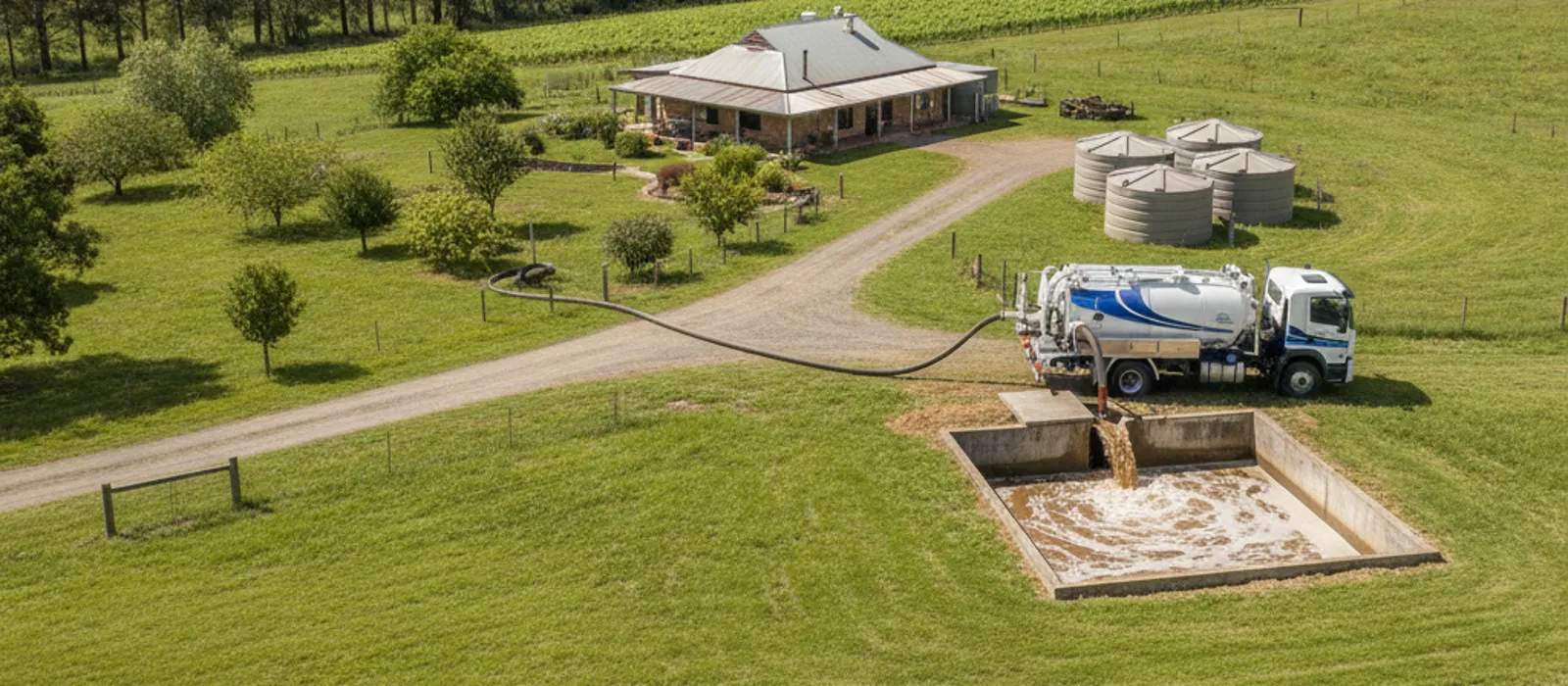
Septic Tank Filling Up Fast After a Pump-Out: The Common Causes
You paid $480 on the Tuesday to have the tank emptied. By the following Monday the lid is off and the water is already back up at the outlet. Nobody new has moved in, nothing has changed in the house, and you are starting to wonder whether the truck actually took anything away.
A septic tank filling up fast after a pump out is one of the more common calls we take across Maitland, Cessnock and Port Stephens. Most of the time the tank itself is perfectly sound. Some of that refill is completely normal and expected, and the rest usually comes down to one of six things. Those six things range from a $15 toilet part to a $12,000 trench replacement, so it is worth knowing which one you are looking at before you ring anyone.
The refill nobody warns you about
A septic tank is designed to sit full. It works by holding wastewater long enough for solids to settle, grease to float, and the clearer middle layer to flow out to your absorption trench. The working level is set by the outlet invert, which is the bottom edge of the outlet pipe. The moment the vacuum truck pulls out of the driveway, the tank starts filling back to that line with the very next flush.
How fast that happens is simple arithmetic. Australian on-site wastewater design allows roughly 120 to 150 litres per person per day, depending on whether you are on town water or rainwater tanks. Four people at 150 litres each is 600 litres a day. A 3,000 litre tank is back at working level in about five days, and a 4,500 litre tank in a little over a week.
So a tank that looks full seven days after a pump-out is not broken. It is doing exactly what it was built to do.
What is not normal is any of the following:
- The level is back to the outlet within 24 to 48 hours of normal household use.
- The water sits visibly above the outlet pipe.
- There is a soggy patch, a green stripe or ponding over the trench.
- Drains gurgle, the toilet is slow to clear, or you can smell it outside.
- On an AWTS, the high water alarm is sounding.
If you have sewage backing up inside, an alarm going, or effluent surfacing on the ground, that is not a wait-and-see job. Call now on 0468 278 123 and we will get a vacuum truck to you same day or next morning.
Why your septic tank is filling up fast after a pump out
1. Clean water is getting in from inside the house. This is the most common cause and by far the cheapest to fix. A toilet cistern with a worn flapper or a badly seated outlet valve can pass 200 to 400 litres a day without making any noise at all. Add a dripping mixer and a hot water relief valve that has started weeping, and you can be pushing an extra 500 litres a day into a tank that was sized for a household, not a leak.
2. Stormwater or groundwater is getting into the tank. Older concrete tanks crack at the joints and around the inlet and outlet penetrations. Lids sitting in a shallow depression, unsealed riser joints and a downpipe discharging a couple of metres from the tank all send surface water straight in. On the heavy clay country around Lochinvar, Paterson and Vacy the water table lifts quickly after a wet fortnight, and a tank with failed seals will fill from the outside in.
3. The absorption trench has stopped accepting effluent. If water cannot leave the tank, the tank stops being a tank and starts being a holding well. Trenches fail from biomat build-up, root invasion, soil compaction from vehicles parked over them, or simply age. This is the expensive end of the list and it is the one people most often mistake for a tank problem.
4. The outlet baffle or effluent filter is blocked. A collapsed baffle, a root mass at the outlet or a clogged effluent filter will hold the level up inside the tank even when the trench is perfectly healthy. It looks identical to trench failure from above the lid, and it costs a fraction as much to put right.
5. The pump-out was only partial. Some operators skim the liquid and leave the compacted sludge on the floor and the crust on top. If seven years of hardened sludge stays behind, you have kept maybe half your usable volume, so of course it fills fast. A proper job breaks up and removes the lot, which is why heavy hardened sludge carries a $75 to $150 loading.
6. On an AWTS, a pump or blower has failed. In an aerated system the pump chamber only empties when the submersible irrigation pump runs. If that pump, its float switch or the controller has died, the chamber fills, the high water alarm trips and the whole system backs up. A failed air blower will not raise the level directly, but it kills the treatment process and the sludge load climbs quickly. Our AWTS servicing and maintenance visits catch most of these before the alarm does.
How to work out which cause you have
You can narrow this down yourself in a day, without digging anything up.
Start with the no-use test. Note the water level, use as little water as you reasonably can for 24 hours, then check it again. If the level climbs while nobody is using water, it is arriving from somewhere other than your fixtures.
Next, look at the water itself. Grey, cloudy and smelly is household effluent, so the problem is on the outlet side. Clear and relatively odourless, especially after rain, points to groundwater or stormwater getting in.
Then check the level against the outlet pipe. At or just below the invert is normal. Sitting above it means effluent is not leaving, and that is the baffle, the filter or the trench.
Finally, read your water meter last thing at night and again before anyone gets up. Any movement with every tap off is an internal leak, and a plumber can chase that down for far less than any septic repair.
Three Hunter Valley jobs that started with the same phone call
A four-bedroom acreage place at Louth Park. A 4,500 litre tank pumped for $460 was back at the outlet inside eleven days, and the no-use test showed the level rising overnight. Two things were going on at once: a toilet cistern passing water continuously into the pan, and a downpipe discharging about a metre and a half from a lid that sat in a hollow. The plumbing repair was their own plumber’s job and the downpipe was an afternoon with a length of agricultural pipe.
A Pokolbin holiday cottage running an AWTS through a full wedding season. High water alarm on a Saturday afternoon with guests in the house. The submersible irrigation pump had failed after years of short, frequent cycles from back-to-back weekend occupancy. Emergency response that evening was a $480 pump-out on the 3,000 litre chamber plus a $200 after-hours loading, then a replacement irrigation pump at $980 installed the following week. The owner now runs quarterly servicing at $120 a visit, which is the right call for a rental that swings from empty to eight people overnight.
A 1990s concrete tank on acreage near Greta. Pumped in June, full again in under three days, and the water was clear rather than grey. That is a groundwater signature, and probing found the trench saturated at 400mm after a wet month. Perished seals around the outlet penetration sat in the $250 to $650 band. The trench itself was quoted for eco-air jetting and rejuvenation at $2,800, with the caveat that on that soil profile it might only buy a few years.
What each fix costs
These are the current Hunter Valley ranges. Access and depth move the price, distance does not, and there is no travel surcharge across the Maitland, Cessnock, Singleton or Port Stephens corridors.
| What is actually wrong | What you notice | Typical cost (AUD) |
|---|---|---|
| Normal refill after pump-out | Full again in 5 to 10 days, no other symptoms | $0, nothing to fix |
| Leaking cistern or tap | Level rises with no water use, water meter creeping | Plumbing part, well under $250 |
| Stormwater or groundwater ingress | Clear water, refill accelerates after rain | Baffle, seal and pipe repair $250 to $650 |
| Blocked outlet baffle or effluent filter | Level above outlet, trench dry | $250 to $650 |
| Partial previous pump-out | Sludge left on the floor, capacity feels halved | Full pump-out $400 to $650, hardened sludge +$75 to $150 |
| Buried lid, no riser | Contractor cannot reach the tank properly | Deep excavation +$75 to $150, riser retrofit $250 to $450 |
| AWTS irrigation pump failure | High water alarm, chamber full | $600 to $1,200 installed |
| AWTS air blower failure | Alarm, odour, poor effluent quality | $650 to $1,400 installed, or diaphragm kit $120 to $250 |
| Absorption trench failure | Ponding, wet patch, level above outlet | Rejuvenation $1,500 to $4,500 |
| Trench beyond rejuvenation | Repeat failures, saturated soil profile | New trench $8,000 to $14,000, licensed drainage contractor |
A diagnosis visit is the cheapest money you will spend here. A septic inspection with a CCTV line check, tank structural assessment, trench absorption probe and a written report runs $250 to $500, or $100 to $200 when it is bundled with a septic tank pump-out. We would rather find a $400 baffle repair than sell you a system you do not need.
When a septic tank refills fast because the trench has failed
If the baffle is clear, the filter is clean, there are no leaks in the house and the level still sits above the outlet, the trench is the answer.
A working trench relies on the soil accepting effluent. Over years a biological mat forms along the trench walls and gradually seals them, and roots, compaction from vehicles and stock, and a rising water table all accelerate it. Once the mat is thick enough, effluent has nowhere to go and it backs up into the tank.
Eco-air jetting and rejuvenation can break up that mat and restore absorption in many trenches, at $1,500 to $4,500. Whether it works depends entirely on the site: soil type, trench age, how much length is still structurally intact, and how high the water table sits. On tight clay with a shallow water table it may only buy a few seasons, and an honest assessment will say so up front.
A replacement trench is a different job altogether. Excavation, new trench construction, distribution pipework and tank set are carried out by licensed plumbing and drainage contractors we work with, and their NSW licence number appears on every quote. A replacement will normally need a site and soil assessment and a Section 68 approval from your council before any work starts, and on difficult sites that assessment needs a suitably qualified consultant on the ground. Budget $8,000 to $14,000 for a new absorption trench, and $12,000 to $18,000 for a conventional tank and gravity trenches together.
One last piece of context. Under the Local Government Act 1993, every owner of an on-site sewage management system in NSW needs an Approval to Operate from their council, and councils across the Hunter set conditions on servicing and reporting. NSW Health publishes the domestic wastewater guidance those approvals sit on. A tank that keeps overflowing is a compliance problem as well as a plumbing one, so it is better dealt with before an inspection letter arrives.
If your tank is filling faster than it should, get a look at it while it is still a repair. Routine pump-outs are scheduled within 48 hours and every load comes with a disposal docket. Book a pump-out or ask for a quote, or call 0468 278 123 and we will tell you over the phone what we would check first.
Related reading: signs your absorption trench is failing, why your AWTS alarm is beeping, and how often to pump a septic tank in NSW.
Frequently Asked Questions
Is it normal for a septic tank to be full a week after pumping?
Yes. A septic tank is meant to operate full to the outlet invert, and a household of four puts around 600 litres a day back into it. A 3,000 to 4,500 litre tank returning to working level in five to ten days is completely normal. It only becomes a problem if the level goes above the outlet pipe, or if it refills within a day or two with normal use.
How do I tell the difference between a trench problem and a leak in the house?
Do a 24-hour no-use test and read your water meter overnight with every tap off. If the meter moves, you have an internal leak. If the meter is still but the tank level keeps climbing, water is arriving from groundwater or stormwater, or effluent is not leaving through the outlet. Clear water points to ingress, grey and smelly water points to the outlet side.
Can a bad pump-out cause the tank to fill up fast?
It can. If only the liquid is drawn off and the compacted sludge and surface crust are left behind, you keep far less usable volume than you paid for, and the tank reaches the outlet again very quickly. Tanks that have gone seven years or more between services often carry hardened sludge that needs breaking up, which adds $75 to $150 to the job. Ask what came out and what the sludge depth was before the truck leaves.
Will pumping the tank again fix a fast refill?
Only if the tank was never properly emptied in the first place. If the trench has failed or the outlet is blocked, another pump-out buys you a few days and solves nothing, and you end up paying $400 to $650 every couple of weeks. That is why we inspect before we recommend anything. A blocked baffle or a faulty float switch at $250 to $650 is usually the real fix, not a new system.
Request Received!
Thank you for reaching out. Our Hunter Valley dispatch team will call you back promptly to confirm details and provide an upfront quote.
Call us directly on 0468 278 123