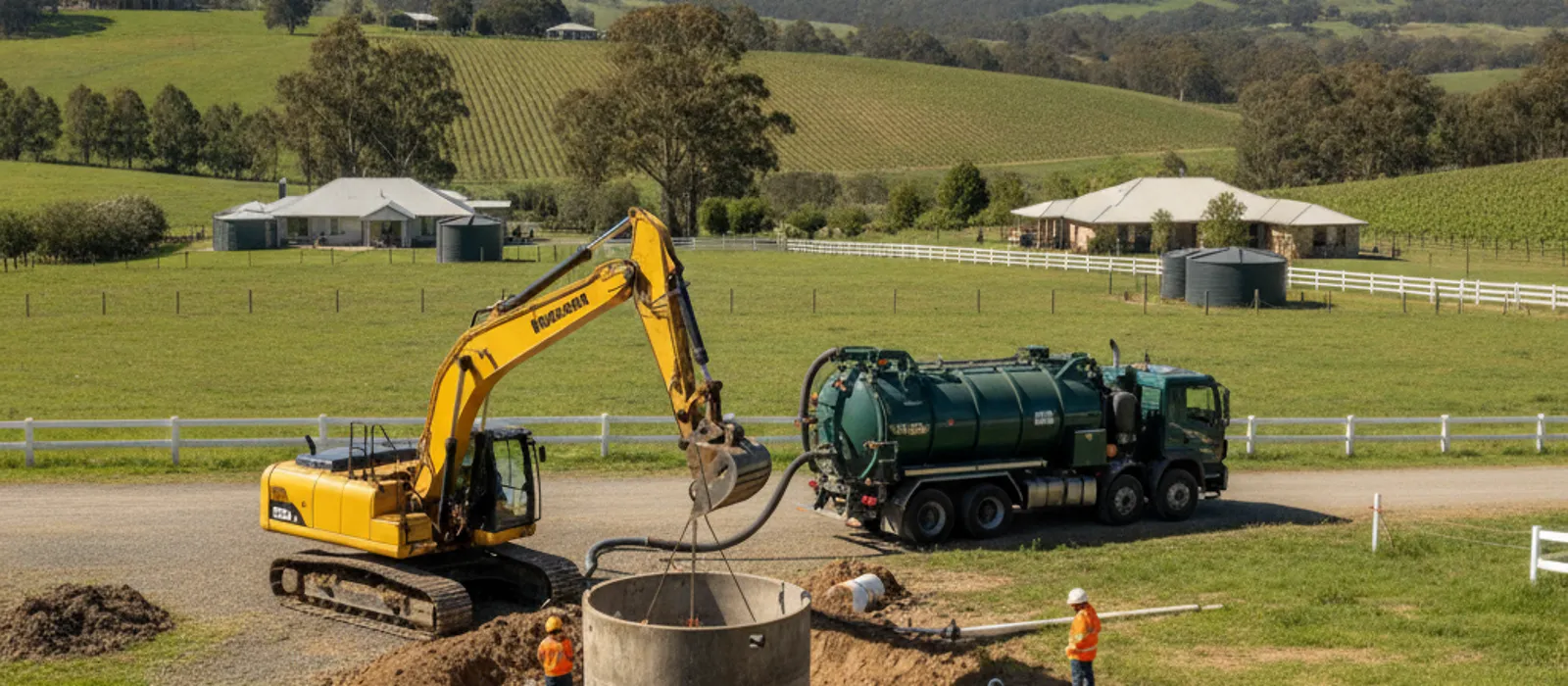
Decommissioning a Septic Tank in NSW: Rules, Steps and What It Costs
A ride-on mower put a rear wheel through a rotten concrete lid on a Dungog acreage block last winter. The tank underneath had been out of service for eleven years, was still holding close to a metre of liquid, and nobody in the household knew it was there. That is the version of decommissioning a septic tank in NSW that nobody plans for, and it costs a lot more than doing the job properly the first time.
An old tank does not become harmless the day you stop using it. It stays a covered void in the ground with a lid that gets weaker every year, and in most cases it still holds sludge and water. Councils across the Hunter know this, which is why they will not simply cancel your Approval to Operate because you tell them the system is no longer in use.
When you actually need to decommission a septic tank in NSW
Most people arrive at this job for one of four reasons.
The first is a sewer connection. When reticulated sewer reaches a village or a fringe street, the old on-site system becomes redundant and the tank has to be dealt with, not just abandoned.
The second is a system replacement. You are putting in an AWTS or a new tank and trench set, and the old vessel is in the way or sitting too close to the new land application area.
The third is a purchase. You have bought a block, the building report mentions an older system somewhere on the property, and nobody can tell you whether it was ever properly retired. If that is you, read our guide on buying a property with a septic tank in NSW before you commit to anything.
The fourth is failure. The tank has cracked, collapsed or been condemned in an inspection, and it is not going to be repaired.
Whatever brought you here, the first physical step is the same: the tank has to be completely emptied by a vacuum truck before anyone touches it with a machine. That part we do. Ring 0468 278 123 and we will get a truck to you, usually within 48 hours for a routine booking.
What NSW councils require before you fill anything in
Under the Local Government Act 1993, every owner of an on-site sewage management system holds an Approval to Operate issued by their council. Decommissioning does not automatically cancel it. You have to close it out, and councils want evidence before they will.
Councils in NSW treat retiring a system as sewage work, so most want either a Section 68 approval or written notification before the work starts. Requirements differ by local government area, so ring your council’s environmental health team first and ask them to send you their checklist in writing. Cessnock takes lodgements through an online channel. The others generally accept email or post.
What almost every Hunter council asks for is consistent:
- Proof the tank was fully pumped out by a service that provides a disposal docket.
- Confirmation the sanitary drain has been disconnected and capped by a licensed plumbing and drainage contractor.
- The base broken out or perforated so the shell can never hold water again.
- The void filled with clean granular material, compacted, or the whole vessel removed from site.
- Photographs of each stage, plus the plumber’s paperwork for the drainage work.
Some councils also want a final inspection before backfill goes in. That is worth confirming early, because it changes the order you book people in. NSW Health publishes the accreditation framework for on-site sewage management facilities that sits behind those council approvals, and it is a useful reference if your council quotes a system category at you.
One thing to be clear about: disconnecting and capping sanitary drainage, and any excavation and pipework, is plumbing and drainage work under NSW law. We do not carry out that part. It is carried out by licensed plumbing and drainage contractors we work with, and their NSW licence number appears on every quote.
Decommissioning a septic tank in NSW, step by step
-
Find and confirm what is actually there. Old Hunter properties often have more than people expect: a twin-chamber tank plus a collection well, or a tank plus a separate greywater pit. Probe rods, council records and old plumbing plans all help. A septic inspection with a written report is the cheap way to avoid a surprise second vessel halfway through.
-
Get the council requirements in writing. Ask specifically whether they want a Section 68 approval, what photographic evidence they need, and whether an inspection is required before backfill.
-
Pump the tank out completely. Every litre of liquid and all the settled sludge comes out, not just the clear layer. Waste is transported and disposed of under NSW EPA waste rules at a licensed treatment facility that has agreed to accept it, and you get a disposal docket for every load.
-
Disconnect and cap the drain. The line from the house is cut and sealed at the tank end by a licensed contractor. If the property is switching to sewer or to a new system, this is the point where the changeover happens.
-
Break out the base. A perforated or broken floor stops the shell acting as a bathtub that fills with groundwater and slowly collapses.
-
Remove the lid and upper walls, or take the whole vessel out. Leaving a lid buried under 200mm of topsoil is how the Dungog mower incident happens.
-
Backfill with clean granular fill and record everything. Sand, gravel or crushed rock placed in layers and compacted. Not topsoil on its own, and not builder’s rubble with organic material in it. Then send the docket, the photos and the contractor’s paperwork to council and ask them to cancel the Approval to Operate.
One sequencing trap is worth naming. If you are replacing rather than removing, the old system has to keep working until the new one is commissioned. That means a short outage window on changeover day, and the old tank gets pumped and retired after the new one goes live, not before.
Fill it in place or take it out, and what each costs in the Hunter Valley
Filling in place is the usual answer for an old concrete tank sitting in open paddock or lawn. The shell is heavy, stable once broken and backfilled, and digging it out achieves nothing except a bigger hole.
Taking it out tends to be the answer for poly tanks, for anything under a proposed driveway or shed pad, and for tanks close to a new absorption area. A thin plastic shell left in the ground will deform and settle years later. If you are weighing up materials for a replacement, our comparison of concrete versus poly septic tanks covers how the two behave in Hunter soils.
Where the tank sits under or near a driveway, a slab or a footing, do not guess at the backfill. Compaction and any load-bearing question in that zone needs a qualified geotechnical or structural engineer on site.
Here is how the money breaks down. The pump-out figures are our own set prices. Everything else is quoted by the contractor doing that part, and the ranges shown are estimates only.
| Line item | Who does it | Typical cost (AUD) |
|---|---|---|
| Full pump-out, up to 3,000L (2 to 3 bedroom) | Hunter Valley Septic | $350 to $500 |
| Full pump-out, 3,500 to 4,500L (3 to 5 bedroom) | Hunter Valley Septic | $400 to $650 |
| Full pump-out, 5,000L or dual tank | Hunter Valley Septic | $650 to $900 |
| Hardened sludge, 7 or more years since last pump-out | Hunter Valley Septic | add $75 to $150 |
| Buried lid deeper than 300mm, no riser fitted | Hunter Valley Septic | add $75 to $150 |
| Hose run beyond 45 metres from the truck | Hunter Valley Septic | add $50 to $120 |
| Disconnect and cap the sanitary drain | Licensed plumbing and drainage contractor | $400 to $900 (estimate) |
| Break out base, excavator and operator | Licensed contractor | $600 to $1,200 (estimate) |
| Clean granular fill, delivered and placed | Licensed contractor | $200 to $600 (estimate) |
| Remove and cart the shell off site | Licensed contractor | $1,500 to $3,500 (estimate) |
As a rough all-in figure, filling a standard household tank in place tends to land between $1,600 and $3,400, and full removal between $2,500 and $5,600. Both are estimates, because access, depth, tank size and how far a truck and excavator can get to the vessel move the number more than anything else. There is no travel surcharge from us across the Maitland, Cessnock, Singleton or Port Stephens corridors. Access and depth change the price, not distance, and we quote before we start.
Two recent jobs give a sense of the spread.
A four-bedroom acreage place at Louth Park connected to sewer after the main was extended down the road. The tank was a 1970s twin-chamber concrete unit of roughly 3,500 litres that had not been pumped in nine years, so the sludge had set hard and the lid sat about 350mm under lawn. The pump-out came to $520 once the hardened sludge and lid excavation loadings went on. Council wanted photos at three stages, the shell was broken and filled in place, and the Approval to Operate was cancelled about a fortnight later.
A Pokolbin holiday cottage replaced an old tank and trench with an AWTS after the trench gave up during a busy season. The old poly tank sat four metres from where the new irrigation area was going, so council would not issue the new Approval to Operate until it was gone. It was pumped, crushed and carted, and the sequencing mattered: the cottage stayed on the old system until the AWTS was commissioned, then the retirement work happened the following week.
Booking the pump-out first is what keeps a job like that moving, because the excavator cannot start until the tank is empty. Get in touch with the property address and rough tank size and we will get a truck locked in.
Never enter the tank, empty or not
This is the part of the job where people get killed, and it is worth being blunt about.
A septic tank is a confined space. Hydrogen sulphide and methane sit in the bottom of the vessel, oxygen levels can be well below survivable, and a tank that has been pumped out an hour ago can still be lethal. SafeWork NSW is direct about it: the hazards in a confined space are not always obvious and can change between one entry and the next.
Most confined space deaths involve more than one person, because someone goes in after the first casualty. Do not enter to retrieve a dropped tool, to check the base, or to help someone. Ring 000 and wait for people with breathing apparatus and a retrieval system.
The second hazard is structural. Old unreinforced concrete lids and the brick tanks common on pre-1980s Hunter blocks fail without warning under the weight of a person, a mower or a vehicle. Keep stock, kids and machinery off any tank area until the lid is off and the void is filled. If you have found a lid you cannot identify, call us on 0468 278 123 and we will come and assess it rather than have you lever it open yourself.
If your system is still in service and you are here because something is going wrong rather than because you are retiring it, start with the signs your septic tank is full or our notes on council OSSM inspection rules in NSW.
Frequently Asked Questions
Do I need council approval to decommission a septic tank in NSW?
In most Hunter local government areas, yes. Councils treat it as sewage work under the Local Government Act 1993 and will want either a Section 68 approval or written notification before the work starts. Requirements vary between Maitland, Cessnock, Singleton, Port Stephens, Muswellbrook and Dungog, so ask your council’s environmental health team for their checklist in writing before you book anyone.
Can I just fill an old septic tank with soil and forget about it?
No. Topsoil tipped into an intact tank leaves a sealed void that fills with groundwater and settles or collapses later, and councils will not cancel your Approval to Operate on that basis. The tank must be emptied, the base broken out so it cannot hold water, and the void filled with clean granular material placed in compacted layers. Anything organic in the fill will rot and subside.
Does the tank have to be pumped out before it is filled or removed?
Always. Sludge and liquid left in a shell is both a contamination risk and a genuine hazard for anyone working near the opening, and every council checklist we have seen asks for proof of a proper pump-out. A full pump-out runs $350 to $900 depending on tank size, with a loading if the sludge has hardened after seven or more years. You receive a disposal docket for the load.
What happens to my Approval to Operate once the tank is gone?
You send council the disposal docket, the licensed contractor’s paperwork for the drainage disconnection, and the photographs they asked for, then request that the approval be cancelled. Until they process that, the property is still recorded as having an on-site system and can still appear on the council inspection cycle. Keep copies of everything, because the next buyer’s conveyancer will ask for them.
Retiring an old tank is not a complicated job, but it is one where the order of operations and the paperwork matter as much as the digging. If you have a redundant tank on your property in the Hunter and you want the pump-out and disposal docket sorted, call 0468 278 123 or send us the details and we will get it booked.
Request Received!
Thank you for reaching out. Our Hunter Valley dispatch team will call you back promptly to confirm details and provide an upfront quote.
Call us directly on 0468 278 123