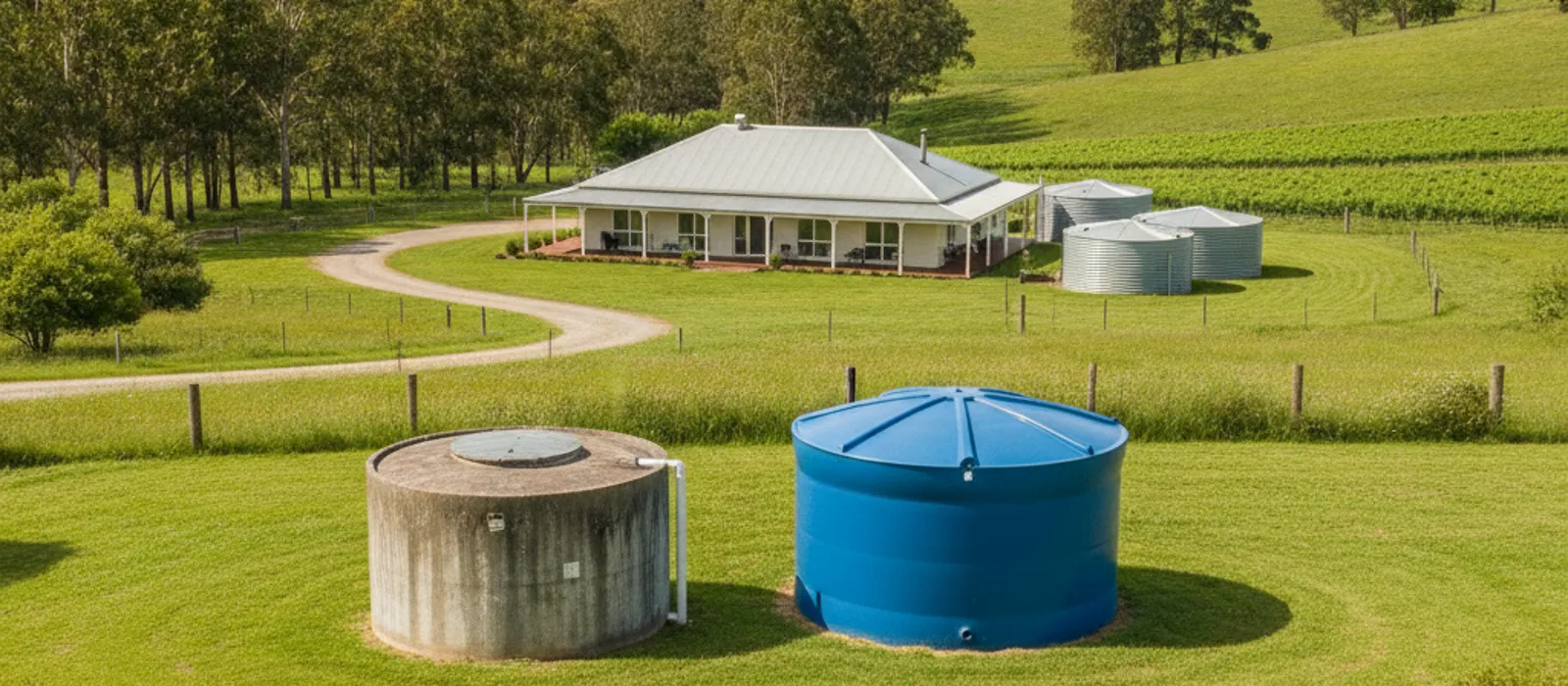
Concrete vs Poly Septic Tank: Which One Lasts Longer on a Hunter Valley Block
A tech stepped near the edge of a 1980s concrete lid on a Gillieston Heights block and the corner crumbled away like a wet biscuit. The walls below the water line were still sound. The crown, the part sitting in the gas space above the liquid, had been quietly eaten for forty years by something most owners have never heard of.
That is the honest starting point for the concrete vs poly septic tank question. Neither material simply wears out. Each one gets attacked by a different thing, and which one lasts longer on your place depends almost entirely on what your place is like underground.
The stakes are real. A conventional tank with gravity trenches, installed by a licensed plumbing and drainage contractor, runs $12,000 to $18,000. A complete AWTS is $15,000 to $25,000 or more. Nobody wants to pay for that twice.
How concrete and poly septic tanks actually fail
Inside every septic tank, bacteria digest solids and release hydrogen sulphide gas. That gas collects in the headspace above the liquid. Where it meets moisture and air on the underside of the lid and the top of the walls, a second group of bacteria converts it into sulphuric acid.
Concrete does not cope well with that. The acid dissolves the cement paste holding the aggregate together, working downward from the crown. The result is a tank with solid walls below the water line and a soft, sandy, crumbling ring above it. Heavy bleach and drain cleaner use, or a poorly vented system, tends to speed it up.
Poly tanks are indifferent to acid. Polyethylene is not attacked by hydrogen sulphide, sewage, or household chemicals at the concentrations a domestic system produces.
What poly cannot ignore is pressure. A poly tank is a shell that depends on the liquid inside and the backfill outside staying in balance. Get the bedding wrong, compact the backfill badly, or empty the tank when the surrounding ground is saturated, and the shell can deform or lift. Concrete solves that problem with sheer mass.
So the real question is not which material is stronger. It is which failure mode your block is more likely to trigger.
If you are not sure what is in the ground at your place, a pump-out is the one time anyone can actually see it. Call 0468 278 123 and we will note the tank material, wall and crown condition, and rough remaining life while the tank is empty, or ask for a callback through the contact form.
Concrete septic tanks: heavy, stable, quietly eaten from the top
Precast concrete has been the default in rural NSW for decades, and there are good reasons for that. A 3,500 litre concrete tank is heavy enough to stay put in wet ground without anchoring. It tolerates side loading from reactive clay far better than a plastic shell.
On a dry, stable site with reasonable venting, a well made concrete tank can give 30 to 50 years of service. That is a general range, not a promise. Crown corrosion is the usual limit, and how fast it arrives depends on venting, household chemical use and how the tank was cast.
The weaknesses are worth knowing before you commit:
- The lid and the top course corrode first. A tank can be structurally sound and still have an unsafe lid.
- Older two-piece and block-built tanks leak at the joint once the mortar goes.
- Reactive clay movement and tree roots can crack a wall or shear an inlet.
- Placement needs truck access plus a crane or excavator, so tight, steep or heavily vegetated blocks get expensive.
A four-bedroom acreage place at Louth Park shows how this plays out. The 4,500 litre concrete tank had not been pumped in nine years. The base pump-out on a tank that size sits at $400 to $650, plus $75 to $150 for hardened sludge after seven years or more, plus another $75 to $150 because the lid was buried around 380mm down with no riser.
The tank itself was fine, but the crown was thin. The owner added an access riser for $250 to $450, so the next pump-out will not start with a shovel. That is the pattern with concrete. It degrades from the top down, and the fixes usually run in the hundreds rather than the tens of thousands.
Poly septic tank vs concrete: where plastic earns its place
Modern poly tanks are rotationally moulded in one piece, so there are no joints to leak. They are ribbed for strength, they will never corrode, and a small crew can walk one into a backyard a concrete truck could never reach. On steep Dungog hillsides and tight blocks on the Newcastle fringe, that access advantage alone can decide the job.
Lighter tanks also mean less plant time, which lowers the installed cost from the licensed drainage contractor doing the work. The saving is on labour, not on the tank.
The trade-offs are specific and they matter:
- Flotation. An empty or near empty poly tank in a high water table can lift. Manufacturers set out anchoring or concrete collar requirements for exactly this reason, and those instructions are not optional.
- Backfill sensitivity. Rocky or poorly compacted backfill can dent or distort the shell over time.
- No vehicle loading. Neither material is safe to drive over unless it is specifically designed and installed for traffic, but poly is far less forgiving of a ute parked on top.
- Pump-out sequencing. In saturated ground, a poly tank should not be run completely dry and left that way.
A low-lying property near Morpeth showed the cost of ignoring that last point. After a wet winter the owner had the poly tank drained right out while the surrounding paddock was still holding water. The tank lifted enough to pull the inlet out of alignment, which turned a routine job into a plumbing repair.
Anyone servicing a poly tank in flood-affected country needs to read the ground water first and stage the pump-out where required. If your system has been through high water recently, our guide on what to check after flooding sets out the order to work through.
Concrete vs poly septic tank: side by side
| What matters | Concrete | Poly (polyethylene) |
|---|---|---|
| Typical service life on a suitable site | 30 to 50 years, crown corrosion usually the limit | 30 years plus claimed by makers, limited by installation quality more than age |
| Main failure mode | Sulphuric acid attack on lid and upper walls, joint leaks, cracking | Deformation, flotation, damage at inlet and outlet penetrations |
| High water table or flood-prone ground | Strong. Mass resists uplift | Needs anchoring or a concrete collar to the maker’s spec |
| Reactive clay and side loading | Handles it well | More sensitive to poor backfill and ground movement |
| Tight, steep or vegetated access | Poor. Needs crane or excavator plus truck access | Good. Can be carried in or placed with small plant |
| Weight when empty | Very heavy | Light enough for a small crew |
| Vehicle traffic overhead | Only if designed and installed for it | Avoid entirely unless engineered for it |
| Lid safety over time | Degrades, needs checking at every service | Stays intact, but seals and risers still need checking |
| Repairability | Baffle and pipe repairs $250 to $650, riser retrofit $250 to $450 | Same repair range for baffles, pipework and risers |
| Who installs it | Licensed plumbing and drainage contractors we work with | Licensed plumbing and drainage contractors we work with |
Read that table as a site matching exercise rather than a scoreboard. A poly tank on a dry Singleton ridge and a concrete tank on the same ridge will both outlive their absorption trenches. On a wet Maitland flat, the ranking changes.
What your block decides for you
Four things on your property drive this decision more than any brochure will.
Water table and flooding. If the ground holds water for weeks after rain, mass matters and poly needs proper anchoring. This is the most common single reason a Hunter Valley installer specifies concrete.
Soil type. Heavy reactive clay moves with moisture. That movement loads the side of a tank and the pipework running into it. It also drives absorption trench sizing, which is the part of the system most likely to fail first regardless of tank material.
Access. If a concrete truck and an excavator cannot get to the spot, concrete is not really on the table without significant extra cost.
Load above the tank. Driveways, stock routes and machinery paths need to be planned around the tank and trench, not over them.
None of that can be settled from a desk. System selection and trench sizing on an unsewered NSW block need a site and soil assessment, and on difficult ground a qualified wastewater engineer should be on site. Under the Local Government Act 1993 you also need an Approval to Operate from your council, whether that is Maitland, Cessnock, Singleton, Port Stephens, Muswellbrook or Dungog. NSW Health sets the accreditation framework for the systems themselves, and its domestic wastewater guidance is the reference councils work from.
Buying a place with an existing system is the other version of this question. A pre-purchase inspection at $250 to $500 covers a CCTV line check, a tank structural assessment, a trench absorption probe and a written report. That is the cheapest way to find out whether you are inheriting a sound tank or a five-figure problem. The full checklist is in our guide to buying a property with a septic tank.
What it costs, and what you cannot change later
The tank is not where your money goes.
A conventional tank with gravity trenches is $12,000 to $18,000 installed by a licensed contractor. A complete AWTS is $15,000 to $25,000 or more. A replacement absorption trench on its own is $8,000 to $14,000. The trench, not the tank, is the expensive and failure-prone half of the system, and it does not care what your tank is made of. Symptoms show up months before replacement becomes unavoidable, and trench failure signs are worth learning to spot early.
The tank material changes maintenance detail, not maintenance frequency. Both types need pumping every three to five years for a household of two to four people, and both need lid and baffle checks at every visit.
| Job | Cost (AUD) |
|---|---|
| Pump-out up to 3,000L (2 to 3 bedroom) | $350 to $500 |
| Pump-out 3,500 to 4,500L (3 to 5 bedroom) | $400 to $650 |
| Pump-out 5,000L or dual tank | $650 to $900 |
| Access riser retrofit | $250 to $450 |
| Baffle or pipe repair | $250 to $650 |
| Pre-purchase inspection | $250 to $500 |
| AWTS quarterly service | $90 to $150 per visit |
A Pokolbin holiday cottage running an AWTS through a full wedding season makes the point. Bookings pushed daily flow well past design load, the blower ran hard, and the owner assumed the tank was the problem. It was not. The primary chamber was sound. Quarterly servicing at $90 to $150 per visit, so $360 to $600 a year, plus a desludge at $450 to $750, brought it back inside spec. Tank material had nothing to do with any of it.
Our approach on jobs like that is repair first. A root-blocked inlet baffle, a perished blower diaphragm or a failed float switch is a $250 to $650 fix, not a reason to quote a new system.
Routine pump-outs are scheduled within 48 hours. A genuine emergency, meaning a sewage backup, an active high-water alarm or an overflow, gets a same-day or next-morning vacuum truck. There is no travel surcharge across the Maitland, Cessnock, Singleton or Port Stephens corridors, because access and lid depth change the price, not distance.
If you are weighing up a replacement quote, or you just want a straight answer about the tank you already have, call 0468 278 123 or book a pump-out and we will tell you what is actually in the ground. If you are mid-purchase, a septic inspection with a written report is the version you want.
Frequently Asked Questions
Which lasts longer, a concrete or a poly septic tank?
On a dry, stable, well-drained site a good concrete tank generally outlasts poly, because mass and rigidity are on its side. On wet, reactive or awkward ground poly often lasts longer in practice, because concrete corrodes faster in poorly vented systems and is harder to place correctly. Installation quality decides more than material does. Treat both lifespans as typical ranges rather than guarantees, since your soil and water table will shift the answer.
Can I drive over a poly septic tank?
No, not unless the tank and its installation were specifically designed for vehicle loading, which most domestic setups are not. Poly is far less tolerant of surface load than concrete, and even concrete tanks crack under repeated traffic. Keep vehicles, stock and machinery off the tank and the trench area completely. A collapsed lid is a serious injury risk, not just a repair bill.
Do Hunter Valley councils care which material I choose?
Councils approve the system, not the material in isolation. Under the Local Government Act 1993 you need an Approval to Operate from Maitland, Cessnock, Singleton, Port Stephens, Muswellbrook, Upper Hunter or Dungog, and the system has to suit the site assessment for your block. Where the water table or soil rules out an unanchored poly tank, that comes through the site assessment rather than a blanket council ban. Cessnock takes lodgements through an online channel, while other councils accept email or post.
Is it worth replacing a cracked concrete tank with poly?
Sometimes, but find out what is actually cracked first. A corroded crown or a damaged lid can often be handled for a few hundred dollars with a new lid and riser, and baffle or pipe repairs sit at $250 to $650. If the walls below the water line are leaking, replacement becomes the honest answer, and at that point access to your block usually decides between concrete and poly. Any replacement, excavation or new trench work is carried out by licensed plumbing and drainage contractors we work with, and their NSW licence number appears on every quote.
Request Received!
Thank you for reaching out. Our Hunter Valley dispatch team will call you back promptly to confirm details and provide an upfront quote.
Call us directly on 0468 278 123