Septic System After Flooding: What Hunter Valley Owners Should Do First
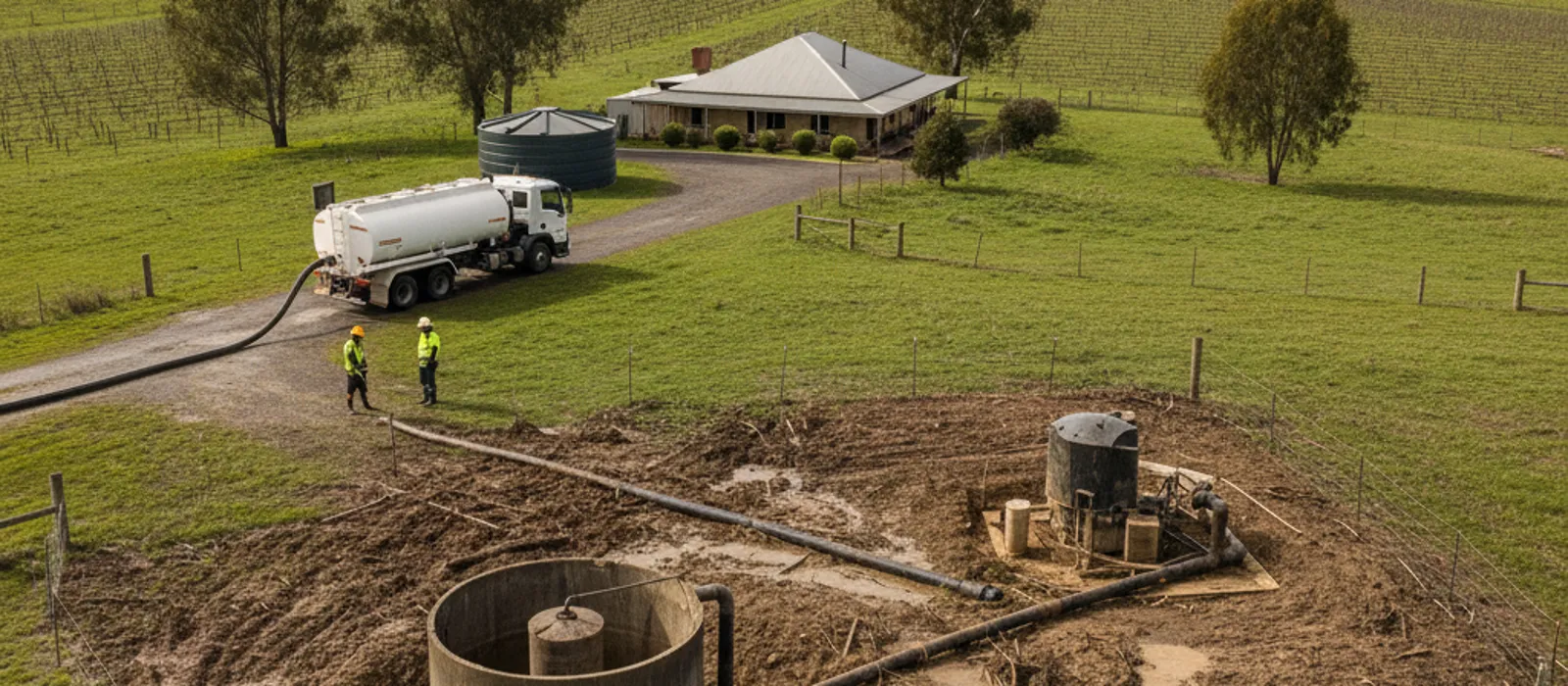
The laundry drain started gurgling about six hours after the rain eased. By the next morning there was a soft dark patch out over the trench and the toilet was taking its time. That is what a septic system after flooding looks like on most acreage blocks around Maitland, Dungog and the Cessnock flats, and how the owner handles the next 48 hours is the difference between a $400 pump-out and a $14,000 trench rebuild.
Flood water does not usually break a septic tank. What it does is take away the one thing the system needs to keep working, which is somewhere for treated effluent to go. Understand that and the right order of steps becomes obvious.
What flood water actually does to a septic system
Your tank is meant to sit full. Waste goes in, solids settle, and liquid moves out to an absorption trench or an irrigation area where the soil finishes the job.
When the water table rises above that trench, the soil is already saturated and there is no room left for effluent. The liquid backs up through the outlet, fills the tank higher than normal, and eventually finds the lowest point in the house or pushes up through the ground above the trench.
Ground water also comes the other way. Perished lid seals, uncapped inspection openings and cracked pipework let flood water into the tank, which fills it faster than the household ever could.
The bacteria in the tank are tougher than people expect. Dilution slows the biology, it does not sterilise it. The part genuinely out of action is the disposal field, and that recovers on the water table’s schedule, not yours.
If sewage is already coming back up inside the house, or liquid is surfacing at the tank lid, do not wait for the paddock to dry. Call now on 0468 278 123 and ask for emergency septic service. A genuine backup, an active high-water alarm or an overflow gets a same-day or next-morning vacuum truck.
The first 24 hours after flooding: your order of operations
Work through these in order. Most of them cost nothing.
- Treat any surface water near the tank or trench as sewage. Keep kids, dogs and livestock off it, wear gumboots and gloves, and wash your hands properly afterwards. NSW Health publishes plain advice on storms and floods that is worth two minutes of reading.
- Cut water use hard. Every litre you send down the drain has nowhere to go. Short showers, no washing machine, no dishwasher, no filling troughs from house taps.
- If you run an AWTS and the blower housing or control box has been under water, switch it off at the switchboard and leave it off. Do not test it by turning it back on.
- Do not have the tank pumped dry while the ground is still saturated. There is a good reason for that, covered in the next section.
- Look at the lid and risers from a distance and do not lift anything to check the level. If a lid has shifted, rope the area off. A displaced septic lid is the most dangerous thing on a rural property after a flood.
- Photograph everything, including the water level against a fence post or the shed. Councils and insurers ask, and the photos are worth more than your memory in three weeks.
- If the house is backing up, ring for a truck. Everything else can wait.
That order matters. Owners who reverse steps two and four are the ones who end up paying twice.
Why pumping a flooded septic tank too early can float it
An empty tank sitting in saturated ground behaves like a boat. Water pressure underneath pushes up, and with nothing inside to hold it down the tank can lift. Poly tanks are the most at risk because they are light. Concrete tanks rarely float outright, but lids, risers and inlet connections can still shift.
A three-bedroom place on low ground near Louth Park learned this the expensive way. The owner had a 3,000 litre poly tank sucked completely dry the morning after the water went down, which is exactly what feels sensible at the time. Over the following week the tank lifted roughly 60 millimetres and pulled the inlet pipe out of its seal. The pump-out was $420, and the repair plus a second pump-out to reset the level added about $600, with the drain connection handled by the licensed plumbing and drainage contractor we work with.
So the rule is simple. If the tank is not overflowing and the house is not backing up, leave it alone until the ground water drops below tank level. If it is overflowing or the house is backing up, pump it, but the operator should leave a working level of liquid in the tank rather than emptying it to the floor. Ask for that specifically.
Whether a full pump-out is safe on your block depends on tank material, how deep it is set, the soil and where the water table sits on the day. That is a judgement call made on site. Our septic tank pumping crews make it before the hose goes in.
AWTS after a flood: power, blower, chlorine and the alarm
An aerated system has electrics, which changes the priorities. The blower usually sits in a housing at ground level or on the tank lid, precisely the height flood water reaches.
A drowned blower is normally finished. Replacement runs $650 to $1,400 installed. If the unit was only splashed and the diaphragms have taken in moisture, a service kit at $120 to $250 can be enough, but a technician determines that with the unit open. A submersible irrigation pump that has been running against a flooded lawn can also fail, at $600 to $1,200 installed.
The high-water alarm will almost certainly be sounding, and after a flood it is usually telling the truth. Our guide to why an AWTS alarm keeps beeping covers the other causes worth ruling out once the water is gone.
Two more things. Chlorine tablets dissolve much faster in a diluted chamber, so disinfection is effectively nil for a while. Do not run irrigation onto the lawn while the system is flood-diluted, because what comes out has not been treated properly.
A Pokolbin holiday cottage running an AWTS through a wet fortnight showed the full picture. The blower housing sat in about 200 millimetres of water for two days, the blower died, the alarm was going, and the irrigation pump was cycling against ground that could not take another drop. Putting it right meant a blower replacement, a full AWTS desludge at $450 to $750 to clear silt from the chambers, and a quarterly service contract at $90 to $150 per visit. Under your council’s Approval to Operate, quarterly AWTS servicing and maintenance is required anyway, and we send the service report to your council after each visit.
Do not restart a submerged blower or control box until a qualified person has looked at it. Water and switchboards are not a homeowner job.
What a flooded septic system costs to sort out
Current Hunter Valley ranges in AUD. Where the job depends on what is found in the ground, the range is wide for a reason.
| Situation after the flood | What is usually needed | Typical cost (AUD) |
|---|---|---|
| Trench saturated, no backup inside, tank sound | Cut water use and wait for the water table to drop | $0 |
| Tank close to overflow, 2 to 3 bedroom house | Pump-out up to 3,000 litres | $350 to $500 |
| Tank close to overflow, 3 to 5 bedroom house | Pump-out 3,500 to 4,500 litres | $400 to $650 |
| Large rural or dual-tank setup | Pump-out 5,000 litres and over | $650 to $900 |
| Sewage backing up, active alarm or overflow | Same-day or next-morning vacuum truck | Base pump-out plus $150 to $300 |
| Lid buried over 300mm with no riser | Hand excavation to expose the lid | Plus $75 to $150 |
| Truck cannot get within 45 metres | Extended hose run | Plus $50 to $120 |
| Not pumped in 7 years or more | Hardened sludge, extra back-pulsing | Plus $75 to $150 |
| Ground water entering at the lid seam | Access riser retrofit | $250 to $450 |
| Inlet baffle or pipework displaced | Repair, drain connections by licensed contractor | $250 to $650 |
| AWTS blower drowned | Blower replacement, installed | $650 to $1,400 |
| AWTS chambers full of silt and flood water | Full AWTS desludge | $450 to $750 |
| Trench still ponding weeks after the water drops | Rejuvenation or eco-air jetting | $1,500 to $4,500 |
| Trench structurally finished | New absorption trench, licensed drainage contractor | $8,000 to $14,000 |
There is no travel surcharge across the Maitland, Cessnock, Singleton or Port Stephens corridors. Access and depth change the price, distance does not, and anything extra is quoted before we start.
To get a number for your own tank, call now on 0468 278 123 or send through your details and we will call you back within 24 hours in business hours.
When the absorption trench has really failed, and when it just needs time
Patience is the cheapest repair available, and most owners do not give it a fair go.
Once the surrounding ground water has dropped and the paddock is walkable again, a healthy trench usually comes back within one to three weeks. Heavy clay country through parts of Maitland and Cessnock takes longer than sandy soil near Port Stephens. That variation is soil, not luck.
Signs the trench has not come back are specific. Water ponding over the trench line in genuinely dry weather. A strip of grass that stays soggy and darker green when everything else has browned off. Smell outside on a dry day. Or the tank filling to the outlet within days of being emptied, which we cover in absorption trench failure signs.
A five-acre property in the Dungog area went through exactly that. A 4,500 litre concrete tank with gravity trenches, ponding after a wet run, and the owner sensibly waited. Five weeks later, in dry weather, it was still ponding. An inspection at $380 with a trench absorption probe found the biomat had sealed hard rather than the trench being structurally gone. Jetting and rejuvenation at $2,800 brought it back, a long way short of a rebuild.
Be realistic about what jetting can do. It clears biomat and restores absorption where the trench aggregate and pipework are still intact. If roots have crushed the line, if flood silt has filled the aggregate, or if the trench was undersized for the soil from day one, jetting buys time and nothing more. On those sites the honest answer is a properly designed replacement built by a licensed plumbing and drainage contractor, and on complex ground that starts with a soil assessment.
Either way, a failed system is a council matter. Every owner of an on-site system in NSW holds an Approval to Operate under the Local Government Act 1993, and the Office of Local Government’s Easy Septic Guide sets out that obligation in practice. We handle the Section 68 paperwork support and can arrange a septic inspection with a written report if your council or insurer wants one.
Get the sequence right and most flood-affected systems here cost a few hundred dollars and a fortnight of careful water use. Get it wrong and you are paying for a floated tank sitting on top of a trench that would have recovered on its own. If you are staring at a wet patch and are not sure which situation you are in, call now on 0468 278 123. Routine pump-outs are scheduled within 48 hours, and an active backup or alarm gets a truck same day or next morning.
Frequently Asked Questions
How long should I wait before pumping out a septic tank after flooding?
Wait until the ground water has dropped back below the level of the tank, which on most Hunter properties is a few days to a fortnight after the surface water goes. Pumping a tank dry while the surrounding soil is saturated risks floating it, especially with a poly tank. The exception is an active backup or overflow, where you pump immediately but leave a working level of liquid in the tank rather than emptying it out.
Can I use the toilet while my septic system is flooded?
Yes, but sparingly, and only if nothing is backing up inside. Every litre you add goes into a tank that has no outlet, so cut showers short and stop the washing machine and dishwasher entirely until the trench starts taking water again. If the toilet is slow, the drains are gurgling, or waste is coming back up, stop using water and get a truck out. Our guide on what to do if your septic is backing up walks through the warning signs.
Does flood damage to a septic system need to be reported to council?
If the system has failed or is discharging to the surface, yes, your council needs to know, because your Approval to Operate is conditional on the system working. Maitland, Cessnock, Singleton, Port Stephens, Muswellbrook and Dungog all handle this slightly differently, with Cessnock using an online lodgement channel and the others accepting email or post. A written inspection report at $250 to $500 usually covers what they ask for. For an AWTS, we send the service report to your council after each visit as part of normal servicing.
Will flooding kill the bacteria in my septic tank?
No, not permanently. Dilution slows the biology and the tank will not treat waste as well for a week or two, but the bacterial population re-establishes on its own once normal flow returns. Skip the additives and starter products sold for this, because there is no good evidence they speed up recovery in a flood-affected tank. What actually helps is reducing the load while the soil dries out.
Request Received!
Thank you for reaching out. Our Hunter Valley dispatch team will call you back promptly to confirm details and provide an upfront quote.
Call us directly on 0468 278 123