Absorption Trenches Explained: How They Work and How NSW Sizes Them
Say you’re looking at a rural block outside Cessnock or Maitland and the agent mentions it runs on a septic tank with an absorption trench. Or you already own one and you’re wondering why the quote for a new trench looks nothing like the quote for a pump-out. Either way, the trench does more of the treatment work than the tank.
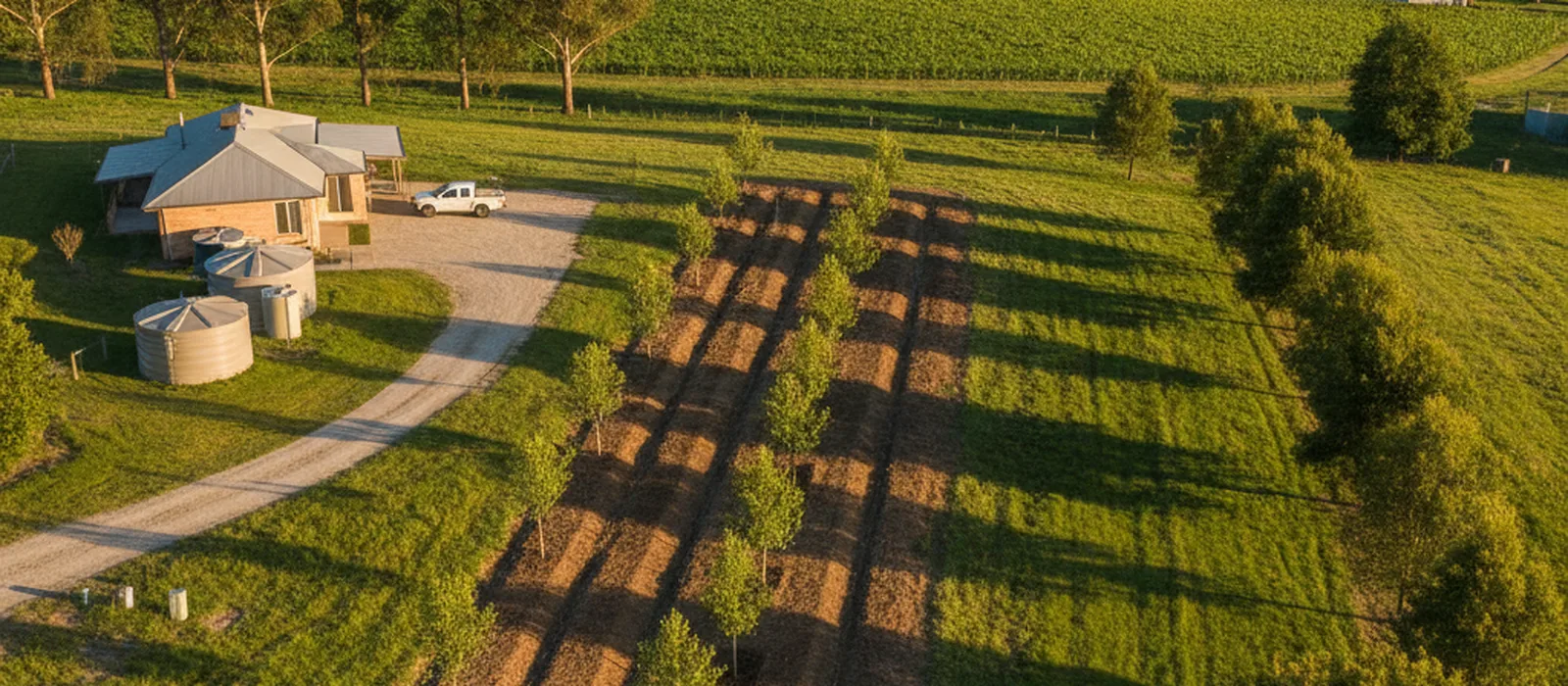
An absorption trench takes the settled, primary-treated effluent leaving the tank and spreads it through perforated pipe or a chamber arch in a gravel-filled trench. The soil underneath absorbs it, filters it, and a thin biological layer on the trench floor finishes the treatment before it moves into the ground. Councils also call it a soakage trench, same thing.
How big it needs to be, and whether a trench even suits your soil, is set out in NSW’s guidelines and confirmed by a site and soil assessment before council approves anything.
What an absorption trench actually is
Effluent leaves the tank already settled: the solids have dropped out as sludge, the fats and oils have floated off as scum, and what flows out the outlet is a comparatively clear liquid, still not something a garden hose or an animal should touch, but no longer raw sewage. That’s primary-treated effluent, and a trench is built to receive it, spreading it along a distribution pipe running the length of the excavation: either perforated pipe bedded in aggregate, or a durable, self-supporting plastic arch sitting straight on gravel with no pipe at all. A geotextile layer goes over the media, then a mound of topsoil, shaped to shed rain rather than let it pool.
Effluent infiltrates through the base and side walls into the surrounding soil. A thin biological layer called a biomat forms on the trench floor as it does: bacteria and fine solids that do genuine treatment work, breaking down pathogens before the water moves further into the ground. A thin, healthy biomat is normal; a thick one, usually caused by solids that should never have left the tank, chokes a trench and turns the lawn above it into a swamp. We’ve covered that in absorption trench failure signs; this piece is about the system working as designed.
Soakage trench and absorption trench mean the same structure. “Drain field” is the American name for it, and you’ll mostly see it on US websites.
How NSW works out the size of a trench
Trench sizing starts from two numbers: how much wastewater the household will produce, and how fast the soil takes it. The OLG guidelines set the first from bedroom count, the design occupancy: a one-bedroom home counts as 3 people, two-bedroom as 4, three-bedroom as 5, four-bedroom as 6, adding one per bedroom after that, regardless of who actually lives there. Multiply by the design flow allowance, 120 litres per person per day on tank water or 150 on reticulated town or bore water, for the daily hydraulic load: a four-bedroom home on town water works out to 900 litres a day.
The second number is where the real variation sits. AS/NZS 1547:2012 grades soil into six categories, Category 1 (gravels and coarse sands) through to Category 6 (medium to heavy clay), and the OLG guidelines set a design loading rate, in millimetres of effluent per square metre per day, for Categories 1 to 5. Conservative Category 1 sand takes around 20mm a day; a weak clay loam in Category 4, the kind of soil found in parts of the Hunter, might take as little as 6mm. Category 6 gets no trench rate at all: those soils need more than soil absorption, in practice an evapotranspiration system on secondary treated effluent, not a plain trench.
Divide the daily load by the loading rate for the trench area required. Run a 900 litre household through both ends of the scale: roughly 45 square metres on sand against roughly 150 square metres on the weak clay loam, more than three times the trench for the identical house, and why a four-bedroom place at Louth Park needs a much bigger disposal area than the same house on sandy ground.
This isn’t a DIY method. Best practice is water balance modelling using local rainfall and evaporation, done by a suitably qualified professional with a background in soil science, geoscience or environmental engineering. That assessment feeds a Section 68 application under the Local Government Act 1993. Cessnock and Muswellbrook councils both confirm a new system or altered disposal area needs council approval first, and Muswellbrook lists poor soils, steep slopes, watercourses and small lots among the site limitations that call for a fuller wastewater report. Our installation and replacement coordination page and septic tank size calculator give a starting estimate, but the number on a council application comes from that assessment.
Trench versus the alternatives
A trench isn’t the only way to get treated effluent into the ground, and on plenty of Hunter blocks it isn’t the first choice.
| System | How it works | Suits |
|---|---|---|
| Absorption trench or bed | Primary or secondary effluent seeps from gravel-filled trenches into the soil | Category 1 to 5 soil with room on the block; durable, long-lived, especially pressure dosed, but the biggest footprint here |
| Evapotranspiration-absorption (ETA) bed or trench | Effluent is drawn up through sand into the grass root zone on top, as well as soaking into the soil below | Lower-permeability soils than a plain trench can handle; beds need specific design on slopes over 10 per cent |
| Mound (raised sand-fill bed) | Effluent is pressure-dosed into an above-ground sand bed that treats it before it reaches the natural soil below | Shallow soil over rock, low permeability or a high water table; needs power for the dosing pump and costs more to build |
| AWTS with subsurface or surface irrigation | A treatment unit produces secondary-quality effluent, then drip line or spray heads distribute it through the root zone | Smaller lots where a trench’s footprint won’t fit, or soil too poor for absorption; needs continuous power and a service contract |
Heavy clay around Maitland and Cessnock is the case for moving off a plain trench: once a soil test comes back Category 6, the guidelines route toward an ETA system on secondary treated effluent instead. Sandy soils and high groundwater around Port Stephens cut the other way: sand drains well enough that a trench isn’t the hydraulic problem, but shallow groundwater and the buffers below can push the design toward a mound or AWTS irrigation for vertical separation. On flood-prone blocks, the guidelines let councils restrict designs and require at least secondary treatment, so expect more than a plain septic-and-trench setup on the floodplain (and see septic system after flooding in NSW if a trench ends up under floodwater). Small lots without room for a large footprint often land on AWTS with irrigation for the same reason: smallest footprint per litre produced.
A trench is the lowest-energy, lowest-maintenance choice where the soil supports it; AWTS with irrigation earns its running costs back in footprint and effluent quality where it can’t. More on that trade-off in septic tank vs AWTS system.
Setback and buffer distances
Wherever the effluent area ends up, it has to sit clear of anything it could contaminate or undermine. The OLG guidelines set ranges rather than single fixed numbers, since the right distance depends on the level of treatment and the risk at that site.
| Feature | Buffer range |
|---|---|
| Property boundaries | 1.5 to 15 metres |
| Buildings | 2 to 6 metres |
| Swimming pools, recreational areas, market gardens | 3 to 15 metres |
| In-ground water tanks and services | 3 to 15 metres |
| Permanent surface water (rivers, dams) | 50 to 100 metres |
| Intermittent water bodies, farm dams, roadside drainage | 15 to 40 metres |
| Bores and wells | 15 to 100 metres |
There are vertical buffers too: at least 0.6 to 1.5 metres between the base of the trench and the seasonal high water table or bedrock, with the point of application raised where a site can’t provide that naturally, one reason a mound suits high-groundwater blocks around Port Stephens better than a straightforward trench. Bores and drinking water catchments get extra scrutiny, so if your block is in one, expect the design to be checked harder.
Living with a trench
A trench built to spec still fails early if the area above it gets treated like the rest of the yard. The OLG’s homeowner guide is blunt: don’t drive or park on any part of the absorption area, because it compacts the soil and can crush the pipes and domes, and don’t build on it or cover it with concrete or pavers. Keep stock off it for the same reason. A small earth bund, about 15 cm high, running uphill of the trench and a little longer than it, diverts surface runoff around it in wet weather, and it’s one of the cheapest fixes going if nobody’s built one yet. On top, plant grass and keep it mown. The OLG guidelines say shrubs and ground covers that grow to 0.5 to 1 metre are fine on an effluent area, but large trees should be planted back from it by at least their expected height, because roots go looking for the moisture and end up in the pipework.
Done properly, an absorption trench lasts 15 to 25 years, per the OLG’s own homeowner guide. Skip maintenance and it can fail in as little as two years. The tank upstream matters more than the trench itself: solids carried over from an overdue pump-out are what seal a trench early, the whole story in our absorption trench failure signs piece. Where a trench is clogged but structurally sound, jetting and a rest period can often bring it back, covered in absorption trench rejuvenation cost. A dual trench system should be swapped every 12 months or so, the simplest way to extend both trenches’ working lives.
Who does what
Sizing a trench is a design job, done by a suitably qualified consultant as part of the site and soil assessment behind a council application. We do the septic inspection and trench absorption probe work, help with the Section 68 paperwork, and coordinate what happens next.
Building it is a different trade. New trench construction, extending an existing one, or moving to a different system is plumbing and drainage work, carried out by licensed plumbing and drainage contractors we work with; their NSW licence number appears on every quote. A new absorption trench is $8,000 to $14,000; a complete new system, tank plus gravity trenches, is $12,000 to $18,000.
What we do directly on an existing trench is maintenance and diagnosis: inspections, trench absorption probes, jetting and biomat rejuvenation where the trench is salvageable, not collapsed. Rejuvenation runs $1,500 to $4,500, a fraction of a rebuild, worth checking before assuming a boggy strip means full replacement. Buying a property? A pre-purchase inspection with a CCTV line check and trench probe is $250 to $500. Our septic replacement cost estimator is a starting point either way, and a granny flat planned means checking granny flat septic requirements in NSW before assuming the trench has capacity.
If you’re not sure whether your trench is sized right for the block, or you’ve just bought a place with one and no paperwork, book a pump-out or ask for a quote, or call 0468 278 123 and we’ll talk through what we’d check first.
Related reading: absorption trench rejuvenation cost, septic tank vs AWTS system, and granny flat septic requirements in NSW.
Frequently Asked Questions
How long should an absorption trench be?
There’s no single length that fits every property. Length comes from a trench’s width and the total area a site and soil assessment calculates, based on daily wastewater load and how fast the soil in Category 1 to 5 absorbs it. A weak clay loam can need three times the area of sandy soil for the same house. It’s a site-specific calculation for a qualified consultant, not a fixed figure.
Can I build my own absorption trench?
No. Installing, extending or replacing an absorption trench is licensed plumbing and drainage work in NSW, and needs council approval under section 68 of the Local Government Act first. Minor repairs, like replacing a cracked lid, are treated differently, so ask your council. We help with the assessment and the paperwork; construction is carried out by licensed plumbing and drainage contractors we work with, whose NSW licence number appears on every quote.
What can I plant over an absorption trench?
Grass, kept mown, directly over the trench. The NSW guidelines say shrubs, ground covers and grasses that grow to 0.5 to 1 metre suit an effluent area, but large trees should be planted back from it by at least their expected height, because roots find the gravel and moisture and can crack the pipework. Avoid shading it, since sun and grass help dry the area out.
Can I drive over it?
No. Vehicles and grazing stock are two of the fastest ways to end a trench’s working life: the weight compacts the soil and can crush the aggregate, arch or pipework underneath. That includes a driveway routed across it, and trade vehicles cutting the corner on their way to other jobs. A small fence or marker along the line is worth having if that’s a regular risk.
How long does an absorption trench last?
A well-built, properly maintained absorption trench should last 15 to 25 years. A poorly built or neglected one, especially where solids from an overdue pump-out have carried into it, can fail in as little as two years. The tank upstream matters more than the trench: keeping it pumped on schedule and fixing a failing outlet tee early protects its working life more than anything done to the trench itself.
Is an absorption trench better than AWTS irrigation?
Neither is better across the board; they suit different sites. A trench is lower energy and cheaper to run where the soil has the depth and permeability for it, but needs a bigger footprint. AWTS with irrigation produces higher-quality effluent from a smaller area and works on soils a trench can’t, but needs continuous power and a service contract. The same assessment decides either way.
Sources and further reading
- NSW Office of Local Government, Onsite Wastewater Management Guidelines (April 2025): design occupancy and flow allowance tables (6-1, 6-2), soil category and design loading rate table (6-4), the areal sizing method, horizontal and vertical buffer distance tables (4-2, 4-3), absorption and ETA system construction (5.7.1 to 5.7.2), mound suitability (5.6.2), flood-prone site restrictions and planting guidance for effluent areas.
- NSW Office of Local Government, The Easy Septic Guide: trench lifespan (15 to 25 years), the trench do’s and don’ts (no driving, parking, building, concrete or pavers), the earth bund wall, and swapping dual disposal areas every 12 months.
- NSW Planning Portal, Section 68 approvals: what installing, altering or operating an onsite sewage facility requires under section 68 of the Local Government Act 1993.
- Muswellbrook Shire Council, Installing or altering an on-site sewage management system: the site limitations that call for a fuller wastewater report, and what a Section 68 application must include.
- Cessnock City Council, On-site Wastewater: confirms council approval is required to install a new system or alter an existing one.
Request Received!
Thank you for reaching out. Our Hunter Valley dispatch team will call you back promptly to confirm details and provide an upfront quote.
Call us directly on 0468 278 123