Taylex Alarm Going Off? What Each Flash Code Means and What to Do
A Taylex alarm tells you what went wrong by the number of times the red light flashes. On a current Taylex ABS (Advanced Blower System), 3 flashes means high water, 5 flashes means no air flow, 3 and 5 flashes together means a tripped circuit breaker, and 1 flash with the buzzer going means a blown irrigation fuse. Press mute to silence it for 24 hours, count the flashes, and decide what to do from the code.
One code can clear on its own; the others need a service agent. This guide follows Taylex’s owner’s manual (Version 1.3, March 2026) and its FAQs, both checked on 28 September 2026, plus the older Taylex controllers still running on Hunter acreage.
If the alarm is going and effluent is on the ground or sewage is backing up inside, skip the reading and call 0468 278 123.
Which Taylex controller do you have?
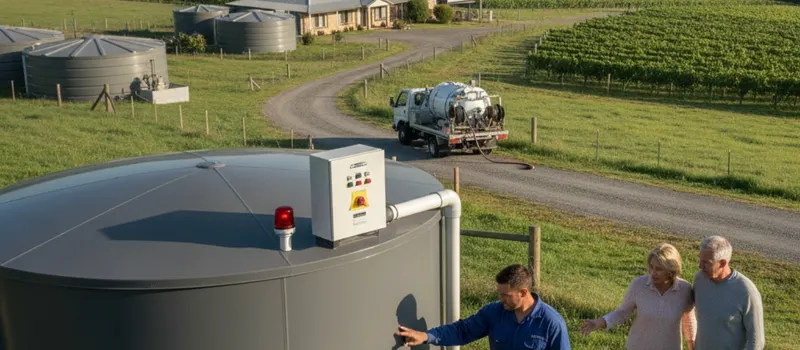
Current Taylex ABS with the Eco Controller. The panel sits on the side of a blue or green blower box on top of the tank. Taylex’s FAQ describes a green light on the right that stays on during normal operation, and an alarm light on the left, above the mute button, that flashes red a set number of times when something is wrong. The flash codes here apply to this panel.
Older Taylex Industries systems. A December 2005 Taylex Industries manual for the Clearwater 90 describes a Compact Series controller with an on/off rocker switch, Mute, Reset and Mode buttons, and separate lights for the aerator, the irrigation fuse and the water level. No flash codes. You read which light has gone red, covered further down.
The Taylex alarm codes at a glance
The meanings come from the alarm code page of the March 2026 manual and Taylex’s FAQ. The last column is what the likely repair costs with us; the manual quotes no prices.
| Flashes | What Taylex says it means | What you can check | Water use | When to call | Likely repair with us (AUD) |
|---|---|---|---|---|---|
| 1 flash, buzzer sounding | Blown irrigation fuse, usually a pump or aerator overload | Nothing | Minimum | Now, to book a service | Depends on the cause; irrigation pump $600 to $1,200 installed |
| 3 flashes | High water level | Wait 15 minutes; irrigation filter, hose kinks, turf valves | Allowed, but minimum | If it has not cleared after the surge, or after 24 hours following heavy rain | Irrigation pump $600 to $1,200 installed; float switch $250 to $650 |
| 5 flashes | No air flow, usually the blower | Hot day with the tank in full sun? Watch it for 24 hours | Cut back | Straight away, unless it is the hot-day case | Air blower $650 to $1,400 installed |
| 3 and 5 flashes | Tripped circuit breaker | One breaker reset in the blower box | Cut back | If it trips again, or the alarm returns within 3 days | Pump $600 to $1,200 or blower $650 to $1,400 installed |
| 2 flashes and 2 beeps at power-on | Start-up test | Nothing | Normal | Not needed | Nil |
One quirk. The January 2025 manual (Version 1.1) listed a single flash as “normal operation”; the March 2026 version and Taylex’s FAQ call it a blown irrigation fuse. One flash with the buzzer sounding is a fault. If you only ever see a silent single flash, ask your service agent which controller version you have.
How long the Taylex mute lasts, and what it does not do
On the Eco Controller, the manual labels the button “press to mute alarm for 24 hours”. It silences the buzzer and nothing else. The fault is not cleared and the red light keeps flashing. The manual doesn’t spell out what happens when the 24 hours run out, but if the problem is still there, expect the buzzer to start again. That is the same fault, not a second one.
- In-house alarm panel. Some systems have an optional 12 V indoor panel. The manual says its red button silences the indoor panel only. The alarm at the tank must be muted separately, and the indoor LED keeps flashing until the fault is fixed.
- Back-to-base modem. This optional modem texts alarms to up to three numbers and, on its backup battery, sends a “No Power” alert. The manual makes keeping credit on its SIM the owner’s job.
- Older Compact Series panels. The 2005 manual says Mute silences the sounder but does not reset the controller, and the red lights stay on. It gives no mute time.
Do not switch the system off at the switchboard to stop the noise. Taylex’s FAQ says the bacteria start dying within about eight hours without power, and in some cases the system then has to be pumped out and restarted. The manual says every switch in the blower box must stay on at all times, or the treatment process and the alarms may not work.
3 flashes: the Taylex high water alarm
A Taylex high water alarm means water is arriving faster than the irrigation pump is sending it out. It is the one code the manual says may sort itself out, and the one that gets messy when it does not.
Give it 15 minutes. The manual says a high water level may be self-correcting when several sources of water arrive at once and overload the system, such as back-to-back washing loads while the showers are running. Wait 15 minutes for the surge to stop. If the sprinklers are running, check again once they stop.
After rain, give it 24 hours. Taylex’s FAQ says 3 flashes after significant rainfall is not unusual and asks owners to monitor it for 24 hours before calling. On heavy Hunter clay an irrigation area can stay wet for days after a storm. The FAQ also says you can keep using water during a Code 3, but as little as possible.
If it has not cleared, check the manual’s four points:
- Is there a filter on the irrigation line before the disposal area, and is it blocked?
- Is the irrigation line kinked or broken?
- Has the irrigation pump failed?
- On surface irrigation, are all the turf valves connected?
A hose kinked by the mower or a turf valve kicked loose stops the irrigation as surely as a dead pump. Taylex’s homeowner guide says your service agent will go through how and when to clean a fitted filter; if nobody has, leave it for the technician. If the sprinklers have not run for a day, the pump or its float may be the cause, and that is a technician job. A replacement irrigation pump is $600 to $1,200 installed with us; a stuck or faulty float switch sits in the $250 to $650 repair band.
Keep water use low until it clears. The manual describes Taylex’s reserve storage as an ‘Emergency Buffer Zone’ of about 39 washing loads. It covers the wait for a technician; it is not spare capacity. If the level keeps rising, or effluent shows at the lids or pools on the ground, it is an emergency, and it gets a same-day or next-morning truck from our emergency septic service.
Taylex asks owners to make sure surface water never pools around or enters the tank. If every storm brings 3 flashes, check that the ground falls away from the tank and no lid has a gap. If the tank has actually been under water, read your septic system after flooding.
5 flashes: no air flow
Five flashes means the controller has detected no air flow. The manual says this usually means the blower is not working properly, with a short circuit given as one possible cause, and Taylex advises calling your local wastewater specialist.
The exception: Taylex’s FAQ says a hot day with the tank in direct sun may trigger a 5-flash alarm. Watch it for 24 hours and call if it persists. On an exposed block around Singleton in January, check that before booking a callout.
Otherwise, do not sit on it. Air keeps the treatment bacteria alive. Two things you can check without opening anything:
- Listen. Taylex’s FAQ says you should not hear the blower unless you are standing right over it, and that loud sounds may mean a problem. Mention any new rattle or knock when you call.
- The switchboard. Look for a tripped safety switch. If it trips again straight after a reset, leave it and call a licensed electrician.
The manual schedules a blower air filter change every 12 months. If the blower has failed, a replacement with us is $650 to $1,400 installed. Our guide to AWTS air blower replacement cost explains the range.
3 and 5 flashes: a tripped circuit breaker
A 3 and 5 flash code means a circuit breaker has tripped. The double power point in the blower box, which feeds the pump and the blower, has a 7 amp breaker underneath that cuts out if either develops a fault.
This is the one code where the manual walks the owner through a fix. Only try it if the blower box and the ground around it are dry, and never after the tank has flooded. In short:
- Remove the four screws on the blower box cover.
- Find the reset button under the double power point.
- Turn both switches off (switch 1 is the pump, switch 2 the blower).
- Push the reset button and wait 10 seconds.
- Turn switch 1 on and wait 10 seconds.
- Turn switch 2 on and wait 10 seconds.
If the breaker trips as soon as one switch goes back on, the manual says the pump or the blower is faulty. Leave that switch off and tell your service agent straight away. If the alarm stays clear, keep an eye on it for the next 3 days.
Do this once, not every hour. Resetting again and again won’t fix a faulty pump or blower, and the manual’s instruction when it trips again is to leave it for your service agent. Anything past the switches and the reset button is work for a licensed electrician.
1 flash: blown irrigation fuse
On the current manual, 1 flash with the buzzer sounding means a blown irrigation fuse, usually from an overload in the pump or aerator. There is no owner fix. The manual and the FAQ both say to contact Taylex or your local wastewater specialist to arrange a service.
Until then, use as little water as you can, because the irrigation side may not be moving water out. A blown fuse is usually a symptom, so the technician’s job is finding what overloaded it.
Older controllers, power cuts and start-up beeps
On the Compact Series controller in the 2005 Clearwater 90 manual:
- Aerator light red: the aerator is not connected, has a fault, or the system fuse has blown.
- Irrigation light red: the irrigation fuse has blown.
- Water level light red: the water has reached a high level, and the light stays red until you press Reset.
That manual allows three resets before an automatic lockout, to be cleared only on your distributor’s advice, and warns not to reset at all if water may have got into the aerator. Its storm tip: press Mute, wait until the sprinklers stop, then try Reset.
On the current Eco Controller, a return of power after a Hunter storm brings two flashes and two beeps. The manual calls this the start-up test, and it should end with a single solid green power light. A flashing red code after that is a real alarm, so go by the code.
For a long outage, Taylex’s FAQ says a system with two female connectors in the box on top of the tank can run its pump from a generator; one connector means it cannot. Ask your service agent before connecting anything.
When to call, and what the council expects
Every AWTS in NSW runs under a council approval to operate, and quarterly servicing is a condition of the system’s NSW Health accreditation. The NSW Health accreditation guideline requires a minimum 12-month service contract and lists the alarm system among the items checked at every service. The OLG’s Onsite Wastewater Management Guidelines (April 2025) tell owners to call a plumber or designated service agent as soon as practicable when an alarm activates, and say the service contract should include a 24-hour emergency call-out number. The service report that goes to your council after each visit records whether the alarms were tested and working.
Whatever the code, treat it as an emergency if it comes with sewage backing up inside, effluent surfacing or pooling, liquid at the tank lids, or flooding.
We service Taylex systems across the Hunter, and quarterly AWTS servicing and maintenance with us is $90 to $150 a visit. For faults common to every brand, see why an AWTS alarm keeps beeping. If your Taylex alarm is going now, ring 0468 278 123 and tell us how many flashes you are seeing.
Frequently Asked Questions
What does 3 flashes mean on a Taylex alarm?
Three flashes on a Taylex ABS controller means the water level in the tank is high. Taylex’s manual says to wait 15 minutes in case a surge of water clears on its own, and its FAQ says to monitor it for 24 hours after heavy rain. If it does not clear, check the irrigation filter, hose and turf valves, then call your service agent.
How long does the mute last on a Taylex alarm?
On the current Taylex ABS Eco Controller, the mute button silences the alarm for 24 hours. It only stops the buzzer; the red light keeps flashing until the fault is fixed, and the buzzer can be expected to return if the problem remains. An optional in-house alarm panel is muted separately from the alarm at the tank.
What does 5 flashes mean on a Taylex system?
Five flashes means the controller has detected no air flow, usually because the blower is not working properly. Taylex recommends calling your local wastewater specialist. The exception in Taylex’s FAQ is a hot day with the tank in direct sun, which can trigger the alarm, so in that case watch it for 24 hours first.
Can I keep using water when my Taylex alarm is going off?
Taylex’s FAQ says you can still use water during a 3-flash high water alarm, but should keep it to a minimum. For any alarm that does not clear, the manual says to limit water use until the fault is fixed. Hold off on washing and the dishwasher, and keep showers short.
Should I turn my Taylex system off to stop the alarm?
No. Taylex’s FAQ says the bacteria begin to die within about eight hours of the power going off, and the system can go anaerobic and be hard to restart. The manual says every switch in the blower box must stay on at all times. Use the mute button instead, which silences the buzzer for 24 hours.
What does 3 and 5 flashes mean on a Taylex alarm?
A 3 and 5 flash code means a circuit breaker has tripped, which Taylex says can be caused by the aerator or other electrical components. The manual gives owners a breaker reset procedure in the blower box. If it trips again when a switch goes back on, leave that switch off and call your service agent, because the pump or blower is likely faulty.
Sources and further reading
- Taylex, Owner’s Manual: Advanced Blower System, V1.3, March 2026: Eco Controller lights, 24-hour mute, alarm code table, high water checks, breaker reset steps, in-house panel, back-to-base modem, start-up test, blower filter schedule, emergency buffer.
- Taylex, Owner’s Manual: Advanced Blower System, V1.1, January 2025: the earlier alarm table listing 1 flash as normal operation.
- Taylex, FAQs: controller lights, flash codes, heavy-rain and hot-day alarms, water use during Code 3, generators, eight-hour die-off when switched off, blower noise, Retro Upgrade Kit.
- Taylex, Homeowner’s Guide (2025): irrigation filter care shown by the service agent, never turning off the power.
- Taylex, Catalogues and Owners Manuals: the manufacturer’s current manual downloads.
- Taylex Industries, Home Owners Manual, December 2005 (Clearwater 90, Compact Series controller): older controller lights, mute, three-reset lockout, storm tip; a copy hosted by a plumbing business.
- NSW Health, Register of accredited AWTS: Taylex ABS 1500 and ABSNR models on the register, checked 28 September 2026.
- NSW Health, Secondary Treatment System Accreditation Guideline: 12-month service contract and the alarm system among the items checked at each service (A3.4).
- NSW Office of Local Government, Onsite Wastewater Management Guidelines (April 2025): owner duty to call a service agent when an alarm activates and the 24-hour emergency call-out number in the contract (appendix A5.6).
Request Received!
Thank you for reaching out. Our Hunter Valley dispatch team will call you back promptly to confirm details and provide an upfront quote.
Call us directly on 0468 278 123