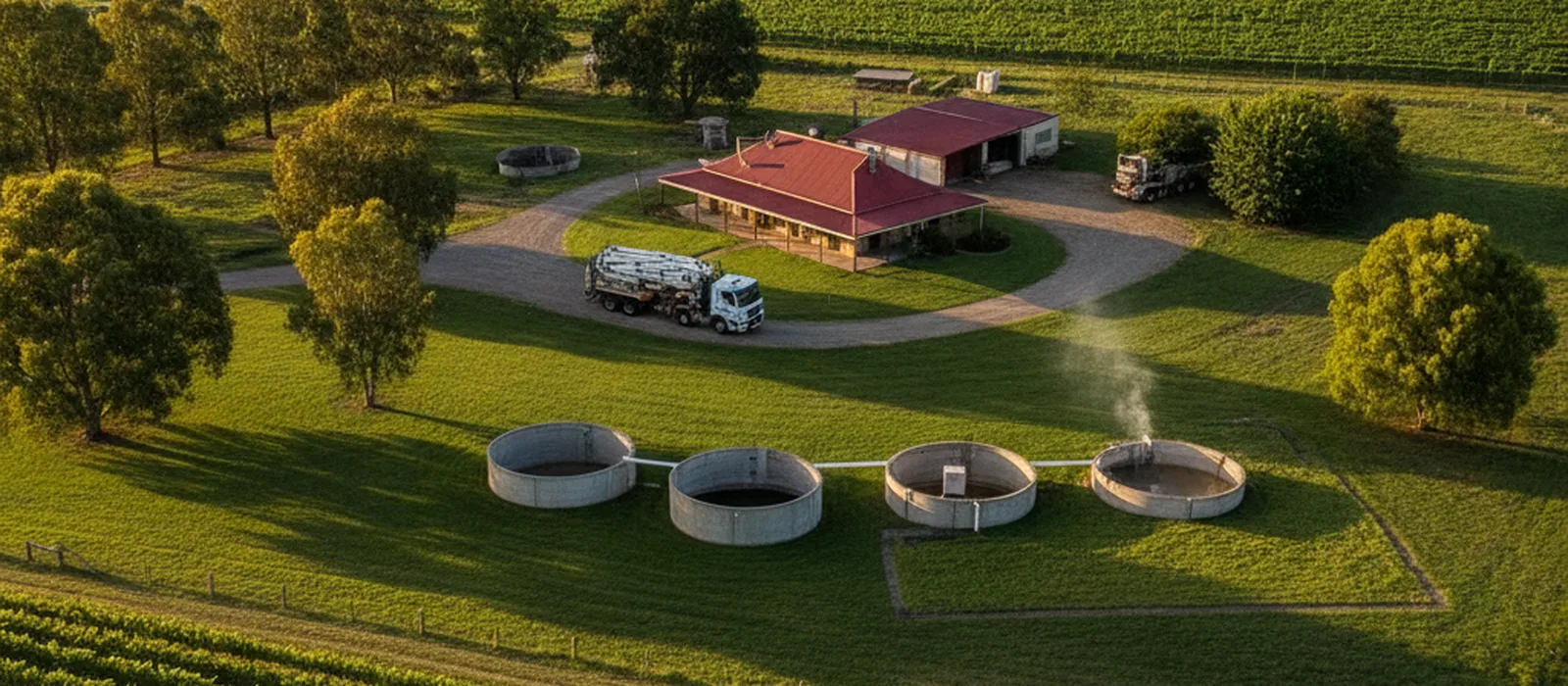
How Does an AWTS Work? The Aerated Wastewater Treatment System, Chamber by Chamber
An aerated wastewater treatment system (AWTS) works in two stages, usually inside one buried tank. First the wastewater settles, as it would in a septic tank; then a blower bubbles air through the liquid so bacteria can break down most of what is left, and the water settles again, gets disinfected and is pumped out to an irrigation area on your block.
That aerated second stage is the whole point. It turns the cloudy liquid a septic tank produces into clear, disinfected secondary effluent that councils will let you irrigate over a lawn or garden. It is also why an AWTS needs power around the clock, has an alarm, and gets a service every three months.
If you are still choosing between a conventional system and an AWTS, our septic tank vs AWTS comparison covers cost and soil. This guide sticks to how it works.
One tank, two kinds of treatment
You will see the same unit called an AWTS, a home sewage treatment plant, an aerobic septic system or a secondary treatment system; Taylex’s owner’s manual lists all of these as names for the same kind of system. NSW Health accredits them as secondary treatment systems, and the OLG guidelines say every domestic AWTS must hold NSW Health accreditation.
The NSW Easy Septic Guide describes an AWTS as two tanks, sometimes built into one larger tank. The first is a basic septic tank where solids settle and anaerobic digestion happens. In the second, oxygen is bubbled through the effluent so aerobic bacteria digest the waste, which is then disinfected with chlorine or ultraviolet light and pumped to an irrigation area.
The NSW Office of Local Government (OLG) guidelines list the usual parts: a primary chamber, an aeration chamber, a clarification chamber, a disinfection unit and a pump chamber. The water travels like this:
House drains → primary chamber → aeration chamber → clarifier → chlorinator → pump chamber → irrigation area
| Stage | What happens | What does the work |
|---|---|---|
| 1. Primary chamber | Solids sink as sludge, fats float as scum, the clearer middle layer moves on | Gravity and anaerobic bacteria |
| 2. Aeration chamber | Air bubbles through the liquid so aerobic bacteria break down dissolved organic matter | Air blower, diffusers, media for bacteria to grow on |
| 3. Clarifier | Fine solids and bacteria settle out of the treated water | Still water, plus an airlift that returns settled solids to the start |
| 4. Disinfection | Clear water picks up a chlorine dose (or passes a UV lamp) | Chlorinator, usually a tablet feeder |
| 5. Pump chamber | Treated water collects until a float switch starts the pump | Submersible irrigation pump, high-water alarm |
| 6. Irrigation area | Water is pumped to drip lines or sprinklers | Irrigation lines, filter, soil and plants |
Brands arrange the stages differently, and some split them across separate tanks, but the sequence stays the same.
Chamber by chamber
1. Primary chamber. Everything from the toilets, showers, kitchen and laundry arrives by gravity. Heavy solids sink, fats and oils float, and the clearer layer in between moves on. Bacteria working without oxygen digest some of the sludge but never all of it, which is why this chamber still fills and still needs desludging.
2. Aeration chamber. This is where an AWTS stops being a septic tank. The blower pushes air down to diffusers near the bottom of the chamber, and it rises as fine bubbles. Oxygen dissolves into the water and aerobic bacteria use it to consume most of the remaining organic matter. Many designs fill this chamber with media that gives bacteria a large surface to grow on, and some cycle the air on and off to help remove nitrogen.
3. Clarifier. In the clarifier the aerated water sits still long enough for fine solids and bacteria to settle. An airlift pipe, driven by the same blower, sends that settled material back to the inlet of the primary chamber. Taylex says this return keeps the primary chamber healthy and working. It is called the sludge return, and a service agent checks it every visit.
4. Disinfection. The clear water then passes the chlorinator, usually a tube of tablets that dissolve slowly as water flows past. The OLG guidelines call tablets in an erosion feeder the most common method in NSW and note it needs no power. Chlorine needs clear water and time: the OLG sets a minimum contact period of 30 minutes. Some units use a UV lamp instead, which needs even clearer water and steady power. Use only the tablet type your system’s manual specifies, and see our guide to AWTS chlorine tablets for how fast they go.
5. Pump chamber. Disinfected water collects here until a float switch starts a submersible pump that sends a dose out to the irrigation area. Fuji Clean’s information pack for its ACE 1200 says the submersible pump cycles two to three times a day with average loading. This chamber also holds the high-water alarm float and emergency storage above it.
6. Irrigation area. The water goes to a designed land application area: drip lines under mulch or just below the surface, or low-throw sprinklers on larger rural blocks where council allows them. The Easy Septic Guide says fixed-line drip is preferred. The irrigation area is sized for your soil and flow, it is part of your council approval, and it gets checked at every service.
The moving parts and what each one does
Most of an AWTS just holds water. These are the parts that wear out.
| Part | Job | What goes wrong |
|---|---|---|
| Air blower | Feeds air to the aeration chamber and drives the airlifts, 24 hours a day | Worn diaphragms or a failed motor; no air and the bacteria stop working |
| Diffusers | Break the air into fine bubbles near the chamber floor | Blocked or broken diffusers give coarse bubbles and poor oxygen transfer |
| Sludge return | Airlifts settled solids from the clarifier back to the primary chamber | A blocked return lets solids build up and carry over to the chlorinator |
| Chlorinator | Doses chlorine into the clear water | Runs empty, tablets set hard, or cloudy water uses the chlorine up |
| Irrigation pump | Sends treated water out when the float calls for it | Pump failure or a blocked filter raises the water level and trips the alarm |
| Control panel | Powers blower and pump, watches for faults, raises the alarm | Tripped breaker, blown fuse, or an alarm muted and forgotten |
When a part fails, our prices are $650 to $1,400 installed for an air blower replacement, $120 to $250 for a blower diaphragm service kit, and $600 to $1,200 installed for a submersible irrigation pump. Blowers get their own guide in AWTS air blower replacement cost.
Primary vs secondary treatment
A septic tank gives primary treatment. An AWTS adds secondary treatment and disinfection. The OLG’s typical effluent figures show the difference.
| Septic tank (primary) | AWTS (secondary) | |
|---|---|---|
| Process | Settling and floating only | Settling, then aerobic biological treatment |
| BOD5 (organic load) | 150 mg/L typical | 20 mg/L performance standard |
| Suspended solids | 50 mg/L typical | 30 mg/L performance standard |
| E. coli per 100 mL | 100,000 to 10 million typical | about 10,000 typical before disinfection |
| Disinfected | No | Yes |
| Where the effluent goes | Absorption trenches or beds, underground | Irrigation, including drip and some surface options |
Figures from OLG Table 5-2. No performance standard exists for primary treatment; the secondary figures are the standard a secondary system must meet.
For an accredited system in service, NSW Health sets limits on any random sample of the final effluent: BOD5 under 30 mg/L, suspended solids under 45 mg/L, E. coli under 100 cfu per 100 mL, and free chlorine between 0.2 and 2.0 mg/L. The service agent tests free chlorine, pH and dissolved oxygen on site.
Cleaner water is why the OLG credits an AWTS with more effluent application options, reduced buffer distances and a small footprint, which helps on smaller lots and sites where trenches struggle. It is still for the garden only: NSW Health’s permitted uses exclude any reuse inside the house.
Why it needs power all the time
A septic tank runs on gravity. The OLG guidelines say an AWTS needs a constant and reliable power supply for aeration and pumping. Fuji Clean lists its ACE 1200 blower at 100 litres of air a minute, running 24 hours a day on 68 watts, and warns that prolonged periods without power will cause the bacteria to die off and the system to fail. Taylex’s manual says the switches in the blower box must stay on at all times, or the treatment process and the alarms may not work.
In a blackout the blower stops, the bacteria go short of oxygen, and the pump stops sending water out while the house keeps filling the tank. The OLG says a pump chamber should hold 24 hours of emergency storage above the high-water alarm. Past that, the tank can overflow, so go easy on water until power is back and expect the alarm when it returns.
Off-grid houses need a power system sized for the blower and pump, which the OLG says needs specialist design. Irregular use matters too. The OLG notes that an AWTS has limited ability to handle shock or intermittent flows unless it was designed for them (newer NSW Health accredited systems are tested for this), so talk to your service agent before leaving a house empty for a long stretch.
What the alarm is telling you
The OLG guidelines say every pump chamber must have a high-water alarm that is both audible and visual. Most control panels watch more than that. The Eco Control Panel on Taylex’s ABS systems, for example, flashes a separate code for each of four faults:
- High water. The pump is not keeping up. Taylex says a surge from several appliances can cause it and it may clear within about 15 minutes; if not, check for a blocked irrigation filter, a kinked or broken line, or a failed pump.
- No airflow. The blower is not delivering air, so the bacteria are going without oxygen. This one needs a service call.
- Blown irrigation fuse, usually from a pump or blower overload.
- Tripped circuit breaker on the pump or blower circuit.
Other brands use different lights and codes, so check the manual in or near your control box. The mute button (24 hours on the Taylex panel) silences the buzzer; it fixes nothing. Causes and first steps are in why your AWTS alarm is beeping. A high-water alarm that will not clear gets a same-day or next-morning truck through our emergency septic service.
Why it needs a service every three months
The Easy Septic Guide says owners of aerated systems must have a maintenance contract for quarterly servicing. The model accreditation conditions in NSW Health’s guideline say the service agent must have completed a course in servicing these systems and be employed or authorised by the manufacturer or supplier, must send a Local Council Service Report to the council after every service, and that owners must not service the system themselves unless the manufacturer authorises it.
At a minimum, each service checks:
- the chlorinator, with a disinfectant top-up
- the pump and air blower
- the alarm system
- slime growth on the filter media
- the sludge return
- the irrigation pump and the land application area
- free chlorine, pH and dissolved oxygen, tested on site
Our quarterly AWTS servicing is $90 to $150 a visit ($360 to $600 a year), including chlorine replenishment, a sludge test, a blower filter clean and the report to your council. The primary chamber still needs desludging every 3 to 5 years (Taylex’s own schedule says 3 to 4), and a full AWTS desludge and pump-out is $450 to $750. See our AWTS servicing page or call 0468 278 123 to book.
What an AWTS cannot do
It does not make sludge disappear. The primary chamber still fills with solids that have to be pumped out.
It cannot take everything a sewer can. NSW Health says spa baths and garbage grinders should not be installed in a house on an AWTS, because the wastewater is too high in solid organic matter. Taylex’s manual warns against antibiotics and heavy use of bleaches, and lists several water sources running at once as a cause of the high-water alarm.
It does not look after itself. The OLG lists high sensitivity of performance to poor maintenance among its limitations. With a dead blower or an empty chlorinator the pump keeps pumping, but what reaches your lawn is no longer treated to standard.
Frequently Asked Questions
How does an AWTS work in simple terms?
Wastewater settles in a first chamber, like a septic tank, so solids and fats separate out. The liquid then goes to an aeration chamber where a blower bubbles air through it so bacteria can break down what is left. It settles again, is disinfected with chlorine, and a pump sends the treated water out to an irrigation area.
What is the difference between an AWTS and a septic tank?
A septic tank gives primary treatment only: solids settle and the liquid soaks into the ground through trenches. An AWTS adds an aerated secondary stage and disinfection, so its water is clean enough to irrigate, at the cost of a blower, a pump, an alarm and a quarterly service.
Does an AWTS need power all the time?
Yes. The blower runs 24 hours a day to keep the bacteria supplied with oxygen, and the pump needs power to send treated water out. A long power cut can kill off the bacteria and let the tank overflow once its emergency storage is used, so it should never be switched off.
How often does an AWTS need servicing in NSW?
Every three months, by a service agent authorised by the manufacturer, who sends a report to your council after each visit. The primary chamber also needs desludging every 3 to 5 years, depending on the measured sludge level. Our quarterly service is $90 to $150 a visit.
What does the AWTS alarm mean?
The control panel has detected a fault, usually a high water level in the pump chamber or no airflow from the blower. Some panels also flag a blown fuse or a tripped breaker. Muting it only silences the buzzer, so cut back on water and call your service agent if it does not clear.
Sources and further reading
- NSW Office of Local Government, Onsite Wastewater Management Guidelines (April 2025): AWTS components and power needs (section 5.4.1), chlorine feeders, contact time and UV, Table 5-2 effluent quality, pump chamber alarms and emergency storage (section 6.5.3), off-grid design and AWTS advantages and limitations (Tables 7-1 and 7-2).
- NSW Office of Local Government, The Easy Septic Guide: the two-tank description of an aerated system, drip irrigation preferred, quarterly servicing contract.
- NSW Ministry of Health, Secondary Treatment System Accreditation Guideline (2018): media and cycled aeration, airlift sludge return, minimum service checklist, who may service, effluent limits, permitted uses, spa baths and garbage grinders.
- NSW Health, Aerated wastewater treatment systems (AWTS): the register of accredited AWTS models.
- Taylex, Owner’s Manual: Advanced Blower System, V1.3 March 2026: treatment steps, alternative names, alarm codes and mute time, power switches, service and desludge schedule, antibiotics and bleach (as at 28 September 2026).
- Fuji Clean Australia, ACE 1200 information pack: blower airflow, wattage and 24-hour running, pump cycles, effect of prolonged power loss (as at 28 September 2026).
Request Received!
Thank you for reaching out. Our Hunter Valley dispatch team will call you back promptly to confirm details and provide an upfront quote.
Call us directly on 0468 278 123